Previously Posted: Driven from your drive

For those new to CabbieBlog or readers who are slightly forgetful, on Saturdays I’m republishing posts, many going back over a decade. Some will still be very relevant while others have become dated over time. Just think of this post as your weekend paper supplement.

Driven from your drive (09.02.2010)

Before reading this post I should warn you that sitting or preferably lying down might lessen the risk of injury to yourself when reaching the end of this sorry tale.

Dr. Richard Dawood is the sort of conscientious doctor we would all like to have as our own. Anxious to be able to negotiate the congested streets of north London quickly should an emergency arise, he purchased a scooter.

He could park the scooter on the tarmac forecourt adjacent to his property, but to draw attention that this land was owned by him, and therefore private property, and not part of the adjacent flagstone pavement, he affixed to his wall a notice which read:

“This forecourt is private property and is not dedicated as a public footway”.

So far so good, indeed in 2001 when he received two parking tickets, although his scooter was parked on his own property, the chief executive of Camden Council wrote to the good doctor apologising for the error admitting he was parked on private land.

Then 2 years ago he received another ticket while parked in the same place and assumed another mistake had been made and wrote asking that the penalty be struck off.

After several letters (and more parking tickets) he was appalled to receive a reply informing him that Camden Council had reconsidered the matter and decided that his forecourt was part of the public footway, whether private or not, and would enforce the penalty notice.
When Dr. Dawood decided to take the case to a parking tribunal, the tickets were mysteriously cancelled just prior to the appeal dates. But five tickets were overlooked by the council and became the subject of a parking tribunal where the adjudicator reserved judgment, siting the case White v The City of Westminster this test case is regularly used by councils to penalise motorists on private land, but crucially if one wheel of their vehicle is on the public pavement.
Dr Dawood then applied for a judicial review of his case, and at this point I would earnestly advise you to hold on to something.

Lord Justice Sedley ruled that Dr. Dawood did own the land or rather, the subsoil marked on his deeds, but the Tarmac surface above was subject to public access, and because there was no physical barrier between the road and the Tarmac strip, marking restrictions did apply.

This ruling means in effect that unless you erect a physical barrier at the point where your drive abuts the highway it could technically be accessed by the public and therefore is now fair game for traffic wardens, and you just know that the Traffic Taliban of Camden Council will use every opportunity to use this loophole to milk the motorist.

When a blog expires

Last month I mentioned a date when daily uploading to CabbieBlog would cease, and it got me thinking about just how long those regular musings would remain available on the Web.

In short, one day this blog is not going to be here. I don’t just mean I’ll have stopped writing new stuff, but the stuff I have written will have vanished.

When my WordPress subscription expires and the blog is hosted for free on their corporate platform, it’ll eventually slip away, either degrading over time or with the plug pulled in a single extinction event. Even if its content was still languishing on multiple servers somewhere in the world, the means to access it, with the URL transferred elsewhere or just extinguished, would mean the death of CabbieBlog.

Much as we take for granted the internet today, over time millennial online protocols begin to change, much as VHS, floppy disks and 8-track tapes, CabbieBlog’s ultimate published legacy is potentially zero.

So I thought I’d run through some of the larger risks concerning the future existence of this blog, whether I’m around to see them or not, and consider not just where its content might still exist; but whether future archivists will still be able to access or read the posts.

WordPress takes issue with my blog and deletes it

WordPress’ terms and conditions state: ‘We have the right (though not the obligation) to reclaim your username or website’s URL due to prolonged inactivity’. So should I metaphorically cease to put pen to online paper they can delete me from the cyberverse.

Mitigation
I keep an archive of the blog in Word documents, but whether the device or program will be readable in many decades time is doubtful.

I take issue with my blog and delete it

I can’t think why I’d want to, but WordPress does have a self-destruct button. Protocols have to be followed, but not many after a few drinks…

Or a hacker could gain access to the blog and cause havoc.

Mitigation
I once used Last Pass to store my passwords, but after reading recently it had security issues I now don’t use the platform and have increased password security. As for drinking, a laptop and beer make uneasy companions.

WordPress decides to withdraw supporting hobbyists in favour of commercial customers

WordPress has been up and running since May 2003, just three years before I started blogging on a different platform. Over these past two decades countless other websites, services and platforms have fallen by the wayside. When WordPress released Gutenberg it was obvious they were aiming at the commercial customer, rather than hobbyists, so I’ll be looking over my shoulder for the online Grim Reaper.

Mitigation
If I’m still active I could transfer the blog to an alternative platform, Google’s Blogger is the obvious solution, but it’ll take some migrating, with thousands of posts, photos and links to other posts on CabbieBlog, and that’s assuming I’m still in a position to achieve this Herculean task.

Internet protocols degrade

It happens slowly but inexorably, something everyone can read one year becomes something nobody can read several years later. Text, photos, embedded maps, videos and sound clips are subject to being superseded by new wizz-bang coding, not to mention HTML commands that new browsers no longer understand causing a carefully-coded table to fall apart in an unreadable splurge. One day a page is going to fail to load because something on it is no longer understood.

Mitigation
Don’t do too much fancy stuff. As I mentioned before, a lot of additional risks would stem from my death or incapacitation, and many changes to services and protocols can be mitigated if I’m still around to deal with them. But if I’m not here then nothing can be done and those problems would gradually mount up over the years until they are no longer readable in their existing form.

WordPress introduces new features that I cannot understand

WordPress has form on this, occasionally introducing some new way of doing things that I have to find a way to work around, and Gutenberg is an example, many of us can’t get our heads around the new protocols. Most shouldn’t affect already-published posts but some future changes might, for example, if they decided that everyone had to upgrade to a bespoke mobile-friendly template and I wasn’t around to do so. This one is an odds-on favourite to happen one day.

Mitigation
If I’m able, to try to learn new ways of doing stuff, my absence makes the demise of CabbieBlog inevitable.

The hosting servers fail to access CabbieBlog

Looking towards a few decades hence and the means of keeping the blog online will progress to the point when the website is not accessible.

Mitigation
Saving CabbieBlog for posterity, it might be wise to consider devising a Blog Legacy Strategy, poised to kick in after my death, so that this blog stays live for as long as possible. But I’d need to trust this chosen person explicitly who has access to vintage servers. Alternatively, the British Library is archiving everything, as part of its long-term UK Web Archive project. They’ve been taking snapshots of this blog, most recently on 1st February 2022, which should mean you’ll always be able to go back in and read through my archives if you really want to.

In conclusion

What I’m saying is to enjoy flicking through this blog while you still can. The navigation works, the comments exist and all the posts and pictures are still accessible, as indeed they have been for the last 15 years. But one day, whenever that may be, it’s all going to fade away and disappear, much like its author.

My thanks to diamondgeezer for much of the technical jargon here.

Every cloud has a silver lining

Here’s a question for you: What connects a London Black Cab with Germany’s Leopard 1 battle tanks being sent to Ukraine?

The answer is the German company Reinmetall, it provides key components for the tank, including the turret and the gun. It also supplies automotive parts for the cab, and the war in Ukraine has changed the fortunes of the 130-year-old company. Before the war the company was valued at €4bn, today it is worth €10bn. With the slow automotive market, the company now is estimated to make €70m from sales of shells for these tanks.

Johnson’s London Dictionary: Scotland Yard

SCOTLAND YARD (n.) Law agency named after small cul-de-sac for reasons doth unknown.

Dr. Johnson’s London Dictionary for publick consumption in the twenty-first century avail yourself on Twitter @JohnsonsLondon

It hasn’t fallen down

London Bridge is falling down,
Falling down, falling down.
London Bridge is falling down,
My fair lady.

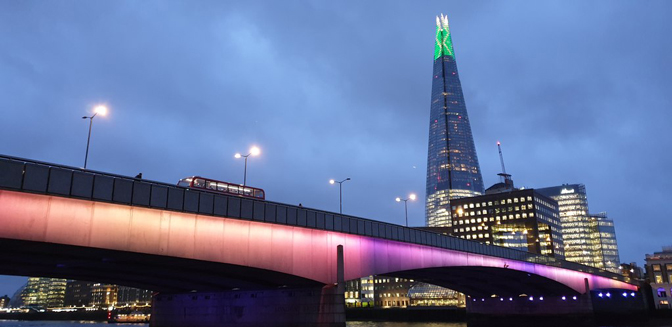
London’s most famous bridge has never fallen down, but it has been replaced several times over the centuries, and the latest incarnation was opened by the Queen 50 years ago this week on 16th March 1973.

Whether by accident or a deliberate nod to the late Queen’s age, Operation London Bridge was the code name for the funeral plan for Queen Elizabeth II, which of course swung into action a few months ago.

London Bridge’s predecessor, famously shipped off to the Arizona desert, had been there since 1831 when it replaced ‘Old’ London Bridge, the medieval one with the houses down it.

Where London Bridge is today is 50 yards upstream from its predecessor.

Have you ever wondered why the Monument feels off-centre and Gracechurch Street terminates with an awkward curve? This piece of poor urban planning is because this was the original alignment of the former bridge, and the introduced curve aligned the road to the modern bridge.

In particular, the northern roadway used to pass the west door of St Magnus the Martyr, a church which for six centuries was the spiritual guardian of this crucial bridgehead. It was one of the first churches to be destroyed in the Great Fire of London so what now occupies the site is Wren’s magnificent replacement. Its clock once projected out above the roadway, and when traffic increased a pedestrian walkway had to be cut through the bottom of the tower.

St Magnus’s importance vanished when the bridge shifted, and its churchyard is now a flagstoned dead end, barely trodden, with a small flowerbed at one end. It’s still worth a visit, though, to see two chunky stones from the Old London Bridge which were relocated here in 1921.

London Bridge and the Shard by Christine Matthews. The top of the Shard is being decorated with different coloured lights designed by local children. (CC BY-SA 2.0)

Taxi Talk Without Tipping