

The Peers Entrance to the House of Lords, to create a more secure portico was supposed to cost around £2 million, but thanks to ‘inflation’ and ‘delays’ it is now going to cost somewhere in the region of £7 million. Just why do you need a burglar-proof front door when you’ve got armed police standing outside evades me, could they not just stick a Ring doorbell on there and be done with it?

Johnson’s London Dictionary: BBC
BBC (n.) Transmitter of information whose largesse knows no bounds.
Dr. Johnson’s London Dictionary for publick consumption in the twenty-first century avail yourself on Twitter @JohnsonsLondon
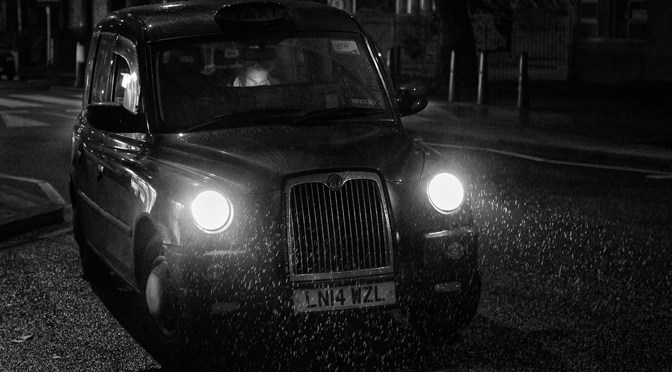
Back to black
Pillar boxes were once green, but they were changed to the familiar red to make them more visible. So why is it that London’s Black Cabs are – well black?
The name ‘black cab’ apparently originated as a slang term within the London private hire trade, whose members had appropriated the term ‘cab’ to describe their Nissans with the ubiquitous aerial on the roof with an old plastic bag protecting the paintwork, it was the official term the Public Carriage Office used until 2000 for the taxicabs they licensed.
Regulations by some British provincial taxi licensing authorities specify the vehicle’s livery to denote it as a vehicle for hire. The Public Carriage Office’s Conditions of Fitness has never specified that a London cab has to be a specific colour, in fact, pre-war cabs had coach-built bodies and were painted in a variety of colours.
After World War II the famous Austin FX3 was introduced, they were supplied with factory-fitted steel bodies, and these were painted in a standard colour of black, due to post-war austerity it was the cheapest colour to supply. Different colours were offered at extra cost, but few, if any buyers were prepared to pay for them and so black became the standard colour for London taxis.
Its successor the FX4 was offered in three colours; black, white and carmine red, though black remained the choice of almost all buyers, many of whom were fleet owners.
In the 1970s, Mann and Overton, the FX4’s sponsors and dealers asked the maker, Carbodies to supply more colours. These were not taken up by fleet buyers, but when the finance regulations were relaxed at the end of the 1970s, more cabmen opted to buy cabs instead of renting them and chose from an increased range of colours.
Now London cabs are found in all colours, including special advertising liveries, but in the opinion of this writer, all cabs should be black to differentiate them from the plethora of alternative private hire vehicles.
Incidentally Back to Black is the second and final studio album released in October 2006 by the late singer/songwriter Amy Winehouse whose father Mitch just happened to be a London cabbie.
Your ride is here, get in by Jeremy Bishop on Unsplash
London in Quotations: Charles Lamb

We can be nowhere private except in the midst of London.

Charles Lamb (1775-1834)
London Trivia: The sky at night
On 19 March 1958 the United Kingdom’s first planetarium opened adjacent to Madam Tussaud’s waxwork museum. Built on the site of an old cinema destroyed by a World War II bomb the new planetarium seated 330 beneath a horizontal dome, the opto-mechanical star projector gave a view of the night sky as seen from earth. Due to falling numbers it was closed in 2006. To say ‘farewell’ to the planetarium the public were allowed free entry to the show in its penultimate week.
 On 19 March 1702 upon the death of William III of Orange, Anne Stuart, the sister of Mary, succeeded to the throne of England, Scotland and Ireland
 Acid Bath Murderer John George Haigh was driven to murder 6 people by lust to drink his victim’s blood. He was hanged at Wandsworth Prison
 The Princess Louise pub at 208 High Holborn was built in 1872 and named after Queen Victoria’s 4th daughter
 The viewing plinth at the top of The Monument was caged in 1842 due to a high number of suicides many having a connection to bakers
 The Soviet Union ran a spy ring from 49 Moorgate. Special Branch raided the place in 1927 finding ¼ million documents and crates of rifles
 Jeffrey Archer’s London phone number ends 007 – he bought the old flat of Bond composer John Barry, who’d chosen the number
 Rackstrow’s Museum of Anatomy on Fleet Street was popular in the 1700s because he was a skilled modeller in replicas of reproductive system
 When The Oval, home of Surrey County Cricket Club, was built in 1845 over 10,000 pieces of turf from Tooting Common were used
 The first London buses were so slow that operators provided free reading matter, the omnibuses could carry 22 people and were pulled by three horses, the service ran four return journeys every day.
 The Wellcome Library on 183 Euston Road is home to the world’s largest collection of cards put in phone boxes by sex workers
 Rumours of a woman with the head of a pig in Manchester Square who inherited a fortune communicating only in grunts – men advertised to meet her
 Trivial Matter: London in 140 characters is taken from the daily Twitter feed @cabbieblog.
A guide to the symbols used here and source material can be found on the Trivial Matter page.
 CabbieBlog