
Tag Archives: London cabbies

London Opinion
As a London cabbie, I just had to include on CabbieBlog a magazine which most Londoners didn’t realise existed, but most cabbies could have edited. London Opinion ran for 50 years, first as a weekly from 26 December 1903 to 27 June 1931, then monthly until April 1954.
 At its height of popularity, it was one of the most influential publications in the world. On 5th September 1914 at the start of the First World War, it published a cover, the image of which encouraged more than two million men to sign up in the first years of the war before conscription was introduced in 1916.
The ‘Kitchener Poster’ has proved to be incredibly powerful, prime ministers, film stars and presidents have emulated that pose.
But if you want London opinion today you can get it from any driver of a London cab, the magazine was subsumed into Men Only.
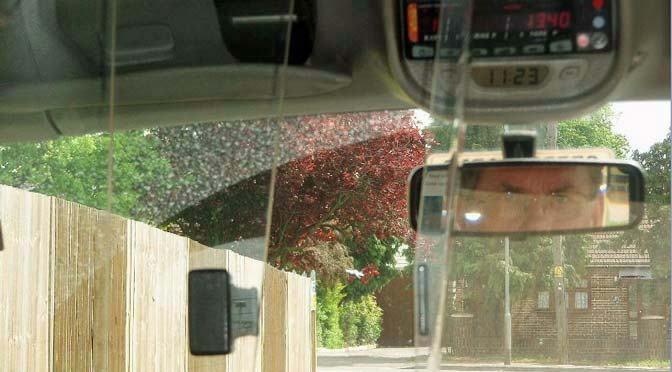
“Busy night?”
Contrary to the popular perception that all cabbies like to chat, punters are also guilty of asking, well, some pretty banal questions.
“Busy Night?”
The problem for the driver here is two-fold: if he answers in the affirmative the punter might be weighing up the opportunity of mugging him; conversely, if he says it’s quiet the passenger queries the reason why it took so long to catch a cab or thinks the cabbie just wants to moan and soon the conversation will turn to the shortcomings of the current Government/England manager/or London’s Mayor.
“What do you do for a living?”
Passengers sometimes enquire politely about what we do for a living. This is not, as you might expect, a unique occurrence on long, late-night journeys, and sometimes asked more than once by the same passenger.
“What time are you on ‘til?”
Many cabbies work the more lucrative evening shift, so the punter probably feels a degree of sympathy as he clocked off work at five. The supplementary inquiry “Can you pick me up?” at a time and place to get me home like we are going to drive halfway across London helping you get the last train home.
“Where do you live? Or live far?”
Why on earth should that be a topic of conversation with a stranger unless, of course, you want a lift home – see the previous inquiry.
“What chance is there of me getting a cab?”
Ditto.
In Ireland one private hire driver, after being repeatedly asked these futile questions has stuck onto the vehicle’s partition screen a notice reading:

Please Don’t ask futile personal quizzes. I am from Ghana, now an Irish citizen. Yes I like it here. I have a Master’s Degree (MBA) UK. Please show due esteem.

The message went viral on Twitter, at the time of writing had received over 166,000 likes and had been shared more than 12,500 times.
 However with over 1,000 replies, inevitably some thought the message was a ‘bit rude’. One comment read:
It’s a bit rude, to be honest. What’s wrong with asking him where he is from originally (presuming he doesn’t have an Irish accent) and whether he likes it here. Having a bit of futile chat is part of what we are.
Another response from Eion Dunning read:
Man in customer service hates customers. Best of luck to him.
John Parsons response was:
As an Irishman living in England for thirty years, I often get asked where I’m from . . . hell, even Irish people ask me where I’m from, they also often ask me if I like England. It’s called fu#king small talk.
Ride-hailing app Uber backed up the driver’s actions saying:
Getting straight to the point is a highly underrated attribute these days.
Others joked that the driver needs a second sign displaying whether he has been busy and what time he finishes.
I know those questions well.
Death in a Taxi
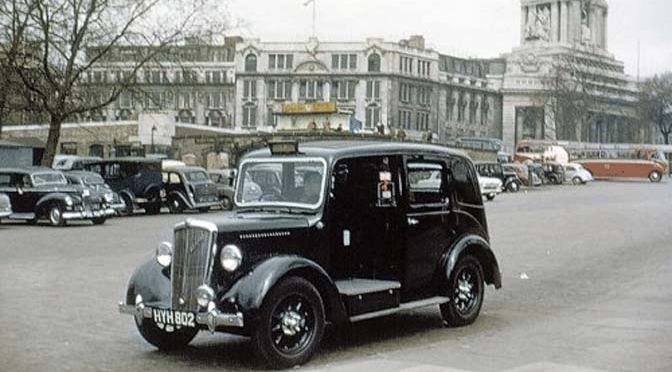
The hansom cab has been a mainstay of the London streets since the 17th century.[1] The black horse-drawn carriages were largely replaced by motorised vehicles by the end of the First World War. The designs of the motorcar taxis were based on the hansom cab that preceded it, which meant that the driver was seated in the open air, or under a canvas roof, and was physically separated from the passengers. This design ensured that the passenger(s) continued to enjoy privacy during their trip and did not have to share it in close proximity to a stranger. It also assuaged any class anxieties about wealthier passengers having to share a space with a driver from a lower socio-economic background.
Taxis occupy a unique position in the transport landscape: they are open to all users who can afford them but provide a private transport experience; they are also essentially urban and predominantly found in big cities. Both these features as well as the separation of passenger and driver all stress the anonymity of the taxi experience. There were no records of who used taxis beyond what a driver could remember of his customers.
It was presumably for these reasons that for some people, the London taxi was the chosen site for murder or suicide. Tabloids reported on several such cases in the first half of the 1920s. In November 1923 the Daily Mirror printed the headline ‘Dead Woman in Cab’.[2] The article described that at the end of the afternoon the previous day, a young man had come into a police station in Knightsbridge and said to the officer on duty ‘the woman is in the cab outside’. In the taxi, the police found the body of Ethel Howard, with a wound to the throat and a razor lying next to the body.
 Daily Mirror, 16 November 1923, p. 2.
At first glance, this could be a case of either suicide or murder. The man who reported the death remained unnamed in the article but was described as a ‘portrait painter’. This immediately sought to evoke images of bohemia in the newspaper reader’s mind. The romance and mystery of the case were brought crashing down to earth in the follow-up article printed the next day, which reported on the magistrate’s inquest on the case.[3]
The ‘portrait painter’ was in fact the 24-year-old butcher’s assistant George William Iggulden. Iggulden and Ethel Howard had been engaged to be married on 16 November. Instead, Iggulden murdered his fiancée the night before the wedding. The Mirror called this ‘the irony of fate’, although the reader may conclude that this was not so much fate as George Iggulden using desperate measures to get out of his commitment. In the taxi, he found a confined space where Ethel would not be able to escape from, and where he was sure not to be interrupted. In this second newspaper article, Iggulden is reported not just to have said ‘the woman is in the cab outside’ but also ‘I did it with a razor’. He was duly remanded to stand trial for murder.
The party who is curiously absent in all this is the taxi driver. The only oblique reference to their presence is in the second article, which described that Iggulden ‘asked to be driven to the nearest police station’ rather than to Chelsea, halfway through the drive. The police are not reported to have spoken to the driver or gotten their statement, and there is no consideration as to what the impact of a murder being committed several feet away from them may have had.
A taxi driver did have a more active role in proceedings in a case in 1925. On 23 April of that year, the Daily Express reported on a ‘Mystery of A Taxicab’.[4] On 21 April, a Sunday, Major Frank Montague Noel Newton had engaged a cab to take him from his club to his hotel. Immediately it is clear to the reader that this passenger is a man of substance, who comfortably moves around the West End. Upon passing the Hotel Metropole (now known as the Corinthia Hotel) just off Trafalgar Square, the driver heard a noise ‘as though someone was knocking on the window with a stick’. The driver was evidentially located outside the cab, with a window separating him and his passenger.
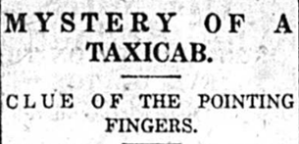
Daily Express, 23 April 1925, p. 9.
The driver didn’t notice anything out of the ordinary when he turned to look through the window, so he drove on to Major Newton’s hotel. Once he arrived there, he engaged the help of the hotel porter to try and rouse Major Newton, who appeared to be asleep. Then the men realised that there was a revolver on the floor of the cab and that the noise the driver had heard was Major Newton shooting himself.
One must make allowances for the noise cars in the 1920s generated, but it still seems extraordinary that a driver would not identify a shot fired within such close proximity. However, the story repeated itself a year later:
On arriving at Charing Cross Station about midnight on Monday the driver of a taxicab found his fare shot dead. The man hailed the driver on Cromwell Road and nothing occurred during the journey to attract attention. When he did not alight at Charing Cross, the driver got down from his seat and found the man lying dead. A revolver was on the floor.[5]
Evidently, for these men, the mobile and anonymous nature of the taxi provided a suitable space for them to commit suicide. They knew they would not be disturbed for the duration of the trip, and that they would be found by a stranger. The man who was driving to Charing Cross was reported to be a Swede visiting London. Like Major Newton, he did not have a fixed address in the city; the locations of their deaths underscore this sense of fluidity and lack of permanency.
For the drivers, finding a dead body in their vehicle appears to have been something they were expected to handle in the course of their employment. They remain anonymous in the reports, their taxis indistinguishable from the rest of the fleet that swarmed London’s streets. It is this anonymity that made their taxis such appealing sites for illicit and illegal behaviour in interwar London.
[1] George N Georgano, A History of the London Taxicab (Newton Abbot: David and Charles, 1972), p. 110
[2] ‘Dead Woman in Cab’, Daily Mirror, 16 November 1923, p. 2
[3] ‘Dead Girl in Taxi’, Daily Mirror, 17 November 1923, p. 2
[4] ‘Mystery of a Taxicab’, Daily Express, 23 April 1925, p. 9
[5] ‘Shot Dead in Taxi’, Daily Mirror, 3 November 1926, p. 2
This post was written by Mara Arts and originally appeared on http://www.interwarlondon.com. You can also find Mara on Twitter – @interwarlondon

Women in the workplace
Close your eyes. Have you got them closed? Now, imagine you’re standing at the side of the road hailing a cab.
The cab pulls up, it’s black obviously. But what of the driver? In BBC TV’s Sherlock: A Study in Pink, Benedict Cumberbatch’s Holmes poses the question: “Who do we trust, even if we don’t know him?”
Do you have an image of the cabbie in your mind? In all probability the driver is white, a man over fifty wearing a flat cap and a scarf around his neck.
You get in and commence your journey, the conversation soon turns to football. Yes, he follows a London team, possibly Arsenal, lives in Essex, and is not the biggest fan of the London Mayor.
You can open your eyes now because you are right. The person imagined by Sherlock Holmes and yourself is your atypical cabbie, for women make up fewer than 2.5 per cent of London cab driving fraternity.
Surprisingly in today’s world, according to Transport for London, in 2019 there was only 519 women amongst 23,301 drivers with licences to cover All London and Suburban areas, even though today’s applications to attain The Knowledge are not reliant on race, religion, gender or sexual orientation.
Women have always played a part in the London cab trade. At one time a widow could inherit her husband’s Hackney Carriage (but not drive it, just hire it out). A list from 1664 reveals that 19 widows had inherited licences.
Much later during the Great War, with many drivers away on the Western Front, who had had the understanding that their licence was protected at the cessation of hostilities, women’s role was questioned. Although the ability to ply for hire rested upon successful completion of The Knowledge, Sir Henry Norman MP asked the Home Secretary, if a refusal to license women was based on “statutory disqualification of a woman or in a decision of the Home Office”. The Home Secretary passed the buck stating “the Commissioner of Police informs me that he cannot in the present circumstances recommend the grant of a licence to a woman”. Sean Farrell writing in Abstracts of Black Cab Lore opines: “With thousands of men dying daily, the women filling the manpower gap up and down the country, it’s hard to imagine just what extra circumstances the Commissioner of Police envisaged.
Eventually, the authorities were forced to license women to drive buses, trams and taxis, although a union official stated driving a taxi was “not a moral occupation for a woman to follow”.
By 1917 four women held taxi licences, although they could hardly be described as your average Londoner. Susan Dudley Ryder (Badge 1366) was the cousin to The Earl of Harrowby and sister of champion women’s golfer Mrs Gavin.
After the Great War, a Select Committee looked into transport problems within London. Much of the evidence submitted for excluding women from driving cabs was the practice by prostitutes of using the passenger compartment to conduct their business, something the upper-class witnesses to the committee seemed to be very knowledgeable. Not so the cabbie, as at the time the driver had no rear-view mirror.
In 1922 the London and Provincial Union of Licensed Vehicle Workers balloted its members in strike action should a woman appear on the road working as a cab driver.
Even after World War II, despite their valiant work in keeping Britain’s factories and farms in production, they were unlikely to attain a licence, let alone a vehicle to drive.
Remarkably the first woman to have completed the modern Knowledge of London to become an All London Green Badge driver was not until 1977 when Marie White (badge 25292) passed. She would regularly be seen on the St. Pancras rank with her little dog in the luggage compartment.
Featured image: Stella Wood who has been a black cab driver for 20 years.
Much of the research into this post has been gleaned from Abstracts of Black Cab Lore: A History of the London Cab Driver by Sean Farrell and From Manor House Station to Gibson Square and back again: Secrets from the London Taxi Trade by Chris Ackrill.
 CabbieBlog