Previously Posted: Oranges and Lemons

For those new to CabbieBlog or readers who are slightly forgetful, on Saturdays I’m republishing posts, many going back over a decade. Some will still be very relevant while others have become dated over time. Just think of this post as your weekend paper supplement.

Oranges and Lemons (22.10.2010)

Standing in the shadow of the East London Mosque in a modest Grand II listed premises on Whitechapel Road is Britain’s oldest manufacturer. As the mosque calls out for worshippers to attend their daily prayers this small factory continues to produce the bells used to call Christians to their place of worship, just as it has done since 1583.

The Church Bell Foundry to give it its formal name was established even earlier in 1570, although a firm link predates even this to 1420 when a Richard Chamberlain was known as a “bell-founder of Aldgate”.

When most heavy industry has left London this remarkable factory is still a family-owned and run company. Having produced some of the world’s great bells including Big Ben, America’s Liberty Bell and bells for what was at the time Russia’s new capital St. Petersburg and even today over 80 per cent of production is making church bells and associated accessories.

The premises date from 1670, just four years after the Great Fire of London, although this eastern end of the City was untouched by the conflagration. It is built on the site of an inn called the Artichoke whose cellars survive and are still used by the foundry today.

The building’s entrance is through a replica bell frame of the company most famous bell, needing 10.5 tons of molten copper mixed with 3 tons of tin “Big Ben” is still the largest bell ever made in London.

Originally the order for the 16-ton bell was given to another bell foundry; Warners of Cripplegate at their Norton factory near Stockton-on-Tees who cast the new bell in August 1856. It was transported by rail and sea to London, and on arrival at the Port of London, it was placed on a carriage and pulled across Westminster Bridge by 16 white horses. The bell was hung in New Palace Yard and it was tested each day until 17th October 1857 when a 4 foot crack appeared, but no-one would accept the blame. Theories included the composition of the bell’s metal or its dimensions. Warners blamed Edmund Denison, an abrasive lawyer who had designed the clock’s mechanism for insisting on increasing the hammer’s weight from 355kg to 660kg. Warners asked too high a price to break up and recast the bell so George Mears at the Whitechapel Foundry was appointed.

The bell was melted down and recast successfully by the Whitechapel Bell Foundry on 10th April 1858, and when finished it took 16 horses the best part of a day to haul the gigantic bell from Whitechapel to Parliament Square.

There are two theories about the origins of the name “Big Ben”: Around the time the clock was due to be completed, the prize fighter and publican Ben Caunt went 60 rounds with the best bare-knuckle boxer in the country, Nat Langham. The bout was declared a draw but it made both men national heroes. Ben Caunt was a huge man and one story has it that the great bell was named after him. The other story attributes the name to Benjamin Hall, the chief commissioner of works, who was addressing the House on the subject of a name for the new bell tower when, to great laughter, someone shouted “Call it Big Ben!”, but no record is to be found in Hansard of this remark.

When the time came to install the bell although this bell was 2.5 tonnes lighter than the first, its dimensions meant it was too large to fit up the Clock Tower’s shaft vertically so Big Ben was turned on its side and winched up. It took 30 hours to winch the bell to the belfry in October 1858. The four quarter bells, which chime on the quarter hour, were already in place.

Big Ben rang out on 11 July 1859 but its success was short-lived. In September 1859, the new bell also cracked and Big Ben was silent for four years. During this time, the hour was struck on the fourth quarter bell.

In 1863, a solution was found to Big Ben’s silence by Sir George Airy, the Astronomer Royal. Big Ben was turned by a quarter turn so the hammer struck a different spot; the hammer was replaced by a lighter version; and a small square was cut into the bell to prevent the crack from spreading.

The total cost of making the clock and bells and installing them in the Clock Tower reached £22,000.

Test Your Knowledge: December 2023

Here on CabbieBlog, we’ve done many Christmas quizzes, so for a complete change, this month’s quiz title is Hiding In Plain Sight. As before the correct answer will turn green when it’s clicked upon and expanded to give more information. The incorrect answers will turn red giving the correct explanation.

1. Which famous scientist has a very large memorial at a major road junction?
John Logie Baird
WRONG The stainless steel box-shaped structure, located on the Elephant and Castle gyratory system, designed by modern movement architect Rodney Gordon in 1959, commemorates Michael Faraday’s importance as a scientist and was placed there because Faraday’s birthplace is nearby in Newington Butts.
Michael Faraday
CORRECT The stainless steel box-shaped structure, located on the Elephant and Castle gyratory system, designed by modern movement architect Rodney Gordon in 1959, commemorates Michael Faraday’s importance as a scientist and was placed there because Faraday’s birthplace is nearby in Newington Butts.
Tim Berners-Lee
WRONG The stainless steel box-shaped structure, located on the Elephant and Castle gyratory system, designed by modern movement architect Rodney Gordon in 1959, commemorates Michael Faraday’s importance as a scientist and was placed there because Faraday’s birthplace is nearby in Newington Butts.
2. Near which park would you find a ‘secret’ command and control centre with a 20ft thick concrete roof?
Regent’s Park
WRONG Described by Sir Winston Churchill as a ‘vast monstrosity which weighs upon the Horse Guards Parade’, the Admiralty Citadel is now covered by Boston Ivy in an apparent attempt to soften the harsh appearance of this vast concrete edifice.
St James’s Park
CORRECT Described by Sir Winston Churchill as a ‘vast monstrosity which weighs upon the Horse Guards Parade’, the Admiralty Citadel is now covered by Boston Ivy in an apparent attempt to soften the harsh appearance of this vast concrete edifice.
Hyde Park
WRONG Described by Sir Winston Churchill as a ‘vast monstrosity which weighs upon the Horse Guards Parade’, the Admiralty Citadel is now covered by Boston Ivy in an apparent attempt to soften the harsh appearance of this vast concrete edifice.
3. Once used as the Port of London Authority’s headquarters, but where is this huge building?
Trinity Square
CORRECT Now a Four Seasons Hotel, 10 Trinity Square was the Port of London Authority, more than 1,200 people each day came to pay port dues for all the boats that were arriving in London. Such was the importance of this building that, in 1946, the General Assembly of the United Nations held its inaugural reception here.
St. Katherine’s Dock
WRONG Now a Four Seasons Hotel, 10 Trinity Square was the Port of London Authority, more than 1,200 people each day came to pay port dues for all the boats that were arriving in London. Such was the importance of this building that, in 1946, the General Assembly of the United Nations held its inaugural reception here.
East Smithfield
WRONG Now a Four Seasons Hotel, 10 Trinity Square was the Port of London Authority, more than 1,200 people each day came to pay port dues for all the boats that were arriving in London. Such was the importance of this building that, in 1946, the General Assembly of the United Nations held its inaugural reception here.
4. Where is the 287-foot-tall Queen’s Tower?
South Kensington
CORRECT Clad in Portland stone and topped by a copper-covered dome, Queen’s Tower in South Kensington is all that remains of the Imperial Institute which was 700 feet long, built to mark Queen Victoria’s Golden Jubilee in 1887. She wasn’t amused as it spoiled her view.
Hyde Park
WRONG Clad in Portland stone and topped by a copper-covered dome, Queen’s Tower in South Kensington is all that remains of the Imperial Institute which was 700 feet long, built to mark Queen Victoria’s Golden Jubilee in 1887. She wasn’t amused as it spoiled her view.
St. James’s Park
WRONG Clad in Portland stone and topped by a copper-covered dome, Queen’s Tower in South Kensington is all that remains of the Imperial Institute which was 700 feet long, built to mark Queen Victoria’s Golden Jubilee in 1887. She wasn’t amused as it spoiled her view.
5. Situated here since the 14th century, Custom House once had a riverfront of nearly 500ft. Which road does it stand on?
Lower Thames Street
CORRECT Formerly used for the collection of customs duties, today the Custom House is used by His Majesty’s Revenue and Customs and stands on 20 Lower Thames Street should you feel obliged to visit.
Lower Ground
WRONG Formerly used for the collection of customs duties, today the Custom House is used by His Majesty’s Revenue and Customs and stands on 20 Lower Thames Street should you feel obliged to visit.
Victoria Embankment
WRONG Formerly used for the collection of customs duties, today the Custom House is used by His Majesty’s Revenue and Customs and stands on 20 Lower Thames Street should you feel obliged to visit.
6. What ‘top secret’ tower was visible across most of London?
The Shard
WRONG Londoners were not expected to notice the 621ft high BT Tower, for many years it did not appear on any map as its location was protected by the Official Secrets Act, and even the taking and storing photographs of the building was forbidden.
BT Tower
CORRECT Londoners were not expected to notice the 621ft high BT Tower, for many years it did not appear on any map as its location was protected by the Official Secrets Act, and even the taking and storing photographs of the building was forbidden.
Canary Wharf
WRONG Londoners were not expected to notice the 621ft high BT Tower, for many years it did not appear on any map as its location was protected by the Official Secrets Act, and even the taking and storing photographs of the building was forbidden.
7. Which building advertises Baron Justus von Liebig’s invention?
Michelin House
WRONG The Oxo Company wanted to advertise their product to Londoners but local authorities were adverse to outside advertising, so Albert Moore, the company’s architect when adding a tower atop their cold store produced a 10ft tall artwork created by piercing holes through the wall, one an X shape and two on either side forming circles. The local authority accepted this as building decoration rather than advertising, giving us the Oxo tower we know today.
Royal Daulton, Southbank House
WRONG The Oxo Company wanted to advertise their product to Londoners but local authorities were adverse to outside advertising, so Albert Moore, the company’s architect when adding a tower atop their cold store produced a 10ft tall artwork created by piercing holes through the wall, one an X shape and two on either side forming circles. The local authority accepted this as building decoration rather than advertising, giving us the Oxo tower we know today.
OXO Tower
CORRECT The Oxo Company wanted to advertise their product to Londoners but local authorities were adverse to outside advertising, so Albert Moore, the company’s architect when adding a tower atop their cold store produced a 10ft tall artwork created by piercing holes through the wall, one an X shape and two on either side forming circles. The local authority accepted this as building decoration rather than advertising, giving us the Oxo tower we know today.
8. The Dazzle camouflage was applied to which London structure?
Battersea Power Station
WRONG Before it was moved to Chatham to make way for the Thames Tideway Tunnel, Dazzle camouflage was applied to the HMS President as part of the World War I centenary art commissions. Intended to optically distort the view of a ship at sea and make the vessel harder to locate and attack, the 2014 painting of the ship in this style was by the artist Tobia Rehberger.
Tower Bridge
WRONG Before it was moved to Chatham to make way for the Thames Tideway Tunnel, Dazzle camouflage was applied to the HMS President as part of the World War I centenary art commissions. Intended to optically distort the view of a ship at sea and make the vessel harder to locate and attack, the 2014 painting of the ship in this style was by the artist Tobia Rehberger.
HMS President
CORRECT Before it was moved to Chatham to make way for the Thames Tideway Tunnel, Dazzle camouflage was applied to the HMS President as part of the World War I centenary art commissions. Intended to optically distort the view of a ship at sea and make the vessel harder to locate and attack, the 2014 painting of the ship in this style was by the artist Tobia Rehberger.
9. What important function did the social housing flats in Pear Tree House at Upper Norwood have?
Nuclear shelter
CORRECT Built during the Cold War, the 18-room nuclear bunker with its bomb-proof double doors and flats above was completed in 1966 and the bunker went into care and maintenance when civil defence was stood down two years later.
Water pumping station
WRONG Built during the Cold War, the 18-room nuclear bunker with its bomb-proof double doors and flats above was completed in 1966 and the bunker went into care and maintenance when civil defence was stood down two years later.
Early warning station
WRONG Built during the Cold War, the 18-room nuclear bunker with its bomb-proof double doors and flats above was completed in 1966 and the bunker went into care and maintenance when civil defence was stood down two years later.
10. What do Sid James and Laurence Oliver have in common?
They spied for Britain in Elstree Studios
WRONG Sid James, Laurence Olivier, Stanley Kubrick, the Duke of Edinburgh, Stephen Fry and Kate Moss have all used a black cab as personal transport to remain anonymous.
Driving a black cab protected their anonymity
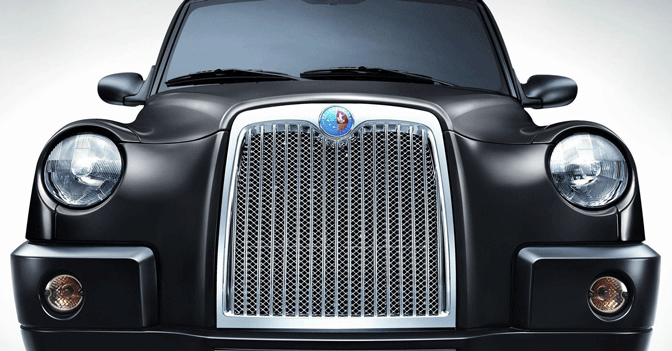
CORRECT Sid James, Laurence Olivier, Stanley Kubrick, the Duke of Edinburgh, Stephen Fry and Kate Moss have all used a black cab as personal transport to remain anonymous.
They acted secret signals during filming
WRONG Sid James, Laurence Olivier, Stanley Kubrick, the Duke of Edinburgh, Stephen Fry and Kate Moss have all used a black cab as personal transport to remain anonymous.

Paying only to find it dumped

According to figures obtained by the Liberal Democrats, 72 billion litres (29,000 Olympic swimming pools) have been pumped into the river by Thames Water in under three years. Mogden near Twickenham was the worst affected site, where 17.1 billion litres of sewage was discharged into the river, closely followed by Crossness in east London, where 15.8 billion litres of sewage was dumped. Naturally these statistics weren’t divulged by Thames Water as they only havea legal obligation to publish the number of hours it’s pumping sewage into London’s river, not the actual volume of the discharges. If you paid a man to dispose of your rubbish, only to find he’d dumped it, you’d call him a crook, and yet we pay water companies to remove our sewage, only to find it dumped in the nearest river.

Johnson’s London Dictionary: Knowledge School

KNOWLEDGE SCHOOL (n.) Seat of learning which doth imbue its students the information they thought they possessed before enrolling.

Dr. Johnson’s London Dictionary for publick consumption in the twenty-first century avail yourself on Twitter @JohnsonsLondon

November’s monthly musings

🚓 What Cab News

Tom Hutley has been working on a No Traffic Lights Challenge across London. Not counting pedestrian crossings, is it possible to get around all 22 boroughs featured on The Knowledge without using traffic lights? After many trials and changes in mapping the route he’s produced this YouTube video: Can you DRIVE across London without lights?

🎧 What I’m Listening

WizCast is a podcast by Dean Warrington, founder of WizAnn Knowledge School. Rujel and Sal completed with 12 appearances and both did it in around 2 years. From Rujel’s first appearance to his suburb appearance was 364 days. If you want to be a London cabbie, WizAnn School is a good place to start.

📖 What I’m Reading

I thought I’d check out the competition for my book, by buying second-hand, Mark Syme’s book, Knowledge Boy: How to Make a London Taxi Driver. I am trying to track down Mark to contribute to a London Grill.

📺 What I’m watching

Shakespeare: Rise of a Genius, I’ve been banging on here about the 400th anniversary of the publication in London of Shakespeare’s First Folio. The BBC has made this spellbinding drama-documentary demonstrating the Bard’s ability to relevant for us all today. It should be compulsory viewing for all year 9 school children.

❓ What else

Some typically ‘like’ nearly everything I have posted, presumably simply because they want to support my work and want me to feel good about uploading these regular missives. But when I choose the ‘like’ option, sometimes I’m really just saying, “I acknowledge and affirm your existence.” Why don’t they have a button just for that?

📆 What date?

Big Ben’s First Bong. On the 31st of December 1923, the chimes of Big Ben were broadcast on the radio for the first time by the BBC, I’ll be writing about that on my Substack platform.

Taxi Talk Without Tipping