To his friends and neighbours on East London’s Tredegar Square, Henry Wainwright was “A most respectable man”; pious, married with five children and a devout teetotaller who lectured cockneys on the evils of liquor.
Little did they realise he was also a bigamist who’d go on to commit one of Victorian London’s most notorious murders.

Henry Wainwright
Henry was in the brush making business- one of his biggest contracts happened to be with the Metropolitan police- and his factory stood at 84 Whitechapel Road. This was close to the Pavilion Theatre (which was demolished in 1962); a favourite haunt of Henry’s, who’d go there to lure its young female performers into seedy flings.

The Pavilion Theatre, Whitechapel
He also frequented Broxbourne pleasure gardens by the River Lea and it was here in 1871 that he met Harriet Lane. The couple went on to have two children and Henry successfully housed his secret family at various addresses including Bedford Square and Cecil Street; an old road once connected to the Strand, just moments away from Trafalgar Square.
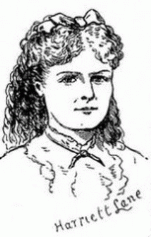
Harriett Lane
By 1874, however, Henry’s finances were suffering. Worse still, Harriet was drinking heavily and threatening to tell all if her lover didn’t maintain a cash flow. Desperate, Henry now turned to his brother Thomas, asking him to woo Harriet away from him. Thomas agreed and commenced the plan under the pseudonym Edward Frieake. In October 1874, a friend of Harriet’s called Mrs Wilmore received a telegram from ‘Mr Frieake’ announcing that he and Harriet were “Off to Paris” for a “Jolly spree.” Soon after, Henry paid a visit to offload the children on Mrs Wilmore, saying Harriet had cut all ties.
In reality, Harriet had been murdered on the afternoon of September 11th after telling friends she was going to meet Mr Frieake at 215 Whitechapel Road. This address was, in fact, a warehouse belonging to Henry, who shot Harriet when she arrived. He then stuffed the body beneath the floorboards.
Despite ‘taking care’ of his problem, Henry’s finances continued to spiral, forcing him to sell the warehouse the following year. This meant having to dispose of Harriet’s rotting corpse which, exactly a year to the day of the murder, he dragged up and cut into pieces. Henry then wrapped the remains in parcels and asked an unwitting acquaintance named Alfred Stokes to help him carry them. The pair lugged their grim cargo along Whitechapel Road and paused by Adler Street whilst Henry went to find a cab.
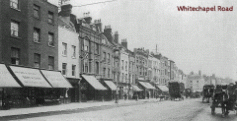
Whitechapel Road
By now Alfred was suspicious of the foul-smelling bundles and decided to have a peek. He was horrified to discover a hand and an arm but before he could do anything, Henry returned with a four-wheel ‘growler’; a style of cab which, at the time, was generally considered to be slower and shoddier than the more agile Hansom cabs.
Parcels loaded, they went to collect Henry’s latest affair- Alice Day- at which point Alfred made his excuses and left. Henry meanwhile told the cabbie to “Drive as fast as you can to the Borough.”
Alfred now gave chase, following the cab as it trotted through Aldgate, Leadenhall Street and over London Bridge before arriving at the Hop Exchange.
On the way, Alfred begged a policeman to stop the cab but was dismissed as a madman. Luckily he found another bobby patrolling St Thomas Street- Constable Turner- who believed him.
By now Henry was puffing a cigar whilst transferring the packages into a nearby building at 56 Borough High Street- which happened to be leased by his brother, Thomas. When Constable Turner and a colleague approached, Henry tried to bribe the pair with £50 each, desperately upping the offer to £200 when they began prodding the parcels. Needless to say, the officers were not impressed and were horrified to discover Harriet’s decomposing head in the first parcel they unwrapped . . .

‘The Whitechapel Tragedy’
Henry Wainwright was found guilty of murder at the Old Bailey on the 1st December 1875 and sentenced to death. His brother was found guilty of being an accessory- although it remains a mystery as to whether he really knew what Henry’s murderous intentions truly were- and imprisoned for seven years.
Henry’s execution was set for the 21st December 1875 and the night before he was understandably restless. “It does not matter,” he told the warden the next morning, “I am about to enter upon a long sleep.”
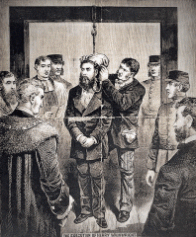
Henry Wainwright’s execution
Featured image: Pictured in the Victorian period and hand-coloured, a four-wheeled Clarence carriage, known as a ‘growler’, due to its sturdy and workmanlike construction, it was built to work as a cab on city streets, ‘growling’ across the cobbles, hence the name.
 This is not a sponsored post. Robert Lordan has permitted this story to be reproduced. Other London related stories can be found at Robs London. All links here conform with guidelines set out in Write a Post.

 On 6 September 1828 the Gothic House for llamas, presented by the Duke of Bedford was opened, he was President of the Zoological Society of London from 1899 to 1936
 Buckingham House built 1702 which would later become Buckingham Palace was built on the site of a notorious brothel
 A ‘tot’ was an artificial Celtic beacon hill arranged along solstice lines London’s most famous tot hill was Westminster hence Fields and Street
 On 6 September 1921 an inquest ruled that 63-year-old retired French cook, Joseph Enecker, had shot himself after suffering hiccups for 48 hours
 Pear Tree Court on Lunham Road has an 18-room nuclear bunker in the basement, now closed as Lambeth declared the borough nuclear free
 165 Broadhurst Gardens was home to Decca Records until the early 1980s, on 1 January 1962, Brian Epstein paid for an hour audition for The Beatles, but they were turned down by Decca
 Bleeding Heart Yard is almost certainly derived from an ancient religious symbol later adopted by a tavern which once stood on the site
 On 6 September 1913 Arsenal played their first game at Highbury, 20,000 watched the Gunners beat Leicester Fosse 2-1
 Building the tunnels for the first section of the District Line (South Kensington to Westminster, 1868) used 140 million bricks
 Until Edward VIII changed the rules in 1936, Beefeaters at The Tower of London were required to sport a beard
 Dulwich College founded in 17th century by actor Edward Alleyn has famous alumni including PG Wodehouse and Ernest Shackleton
 Trivial Matter: London in 140 characters is taken from the daily Twitter feed @cabbieblog.


