

Minicabs make up nearly a THIRD of all night-time traffic in London according to the Mayor’s data, and now Uber have said that their aim is 20,000 new drivers on their platform before the start of 2023. Too many, not enough or just right?

Johnson’s London Dictionary: Marble Arch
MARBLE ARCH (n.) White edifice, once lokated outside a royal residence, whose function is unclear except to prohibit ingress by the publik, whilst only permitting regal throughfare
Dr. Johnson’s London Dictionary for publick consumption in the twenty-first century avail yourself on Twitter @JohnsonsLondon
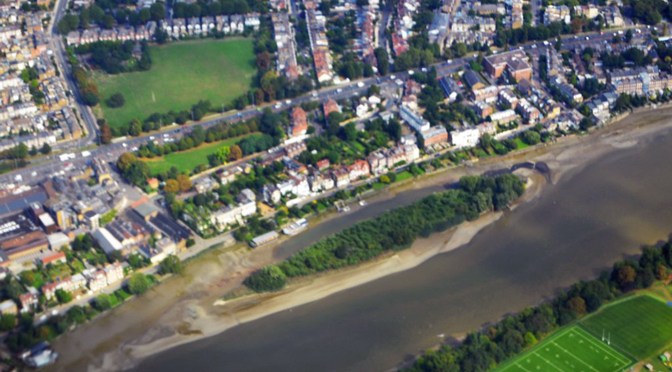
The Thames eyots
One of the conundrums when working as a London cabbie is, just where do you stop for lunch? The public’s perception that we all meet at a convenient diner is true for some, but where do you take your break if you’re on the other side of London?
One of my favourite watering holes, in more ways than one, was Chiswick Mall with its Georgian and Regency houses strung out along the River Thames.
Opposite these houses in the river is the Chiswick Eyot, the first major island you come to in the Thames if you’re travelling up from central London.
This island is an eyot, one of 120 islands in the Thames, each with its unique character and atmosphere, some have many people living on or around them in bungalows or houseboats, but like the Chiswick Eyot, some are completely uninhabited and are all the more mysterious for it.
The Chiswick Eyot is a protected nature reserve, and can completely flood on the fast-moving high tides – there are warning signs planted there telling you so. With permission at low tide, you could wade out to the eyot, but even then it would be at your own risk of the tide advancing.
At low tide, the island rears up before you, with a long raised bank around this four-acre lump of land covered at one end with clipped willow trees that once grew on many of the Thames islands. The willows were used to make baskets for the London markets and crayfish pots. This is the last place where basket makers still come across and cut them anywhere on the Thames, keeping alive an ancient craft.
The island is incredibly unstable, such is the force of the Thames’s tides that it is subject to continual erosion, and if it wasn’t for the work of volunteers who have helped to shore up its banks, it would have been washed away by now. This means that historically the island was much larger. Even today it’s constantly in danger of falling apart completely.
Unfortunately, the island is also being invaded by Chinese Mitten Crabs, a species of crab thought to have been introduced to the Thames estuary about 1935, arriving here as a by-product of intercontinental shipping by clinging onto the hulls of ships. The crabs burrow into muddy banks and create complex interconnected burrows. The consequences for Chiswick Eyot are potentially disastrous, as the crabs’ burrowing loosens the mud around the eyot, and when the tide flows in and out, the earth is washed away, steadily eroding the island over time.
Featured image: The Chiswick Eyot. The River Thames rises at Thames Head in Gloucestershire on the slopes of the Cotswolds and flows generally eastward to its mouth near Southend in Essex. At 215 miles long it is one of the longest rivers in Britain and the longest entirely in England. It is one of the most important rivers in Britain by N Chadwick (CC BY-SA 2.0)
London in Quotations: Tony Tanner

London is a world of glamour, excitement, activity, amusement and all the attractions of worldly wit and casual relationships; but we also infer that it is a world of endlessly false appearances, a world in which manners substitute for morals, a world given over to cold deception, manipulation and exploitation.

Tony Tanner (1935-1998), Jane Austen
London Trivia: Libyan People’s Bureau shooting
On 17 April 1984 on this Tuesday at 10.18 a.m., during an anti-Gadaffi rally at the Libyan People’s Bureau, No. 5 St James’s Square, W1, shots were fired from a window at the Bureau, one of which killed PC Yvonne Fletcher, a few yards away from her fiancé who was also a policeman.
 On 17 April 1999 a nail bomb exploded in Brixton, injuring at least forty-five people. It was thought that the target was the largely black clientele of Brixton Market
 The term ‘down-under’ comes from a tunnel on Millbank which deported prisoners were led in chains to barges on their first leg to Australia
 Chiswick House built to house Lord Burlington’s art collection became a lunatic asylum before being listed for demolition in the 1950s
 In 1974 Cass Elliot died of a heart attack in Harry Nilsson’s Mayfair flat the same block that The Who drummer Keith Moon died 4 years later
 The Lamb and Flag pub at St Christopher’s Place in the 19th century was reputed to be the haunt of anarchists
 Naked statutes outside Zimbabwe House caused an outcry when unveiled in 1908 the building opposite replaced its windows with frosted glass
 Pasqua Rosee a Sicilian servant first introduced coffee to London first to his master’s guests then in a shed by St Michael Cornhill in 1652
 Set up in 1869 the Hurlingham Club originally hosted pigeon shooting before becoming a major venue for tennis
 The longest tube journey one can take without changing trains is Epping to West Ruislip a distance of 34.1 miles
 In April 1755 after 9 years work and payment of 1,500 guineas Samuel Johnson’s A Dictionary of the English Language was published in London
 Zizzi is French for willy at Zizzi’s on the Strand in April 2007 a man ran in took a knife jumped on a table dropped his trousers and cut off his penis
 Trivial Matter: London in 140 characters is taken from the daily Twitter feed @cabbieblog.
A guide to the symbols used here and source material can be found on the Trivial Matter page.

