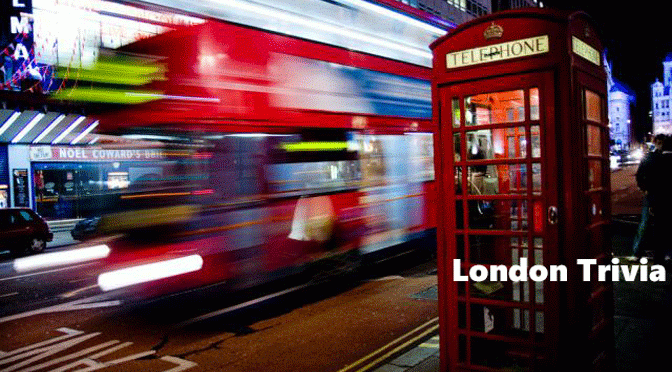
London Trivia: Stitched up

On 5 November 1739 the house of a master weaver on Spital Square was attacked by journeymen. The owner of the workshop had allegedly tried to get silk binding done for free as part of the price for a weaving job. Troops were called out from the Tower of London. The Riot Act was read out to the assembled crowd. At the end several solders were hurt by protesters throwing tiles and bricks from the tops of the houses.

On 5 November 1947 London Zoo’s most famous resident Guy the Gorilla arrived at the zoo on Guy Fawkes Day hence being named Guy

Until 1859 it was illegal to celebrate the arrest of Guido Fawkes on 5 November by burning a guy, and presumably asking passers-by “penny for the guy, mister?”

In 1831 London became the first city in the world to have 1 million inhabitants only overtaken in size by Tokyo 126 years later

When Guy Fawkes was executed hanging broke his neck preventing the drawing and quartering (removing his intestines, arms and legs) while alive

When entering The Houses of Parliament its Members are still banned from wearing a suit of armour under an Act made by Edward II in 1313

Lions of Trafalgar Square were sculpted from life artist Landseer used dead lions from London Zoo until neighbours complained of the smell

The London Eye can carry 800 people each rotation comparable to 11 double decker buses receives on average more visitors per year than the Taj Mahal and the Great Pyramid of Giza

After Percy Lambert was killed racing at Brooklands in 1913 he was buried at Brompton Cemetery in a coffin designed to match his racing car

Wealthy oil baron Nubar Gulbenkian had a luxurious taxi conversion. He told friends “Apparently it can turn on a sixpence, whatever that is”

St. Paul’s Cathedral at 365ft high and over 40 years to construct. It took so long to complete its builders had the reputation of being lazy

The only qualification needed to join Edmund Kean’s Wolf Club at the Coal Hole, Strand was your wife had forbidden you to sing in the bath

CabbieBlog-cab.gifTrivial Matter: London in 140 characters is taken from the daily Twitter feed @cabbieblog.
A guide to the symbols used here and source material can be found on the Trivial Matter page.

Previously Posted: Fat Flying Rats

For those new to CabbieBlog or readers who are slightly forgetful, on Saturdays I’m republishing posts, many going back over a decade. Some will still be very relevant while others have become dated over time. Just think of this post as your weekend paper supplement.

Fat Flying Rats (28.09.2010)

Using my ATM has of late been a hazardous experience, not from any street crime, but a far more dangerous assailant coming from the sky. Our local bank has erected a rather splendid sign above its frontage which has proved a perfect perch for pigeons, dozens of them. While ex-mayor Ken Livingstone’s most positive contribution to London has been to reduce the pigeons of Trafalgar Square from 4,000 to a mere 120, they have unfortunately like other vagrants just moved elsewhere.

He first banned the sale of pigeon feed in 2001 resulting in a family business that had traded for decades having to shut shop. Next at a cost of £60,000 a year he introduced a pair of Harris hawks, with their handler, the expense has almost certainly been covered by the reduction in the cost of cleaning up pigeon droppings from the surrounding areas.

Unfortunately, the rest of London is still plagued by these feral creatures that carry (sorry about this!) histoplasmosis, cryptococosis and psittacosis, so it would seem the pigeons above my ATM could previously have been a tourist “attraction” from Trafalgar Square.

On my garden on the bird, table are regularly two ring-necked doves, slim beautiful creatures, even if they are a little stupid and the contrast between our doves and London feral pigeons could be not starker.

Now with our fast-food litter lout culture it has given us pigeons so fat that they can hardly fly out of the way of my cab, with many of them having trouble taking off as they are missing a toe or foot after standing in the piles of their own corrosive droppings. These urban birds are even more stupid than their rural cousins, after centuries of evolution, not one of them have realised that by placing their foot even if it is now a stub, on a piece of bread, they wouldn’t have to throw it over their heads, tearing a piece off in the process.

The numbers of our wild friends, along with foxed and rats needs to be reduced, reports recently have included, dive bombing seagulls, foxes biting children in their beds and if it is to be believed rats 30 inches long.

Sparrow hawks regularly kill pigeons in my garden while the other birds are clever enough to get out of the hawks way it’s only the pigeons that get caught, they could be used to keep the numbers in London down, feeding them something to reduce their sex drive might deprive Londoner’s the opportunity of the amusing spectacle of the males courting rituals, but could have the desired effect.

Writing in the Evening Standard Sebastian Shakespeare suggests a course of action which might prove rather startling to tourists, as the bird’s fall of their perch (or their hands) and I quote:

A more pragmatic way might be to hand out poisoned bird feed to tourists and actively encourage them to feed the pigeons. This would kill two birds with one stone, so to speak: the tourists would still get their photo opportunities and it would be a very cost-effective way of keeping the pigeon population down.

If you still have the need for more about pigeons, I would direct you to Pigeon Blog probably the largest site you find on everything that’s amusing about our fat flying friends.

Test Your Knowledge: November 2023

In November 1623, 400 years ago, Shakespeare’s First Folio was posthumously printed in London, try this month’s quiz on the Bard’s playhouse. As before the correct answer will turn green when it’s clicked upon and expanded to give more information. The incorrect answers will turn red giving the correct explanation.

1. What year did the original Globe Theatre open?
1589
WRONG The Globe was built in 1599 on Maiden Lane (now known as Park Street) in Southwark on the Southside of the Thames.
1599
CORRECT The Globe was built in 1599 on Maiden Lane (now known as Park Street) in Southwark on the Southside of the Thames.
1579
WRONG The Globe was built in 1599 on Maiden Lane (now known as Park Street) in Southwark on the Southside of the Thames.
2. What type of performance did a red flag flown outside signify?
Comedy
WRONG Depending on the genre of play being performed, colour-coded flags were used outside the theatre to let spectators know what type of play they would be seeing. A red flag was flown for a history play, white for a comedy play and black for a tragedy play.
History
CORRECT Depending on the genre of play being performed, colour-coded flags were used outside the theatre to let spectators know what type of play they would be seeing. A red flag was flown for a history play, white for a comedy play and black for a tragedy play.
Tragedy
WRONG Depending on the genre of play being performed, colour-coded flags were used outside the theatre to let spectators know what type of play they would be seeing. A red flag was flown for a history play, white for a comedy play and black for a tragedy play.
3. What was the first play performed at the original Globe Theatre?
Julius Caesar
CORRECT It is thought that the first Shakespeare play performed at the original Globe was Julius Caesar, in 1599. The modern Shakespeare’s Globe opened to the public in 1997, with a production of Henry V.
Henry V
WRONG It is thought that the first Shakespeare play performed at the original Globe was Julius Caesar, in 1599. The modern Shakespeare’s Globe opened to the public in 1997, with a production of Henry V.
Romeo and Juliet
WRONG It is thought that the first Shakespeare play performed at the original Globe was Julius Caesar, in 1599. The modern Shakespeare’s Globe opened to the public in 1997, with a production of Henry V.
4. Where was the wood sourced to build the original Globe Theatre?
An old theatre
CORRECT The timber used to build the Globe Theatre was reused wood from ‘The Theatre’, an earlier theatre owned by the father of one of the Globe’s funders. It was dismantled taken across the Thames and reconstructed in a couple of days.
Queen Elizabeth’s Oak Forest
WRONG The timber used to build the Globe Theatre was reused wood from ‘The Theatre’, an earlier theatre owned by the father of one of the Globe’s funders. It was dismantled taken across the Thames and reconstructed in a couple of days.
Donated from patrons
WRONG The timber used to build the Globe Theatre was reused wood from ‘The Theatre’, an earlier theatre owned by the father of one of the Globe’s funders. It was dismantled taken across the Thames and reconstructed in a couple of days.
5. How many people could fit into the original Globe Theatre?
3,000
CORRECT The Globe was an open-air amphitheatre shaped like a doughnut and had a seating capacity of up to 3,000 spectators.
2,000
WRONG The Globe was an open-air amphitheatre shaped like a doughnut and had a seating capacity of up to 3,000 spectators.
1,000
WRONG The Globe was an open-air amphitheatre shaped like a doughnut and had a seating capacity of up to 3,000 spectators.
6. What was the name given to members of the audience standing in front of the stage?
Peasants
WRONG The cheapest price to watch a performance at the Globewas only 1 penny (about the price of a loaf of bread), which bought you a place amongst the ‘groundlings’ standing in the ‘yard’ around the stage. (There were 240 pennies in £1.) For another penny, you could have a bench seat in the lower galleries which surrounded the yard. Or for a penny or so more, you could sit more comfortably on a cushion.
Groundlings
CORRECT The cheapest price to watch a performance at the Globewas only 1 penny (about the price of a loaf of bread), which bought you a place amongst the ‘groundlings’ standing in the ‘yard’ around the stage. (There were 240 pennies in £1.) For another penny, you could have a bench seat in the lower galleries which surrounded the yard. Or for a penny or so more, you could sit more comfortably on a cushion.
Patrons
WRONG The cheapest price to watch a performance at the Globewas only 1 penny (about the price of a loaf of bread), which bought you a place amongst the ‘groundlings’ standing in the ‘yard’ around the stage. (There were 240 pennies in £1.) For another penny, you could have a bench seat in the lower galleries which surrounded the yard. Or for a penny or so more, you could sit more comfortably on a cushion.
7. What time did most plays at the original Globe Theatre begin?
17.00
WRONG The sun was the only source of light, so plays were performed in the daytime instead of at night as they are now. No candles were used for lighting because the Globe was built using very flammable materials like wood and plaster, which meant it was vulnerable to fire. All performances had to end before nightfall so that playgoers could return safely home.
19.00
WRONG The sun was the only source of light, so plays were performed in the daytime instead of at night as they are now. No candles were used for lighting because the Globe was built using very flammable materials like wood and plaster, which meant it was vulnerable to fire. All performances had to end before nightfall so that playgoers could return safely home.
15.00
CORRECT The sun was the only source of light, so plays were performed in the daytime instead of at night as they are now. No candles were used for lighting because the Globe was built using very flammable materials like wood and plaster, which meant it was vulnerable to fire. All performances had to end before nightfall so that playgoers could return safely home.
8. What is the nickname given to the original Globe Theatre?
The Rose
WRONG The theatre’s owner, Burbage named it The Globe after the figure of Hercules carrying the globe on his back – for in like manner, the actors carried the Globe’s framework on their backs across the Thames.
The Curtain
WRONG The theatre’s owner, Burbage named it The Globe after the figure of Hercules carrying the globe on his back – for in like manner, the actors carried the Globe’s framework on their backs across the Thames.
The Globe
CORRECT The theatre’s owner, Burbage named it The Globe after the figure of Hercules carrying the globe on his back – for in like manner, the actors carried the Globe’s framework on their backs across the Thames.
9. How was the commencement of a performance announced?
A trumpet
CORRECT To announce to the audience that the play was about to begin, a trumpet would be blown to signal to people it was time to take their final places.
A town crier
WRONG To announce to the audience that the play was about to begin, a trumpet would be blown to signal to people it was time to take their final places.
A musical performance
WRONG To announce to the audience that the play was about to begin, a trumpet would be blown to signal to people it was time to take their final places.
10. What happened to the original Globe Theatre?
Flood
WRONG The Globe Theatre burnt down in 1613 after a special effect on stage went wrong. A cannon used for a performance of Henry VIII set light to the thatched roof and the fire quickly spread. Supposedly it took less than two hours to burn down completely. Luckily, according to one of the few surviving documents of the event, nobody was hurt in the fire except for a man whose burning trousers had to be put out with a bottle of beer! Following the fire, the Globe Theatre was rebuilt in the same spot in 1614
.
Fire
CORRECT The Globe Theatre burnt down in 1613 after a special effect on stage went wrong. A cannon used for a performance of Henry VIII set light to the thatched roof and the fire quickly spread. Supposedly it took less than two hours to burn down completely. Luckily, according to one of the few surviving documents of the event, nobody was hurt in the fire except for a man whose burning trousers had to be put out with a bottle of beer! Following the fire, the Globe Theatre was rebuilt in the same spot in 1614
.
Riot
WRONG The Globe Theatre burnt down in 1613 after a special effect on stage went wrong. A cannon used for a performance of Henry VIII set light to the thatched roof and the fire quickly spread. Supposedly it took less than two hours to burn down completely. Luckily, according to one of the few surviving documents of the event, nobody was hurt in the fire except for a man whose burning trousers had to be put out with a bottle of beer! Following the fire, the Globe Theatre was rebuilt in the same spot in 1614
.

Taxi numbers plummet

According to recently released data from Transport for London, the number of licensed taxis in the capital plummeted by 119 vehicles in the week ending 15th October 2023, while private hire licences continued to show an upward trend.

This left a total of 14,907 black cabs available to ply-for-hire in the capital covering 24 hours a day 7 days a week. during the same week.

On the plus side, 55 new electric cabs hit London’s streets.

In contrast, the private hire sector showed continued growth, with the number of private hire vehicles licensed climbing by a huge 206 compared to the previous week, reaching a total of 90,765.

These figures highlight the ongoing challenges faced by the traditional taxi industry, with some attributing the decrease in licensed taxis to high vehicle costs making it more difficult for part-time drivers to work.


Johnson’s London Dictionary: Ulez cameras

ULEZ CAMERAS (n.) Black Sentinels much given to damage by vigilantly groups that do name themselves Blade Runner.

Dr. Johnson’s London Dictionary for publick consumption in the twenty-first century avail yourself on Twitter @JohnsonsLondon