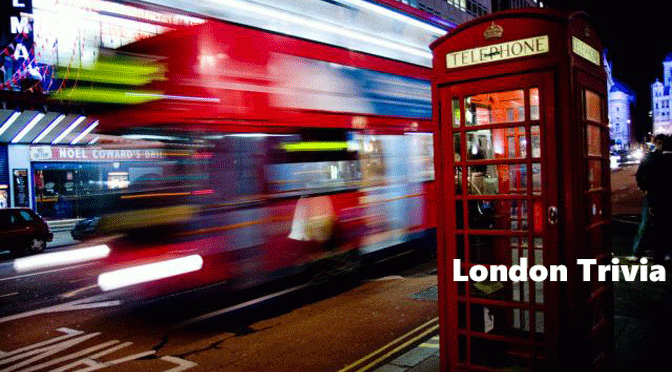
London Trivia: Taxi getaway

On 6 March 1997 Picasso’s Tête de Femme worth £700,000 was stolen from the Lefevre Gallery in Mayfair, by a man brandishing a sawn-off shotgun. The raid was over in 35 seconds, the thief jumped into a taxi which took him to, of all places, Halford’s in Battersea at which point he made a phone call before travelling on to Wimbledon and evading capture. To the dismay of art lovers, the painting was later recovered.

On 6 March 1961 the image of the capital’s taxi cab as a black Austin FX3 changed as the capital’s first mini cab by Carline Cabs arrived

Among the final few people ever to be imprisoned in the Tower of London were the Kray twins. (Recaptured after deserting from the Army)

Percy Circus, WC1 was named after writer Sydney Smith’s brother Robert Percy Smith who was a director of the New River Company

Charles Dickens nearly became an actor but missed the audition at the Covent Garden theatre due because he had flu

John Quincy Adams, sixth president of the USA, was married in All Hallows by the Tower in 1797, the oldest church in the City of London was founded in 675AD

In 1747 William Hogarth painted The Stage Coach at the former Angel Inn, 1 Islington High Street, rebuilt and occupied by Co-op Bank

The founder of Soho restaurant Quo Vadis chose the name because he didn’t know whether it would succeed – it means ‘where are you going?’

As the boat race is taking place Spitalfields City Farm raise funds for animal feed by racing 3 goats: ‘Oxford’ and ‘& Cambridge’

Next time you can’t find a bus, try Waterloo Bridge, there, one crosses the Thames every 16 seconds, but very slowly

Edward Garton had an incentive to change the name of his Gartons sauce everyone spelt it backwards and you get snot rag – so HP Sauce it was

On 6 March 1998, the Meteorological Office in Bracknell was rung by a pensioner from Shirley distressed at seeing her garden covered in frogs

CabbieBlog-cab.gifTrivial Matter: London in 140 characters is taken from the daily Twitter feed @cabbieblog.
A guide to the symbols used here and source material can be found on the Trivial Matter page.

Previously Posted: My favourite things

For those new to CabbieBlog or readers who are slightly forgetful, on Saturdays I’m republishing posts, many going back over a decade. Some will still be very relevant while others have become dated over time. Just think of this post as your weekend paper supplement.

My favourite things (27.12.09)

It’s that time of year when the media is crammed full of trivia, so in the Christmas tradition, here are CabbieBlog’s London favourites:

Neighbourhood: Clerkenwell; I had my first job in London in this small district populated at the time by Italians giving us great delicatessens, a catholic church and an introduction to their beautiful language. The principal industries there was watchmaking and typesetting.

Building: St. Paul’s is obscured by other buildings, so the best place to see it is from Bankside on the other side of the Thames, then cross by Millennium Bridge and climb to the top, and don’t forget to visit the crypt.

View: No problem choosing this one, Waterloo Bridge in the evening. Wordsworth got it wrong when he wrote Upon Westminster Bridge:
Earth has not anything to show more fair:
Dull would he be of soul who could pass by
A sight so touching in its majesty:
This City now doth like a garment wear

Nice sentiment, wrong bridge. But to be fair to Bill, Waterloo wasn’t built then, Ray Davis was right though, with Waterloo Sunset.

Open Space: Hampstead Heath, the highest point in London, with its varied landscape and nutcases swimming in its famous ponds.

Interesting Shop: Pollock’s Toy Museum and shop in Scala Street near Goodge Street. A fascinating collection of toys from a bygone era.

Bar/Pub/Restaurant: Bar Italia on Frith Street, Soho, for the best cappuccino north of the Alps, their espresso machine is over 50 years old and still going strong. Open 24 hours a day, they just kick you out into the street when they want to clean the place. Or for a slightly upmarket tea try Claridges, good value, superb service and no tourists.

London book/film/documentary: London Sight Unseen by Snowdon. I was bought this book a few years ago. Snowdon travelled all over the capital photographing anything unusual or fascinating that caught his photographer’s eye. Or watch the play “The Knowledge” by the late Jack Rosenthal a brilliant comedy about becoming a cabbie.

London street/road/square: Queen Anne’s Gate. Unlike her statute outside St. Paul’s Cathedral, this exquisite little turning which takes its name from the aforementioned queen, encapsulates Georgian London, go there and be amazed that there are still places left in London like this, just don’t tell those modern architects, they’ll want to develop it.

Londoner: Thomas Coram although born in Lyme Regis, Dorset and spent much of his early life at sea and in the American colonies he’s an adopted Londoner. He later became a successful merchant in London, as a great philanthropist Coram was appalled by the many abandoned, homeless children living in the streets of London. On 17 October 1739, he obtained a Royal Charter granted by George II establishing a “hospital for the maintenance and education of exposed and deserted young children.” Visit the Foundling Museum near the children’s playing fields which take his name, just don’t go into the playground next door, you must be accompanied by a minor.

Period: 1650-1720 This is the time when London was brought to its knees after the Great Fire of London, yet within decades London was reborn as the greatest city in the world, in addition to surviving civil war, plague, drought and bankruptcy. It’s a time when London gave rise to a generation of extraordinary men: Sir Christopher Wren, Robert Hooke, John Locke, John Evelyn and Nicholas Barbon.


Test Your Knowledge: March 2022

Claiming something to be the ‘oldest’ is often fraught with problems, so bear with me on what I think are the correct answers. As with the previous Quizzes, the correct answer will turn green when it’s clicked upon and expanded to give more information. The incorrect answers will turn red giving the correct explanation.

1. Britain’s oldest door can be found in which religious building in London?
Westminster Abbey
CORRECT Westminster Abbey has Britain’s oldest door, dated for the first time in 2005 by the process known as dendrochronology, it showed the wood had been felled after 1032 and the door constructed sometime in the 1050s during the reign of King Edward the Confessor.
Tower of London
WRONG Westminster Abbey has Britain’s oldest door, dated for the first time in 2005 by the process known as dendrochronology, it showed the wood had been felled after 1032 and the door constructed sometime in the 1050s during the reign of King Edward the Confessor.
Fulham Palace
WRONG Westminster Abbey has Britain’s oldest door, dated for the first time in 2005 by the process known as dendrochronology, it showed the wood had been felled after 1032 and the door constructed sometime in the 1050s during the reign of King Edward the Confessor.
2. What is the capital’s oldest mainline train station in Zone One?
Kings Cross
WRONG London Bridge station was opened in December 1836. Kings Cross was opened in 1852 and named after a huge statue of much-derided statue of George IV, removed in 1842. Charing Cross Station was named after a short street near the notional centre of London from which distances from the city are measured and opened in 1864.
London Bridge
CORRECT London Bridge station was opened in December 1836. Kings Cross was opened in 1852 and named after a huge statue of much-derided statue of George IV, removed in 1842. Charing Cross Station was named after a short street near the notional centre of London from which distances from the city are measured and opened in 1864.
Charing Cross
WRONG London Bridge station was opened in December 1836. Kings Cross was opened in 1852 and named after a huge statue of much-derided statue of George IV, removed in 1842. Charing Cross Station was named after a short street near the notional centre of London from which distances from the city are measured and opened in 1864.
3. Which restaurant claims to be London’s oldest?
Rules
CORRECT Established in 1798, Rules is regarded as London’s oldest restaurant. Edward, The Prince of Wales would entertain his mistresses there in a secret room. Established in 1889, Sweetings is London’s oldest seafood restaurant, apparently gangster George Francis once offered one-time owner George Needham £1,000,000 in cash for the restaurant. Wiltons began life as an oyster stall in 1742 before its establishment in St James in the 1840s, they proudly announced in 2017 that it was older than America.
Wiltons
WRONG Established in 1798, Rules is regarded as London’s oldest restaurant. Edward, The Prince of Wales would entertain his mistresses there in a secret room. Established in 1889, Sweetings is London’s oldest seafood restaurant, apparently gangster George Francis once offered one-time owner George Needham £1,000,000 in cash for the restaurant. Wiltons began life as an oyster stall in 1742 before its establishment in St James in the 1840s, they proudly announced in 2017 that it was older than America.
Sweetings
WRONG Established in 1798, Rules is regarded as London’s oldest restaurant. Edward, The Prince of Wales would entertain his mistresses there in a secret room. Established in 1889, Sweetings is London’s oldest seafood restaurant, apparently gangster George Francis once offered one-time owner George Needham £1,000,000 in cash for the restaurant. Wiltons began life as an oyster stall in 1742 before its establishment in St James in the 1840s, they proudly announced in 2017 that it was older than America.
4. Some of the world’s earliest shops can be found in London, but which is the oldest?
Lock & Co
CORRECT Curiously all three are near each other. Lock & Co founded in 1676 is the oldest hatter in the world who invented the bowler. Berry Brothers are next door and have been supplying fine wines since 1698. Founded by a saddler and whip maker in 1750, Swaine Adeney Brigg has been selling leather goods for centuries, supplying luggage for films including the Kingsman movies.
Berry Brothers & Rudd
WRONG Curiously all three are near each other. Lock & Co founded in 1676 is the oldest hatter in the world who invented the bowler. Berry Brothers are next door and have been supplying fine wines since 1698. Founded by a saddler and whip maker in 1750, Swaine Adeney Brigg has been selling leather goods for centuries, supplying luggage for films including the Kingsman movies.
Swaine Adeney Brigg
WRONG Curiously all three are near each other. Lock & Co founded in 1676 is the oldest hatter in the world who invented the bowler. Berry Brothers are next door and have been supplying fine wines since 1698. Founded by a saddler and whip maker in 1750, Swaine Adeney Brigg has been selling leather goods for centuries, supplying luggage for films including the Kingsman movies.
5. We’ve more statues than you could shake a stick at, but which is the oldest?
King Alfred the Great in Trinity Church Square
CORRECT Created in the 14th century in honour of King Alfred, the man who ruled Wessex in the 9th century was originally located at the Palace of Westminster before it was brought to its present location in 1823 at about the time the square was being laid. Credited as being London’s oldest equestrian bronze, King Charles I statue is used to measure all distances from London. Queen Elizabeth I dates from 1586 and was created during her reign.
King Charles I sitting astride his horse on the southern side of Trafalgar Square
WRONG Created in the 14th century in honour of King Alfred, the man who ruled Wessex in the 9th century was originally located at the Palace of Westminster before it was brought to its present location in 1823 at about the time the square was being laid. Credited as being London’s oldest equestrian bronze, King Charles I statue is used to measure all distances from London. Queen Elizabeth I dates from 1586 and was created during her reign.
Queen Elizabeth I standing on the facade of St Dunstan-in-the-West in Fleet Street
WRONG Created in the 14th century in honour of King Alfred, the man who ruled Wessex in the 9th century was originally located at the Palace of Westminster before it was brought to its present location in 1823 at about the time the square was being laid. Credited as being London’s oldest equestrian bronze, King Charles I statue is used to measure all distances from London. Queen Elizabeth I dates from 1586 and was created during her reign.
6. Where is what’s claimed to be London’s oldest house?
Mayesbrooke Road, Barking
WRONG Estimated to have been first built in 1435 this house was known as Walthamstow Tony. Sadly, this isn’t after a 15th century East London ‘Tone’ living in Walthamstow, but the name probably derives from the combination of a Saxon landowner ‘Waltheof’ and the name of a French nobleman called Ralph de Toni. Hidden down a small street in Farringdon lies 41/42 Cloth Fair, built between 1597 and 1614, this is the only house in the City of London to have survived the Great Fire of London. Was the Gunpowder Plot hatched at Eastbury Manor House, Mayesbrooke Road, Barking built in 1557? So says a local tradition supported by the author Daniel Defoe.
Cloth Fair, Smithfield
WRONG Estimated to have been first built in 1435 this house was known as Walthamstow Tony. Sadly, this isn’t after a 15th century East London ‘Tone’ living in Walthamstow, but the name probably derives from the combination of a Saxon landowner ‘Waltheof’ and the name of a French nobleman called Ralph de Toni. Hidden down a small street in Farringdon lies 41/42 Cloth Fair, built between 1597 and 1614, this is the only house in the City of London to have survived the Great Fire of London. Was the Gunpowder Plot hatched at Eastbury Manor House, Mayesbrooke Road, Barking built in 1557? So says a local tradition supported by the author Daniel Defoe.
Church Lane, Walthamstow
CORRECT Estimated to have been first built in 1435 this house was known as Walthamstow Tony. Sadly, this isn’t after a 15th century East London ‘Tone’ living in Walthamstow, but the name probably derives from the combination of a Saxon landowner ‘Waltheof’ and the name of a French nobleman called Ralph de Toni. Hidden down a small street in Farringdon lies 41/42 Cloth Fair, built between 1597 and 1614, this is the only house in the City of London to have survived the Great Fire of London. Was the Gunpowder Plot hatched at Eastbury Manor House, Mayesbrooke Road, Barking built in 1557? So says a local tradition supported by the author Daniel Defoe.
7. You can still worship in London’s oldest Christian church, but which one?
St. Bartholomew-the-Great
WRONG Believed to be one of the oldest sites of Christian worship in England, St. Pancras Old Church was established around the 4th century, on the site of a former Roman temple. St Bartholomew-the-Great in Smithfield might be the oldest intact continuous place of worship, dating back to 1123. Some parts of the original building remain. All Hallows dates back to 625, but very little of the original structure remains.
All Hallows by the Tower
WRONG Believed to be one of the oldest sites of Christian worship in England, St. Pancras Old Church was established around the 4th century, on the site of a former Roman temple. St Bartholomew-the-Great in Smithfield might be the oldest intact continuous place of worship, dating back to 1123. Some parts of the original building remain. All Hallows dates back to 625, but very little of the original structure remains.
St. Pancras Old Church
CORRECT Believed to be one of the oldest sites of Christian worship in England, St. Pancras Old Church was established around the 4th century, on the site of a former Roman temple. St Bartholomew-the-Great in Smithfield might be the oldest intact continuous place of worship, dating back to 1123. Some parts of the original building remain. All Hallows dates back to 625, but very little of the original structure remains.
8. Love it, or loathe it, can you identify the oldest actress to appear on BBC’s Eastenders?
Barbara Windsor
WRONG June Brown joined the show in 1985, the year it was created, and stayed until January 2020, playing Dot Cotton the chain-smoking, quick-witted and loveable character who left the square in 2020 aged 94. Gretchen Franklin played Ethel Skinner’s final scenes at the age of 89, marking the end of her acting career. The late Barbara Winsor was a mere 79 years old when she left The Vic.
Gretchen Franklin
WRONG June Brown joined the show in 1985, the year it was created, and stayed until January 2020, playing Dot Cotton the chain-smoking, quick-witted and loveable character who left the square in 2020 aged 94. Gretchen Franklin played Ethel Skinner’s final scenes at the age of 89, marking the end of her acting career. The late Barbara Winsor was a mere 79 years old when she left The Vic.
June Brown
CORRECT June Brown joined the show in 1985, the year it was created, and stayed until January 2020, playing Dot Cotton the chain-smoking, quick-witted and loveable character who left the square in 2020 aged 94. Gretchen Franklin played Ethel Skinner’s final scenes at the age of 89, marking the end of her acting career. The late Barbara Winsor was a mere 79 years old when she left The Vic.
9. Have you watched a match at London’s oldest football club?
Fulham
CORRECT Their formation in 1879 make Fulham the oldest professional club in London and the second oldest in the world. The oldest senior non-league club is thought to be Cray Wanderers, founded in 1860, currently playing in Bromley.
Chelsea
WRONG Their formation in 1879 make Fulham the oldest professional club in London and the second oldest in the world. The oldest senior non-league club is thought to be Cray Wanderers, founded in 1860, currently playing in Bromley.
Arsenal
WRONG Their formation in 1879 make Fulham the oldest professional club in London and the second oldest in the world. The oldest senior non-league club is thought to be Cray Wanderers, founded in 1860, currently playing in Bromley.
10. Noted for its quintessential squares, but which is London’s oldest?
Charterhouse
WRONG The earliest squares were little more than open grass, surrounded by timber fences. The first square to have a properly laid out garden at its centre was probably Soho Square built in 1681 by the Earl of Macclesfield. Did you know? The body of Oliver Cromwell is said to lie beneath Red Lion Square, dug up from Westminster Abbey in 1666 and dumped in unconsecrated ground.
Soho
CORRECT The earliest squares were little more than open grass, surrounded by timber fences. The first square to have a properly laid out garden at its centre was probably Soho Square built in 1681 by the Earl of Macclesfield. Did you know? The body of Oliver Cromwell is said to lie beneath Red Lion Square, dug up from Westminster Abbey in 1666 and dumped in unconsecrated ground.
Red Lion
WRONG The earliest squares were little more than open grass, surrounded by timber fences. The first square to have a properly laid out garden at its centre was probably Soho Square built in 1681 by the Earl of Macclesfield. Did you know? The body of Oliver Cromwell is said to lie beneath Red Lion Square, dug up from Westminster Abbey in 1666 and dumped in unconsecrated ground.

Gift shops?

Have you walked down the eastern end of Oxford Street recently? How do those emporiums selling ‘tourist’ crap survive? Usually empty of customers, they are purveyors of low-margin stock from high-rent retail spaces to, judging from the routine absence of punters, an indifferent public. I’m afraid there can only be one answer: money laundering.

Johnson’s London Dictionary: Houses of Parliament

HOUSES OF PARLIAMENT (n.) Edifice designed to impress the naive, whose incumbants doth speak with alacritous mannerisms, but whose actions are tardy

Dr. Johnson’s London Dictionary for publick consumption in the twenty-first century avail yourself on Twitter @JohnsonsLondon