We challenge our contributors to reply to ten devilishly probing questions about their London and we don’t take “Sorry Gov” for an answer. Everyone sitting in the hot seat they will face the same questions ranging from their favourite way to spend a day out in the capital to their most hated building on London’s skyline to find out what Londoners think about their city. The questions are the same but the answers vary wildly.

Don Brown is a London Blue Badge tourist guide and has been taking people around the capital for the past seven years both in real life and online at uktoursonline.com. He also writes the Stuff About London blog, looking at various things about London that have caught his eye. He recently stepped down as the Director of The London Society, a civic society concerned with trying to make London a better place in which to live and to work.
What’s your secret London tip?
Go off the main streets – dive up the little alleys and side roads that lead off the direct route anywhere. Half the time there’ll be nothing out of the ordinary, but the other half you’ll discover some building, square, green space or something that you would never have known existed. (And if I’m ever guiding visitors from the US I also advise them to spend an evening in a pub, because that’s where you see and hear the real London, because the real London are the people.)
What’s your secret London place?
The Onion Garden in Seaforth Place behind Victoria Street. It’s a tiny little bit of rus in urbe squished between an access road and the tube line that is the work of a garden designer called Jens Jakobson. There’s a coffee stall where you can grab a drink and have ten minutes just recharging in the greenery.
What’s your biggest gripe about London?
Too much traffic! There are too many cars and they’re too big. The best bits of the city are the ones that have made themselves more pedestrian-friendly – the new public square in front of Somerset House on Strand for example, which has turned a six-lane highway jammed with buses into a beautiful, peaceful, calming space.
What’s your favourite building?
It always starts and finishes with St Paul’s Cathedral; it never fails to lift the spirits whether you’re right underneath it or just glimpse it from the train as you rattle into Waterloo.
What’s your most hated building?
I still can’t come to terms with the Walkie Talkie. There are lots of very good tall buildings across the city, but this is overbearing and ugly.
What’s the best view in London?
If you’re on the top deck of a bus on a summer’s evening as you cross Waterloo Bridge you look downriver to St Paul’s and the City, and see the sun gleaming off the glass of the towers and casting a soft light on the dome; upriver, the sky is red behind Big Ben and Parliament. Paradise.
What’s your personal London landmark?
Thirty years ago they were resurfacing Albert Bridge, but it was open to pedestrians. I walked over it just as it was getting dark and as I got to the middle all the lights came on and it seemed like they were illuminating the bridge just for me.
What’s London’s best film, book or documentary?
There’s an old Ealing comedy called Hue and Cry which has a bunch of kids running around the bombsites of the post-Blitz city and provides a glimpse of what London suffered in the war. My favourite book would be Jerry White’s History of London in the 19th century, telling the story of how this place grew to be the world’s first ‘megalopolis’, a city that was so big it became impossible for anyone to know it all.
What’s your favourite restaurant?
I don’t do that much eating out, but places I can’t pass without going in include the Bar Italia (double espresso and a cannolo), Brick Lane Beigel Bake (tuna and sweetcorn), and anywhere that does proper Portuguese Pastel de Nata custard tarts.
How would you spend your ideal day off in London?
A walk, I think. You can stroll down the river from Battersea Park to London Bridge without having to cross a road and all the big sites of London appear as you make your way east. Grab a bit of lunch at the Royal Festival Hall food market at weekends, pop into Tate Modern (or detour across the Millennium Bridge), fill yourself up on samples from the cheese stalls at Borough Market then finish off with a pint in front of the fire in the Parliament Bar at The George.




 On 5 November 1947 London Zoo’s most famous resident Guy the Gorilla arrived at the zoo on Guy Fawkes Day hence being named Guy
 Until 1859 it was illegal to celebrate the arrest of Guido Fawkes on 5 November by burning a guy, and presumably asking passers-by “penny for the guy, mister?”
 In 1831 London became the first city in the world to have 1 million inhabitants only overtaken in size by Tokyo 126 years later
 When Guy Fawkes was executed hanging broke his neck preventing the drawing and quartering (removing his intestines, arms and legs) while alive
 When entering The Houses of Parliament its Members are still banned from wearing a suit of armour under an Act made by Edward II in 1313
 Lions of Trafalgar Square were sculpted from life artist Landseer used dead lions from London Zoo until neighbours complained of the smell
 The London Eye can carry 800 people each rotation comparable to 11 double decker buses receives on average more visitors per year than the Taj Mahal and the Great Pyramid of Giza
 After Percy Lambert was killed racing at Brooklands in 1913 he was buried at Brompton Cemetery in a coffin designed to match his racing car
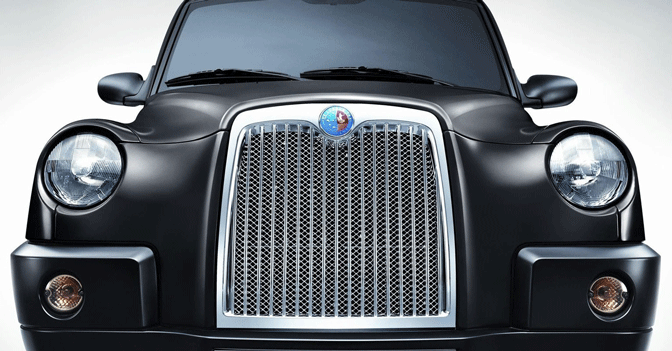
 Wealthy oil baron Nubar Gulbenkian had a luxurious taxi conversion. He told friends “Apparently it can turn on a sixpence, whatever that is”
 St. Paul’s Cathedral at 365ft high and over 40 years to construct. It took so long to complete its builders had the reputation of being lazy
 The only qualification needed to join Edmund Kean’s Wolf Club at the Coal Hole, Strand was your wife had forbidden you to sing in the bath
 CabbieBlog