

The iconic Knowledge of London (KoL), a comprehensive test for taxi drivers to master the city’s streets, has evolved significantly over the decades. But has the KoL become harder or easier to complete?
With London’s expansion, the challenge of learning its intricate road network has intensified. Complex one-way systems like Covent Garden, and the introduction of Low Traffic Neighbourhoods (LTNs), have significantly altered and elongated the routes.
London’s growth in recent decades has led to more restaurants, businesses, and landmarks packed into towering buildings and densely developed areas, utilising every square inch of the capital like never before.
It could be argued that these changes demand a deeper understanding and recollection of routes for taxi drivers undergoing the KoL examinations.
New areas and communities that did not exist for some cabbies whilst learning the capital decades ago. Canary Wharf was unheard of and the area was once disused docks, but now that has transformed into a sprawling network of towers on the Isle of Dogs, demanding closer attention on the Knowledge.
The Blue Book runs are seen as the foundational element when learning the Knowledge. These runs cover essential big road routes and areas in London, although students today have fewer routes to learn by rote. However, the learning does not stop at these runs, they are just a framework to build upon.
Learning includes additional routes like the ‘missing pieces’, one-way systems, livery runs for The City and turnaround books, which detail smaller roads. There’s also the ‘livery runs’ which help cabbies better understand and recite the City, there are books covering runs spanning the entire radius learned within the Knowledge, such as from Crystal Palace to Alexandra Palace.
Critically, despite all these changes over decades, the standard for passing the Knowledge has remained consistent at 30 per cent.
While the fundamental standards of the KoL have stayed the same, the testing criteria over the years have changed.
I was listening to a recent podcast between WizAnn’s Dean Warrington and the United Cabbies Group’s (UCG) Trevor Merralls, as the current standards were discussed at great length.
Interestingly from the Knowledge school’s perspective, the perceived height of difficulty was between the 1990’s and the 2000’s, the very time that Dean and I were undertaking KoL.
Students at that stage were learning more obscure points: blue plaques, door nameplates and obscure statuary.
Dean Warrington with his innovative KoL course estimated that students can now get through the KoL knowing roughly 6,000 places of interest, which are the most frequently asked questions, on top of the capital’s road network.
Is the Knowledge easier now?
No.
Is the Knowledge harder now?
No.
The required standard remains.
How students get to that standard more efficiently is likely to become the central discussion point moving forward, especially as the industry awaits Transport for London’s KoL review findings to be published soon.
Taken from an original article by Perry Richardson on TaxiPoint.



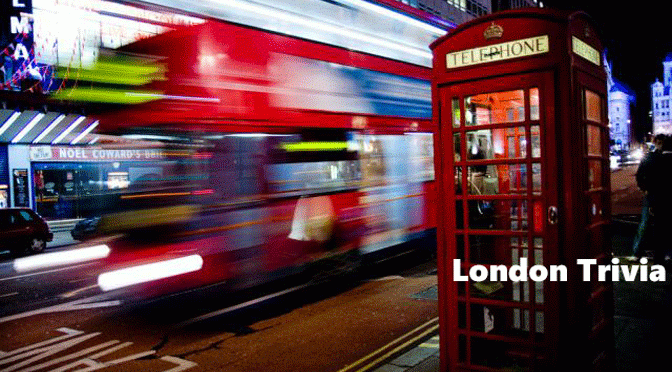
 On 18 February 1901 Winston Churchill made his maiden speech in The House of Commons, justifying the burning of Boer farms
 In the 16th century, a London law forbade wife beating after 9:00pm, but only because the noise disturbed people’s sleep
 The settled road surface of Charterhouse Square, laid down in the 1860s has been given Grade II listed status by English Heritage
 Playwright Ben Jonson couldn’t afford normal burial in Westminster Abbey determined by plot size was buried upright standing for an eternity
 During the outbreak of World War II London Zoo killed all their venomous animals in case the zoo was bombed and the animals escaped
 The Reform Club in Pall Mall is the fictional start to Jules Verne’s book Around The World In Eighty Days later made into a film
 London has the oldest bicycle shop in the world (Pearsons of Sutton, established as a blacksmiths in 1860), and the second oldest cycle track in the world, Herne Hill, opened in 1891
 Twickenham and Harlequins home Twickenham Stoop are a mere 700 yards apart, nowhere in London are two such high profile stadiums in such close proximity
 The first crash on the Tube occurred in 1938 when two trains collided between Waterloo and Charing Cross, injuring 12 passengers
 Gropecunt Lane once ran north from Cheapside so called as it was a famous haunt of prostitutes it was renamed by kllljoys in the Reformation
 On 18 February 1888 the very first Salvation Army hostel was opened by General William Booth at 21 West India Dock Road


 CabbieBlog