

For those new to CabbieBlog or readers who are slightly forgetful, on Saturdays I’m republishing posts, many going back over a decade. Some will still be very relevant while others have become dated over time. Just think of this post as your weekend paper supplement.
Avoid idleness and intemperance (22.04.11)
In 1837 a young woman found herself the monarch of her country, she was to remain Queen during an unprecedented time of burgeoning industry and wealth creation, giving her name to the 64 years she reigned and a time Britain was at its zenith of influence and power.
That same year a novel was printed which would change a country’s attitude to the poorest and venerable, that novel was the second major work to be published by Charles Dickens.
Charles Dickens was no stranger to poverty. In 1823 when his father lost his job and was sent to Marshalsea debtor’s prison 11-year-old Charles worked in a blacking factory pasting labels on shoe polish bottled for six shillings a week. At that time he also certainly worked alongside children from the workhouse, it was an experience that would remain with him all his life and be the subject of his novel Oliver Twist.
In 1834 a Poor Law was enacted, with the sole purpose of discouraging claiming relief in times of poverty and forcing individuals to take work offered to them however low the pay. Welfare assistance was only available inside the workhouse, once admitted the unfortunate inmates would be deloused and forced to wear uniforms, families were broken up and if individuals were capable of working they would be sent to labour for unscrupulous employers. The very young, ill or old who were unable to produce an income were in most cases refused admission to the workhouse and starved to death.
In a fascinating piece of research, Dr Ruth Richardson has established the source material for Oliver Twist which tells the story of the illegitimate orphan Oliver who endures a miserable time at the workhouse and during his parish apprenticeship with an undertaker, before running away and being taken in by a gang of juvenile pickpockets.
It was known that Charles Dickens lived in a certain Norfolk Street twice in his early life for a period of four years. Dr Richardson has established that Norfolk Street once was the southern continuation of Cleveland Street which exists today and that Dickens lived only nine doors away from the Cleveland Street workhouse ending years of speculation by historians to the exact location of Dickens’s childhood home.
Cleveland Street Workhouse was constructed in about 1780 on what at that time was a burial ground. Starting life as the parish workhouse for St. Paul’s, Covent Garden in 1836 it functioned as an infirmary, maternity unit, insane asylum or a place to deposit those suffering from highly contagious diseases.
Even by workhouse standards 44 Cleveland Street was dreadful, a contemporary account by Dr Joseph Rogers the chief medical officer at the workhouse from 1856-68, reported: a laundry in the basement filling the dining hall with foul-smelling steam; carpets regularly beaten directly outside the men’s infirmary; the nursery both damp and overcrowded; “nursing” provided only by elderly female inmates, many of whom were apparently habitually drunk; the brutal indifference of the Guardians of the workhouse; the “dead house” adjoins the main structure. This led him to campaign for better standards in the medical care available to workhouse inhabitants.
After the Poor Law was reformed the Cleveland Street Workhouse passed first into the control of the Central London Sick Asylums District, then to the Middlesex Hospital and thence to the University College London Hospital complex. Closing in 2006 when UCLH moved all their services onto a single unified site.
The building is believed to be London’s only existing purpose-built Georgian workhouse, a rare example of social engineering from the 19th century; now after a five-year-long campaign the most famous workhouse in the world has been saved thanks to its Grade II listing.
Without it would Charles Dickens have written so passionately his most successful novel and then spent a lifetime campaigning for better welfare to be given to the poor? Now 44 Cleveland Street has been given a Heritage listing we have an opportunity to convert this rare Georgian building into flats whilst keeping its integrity, and use some of that income to provide a teaching and resource centre at the very heart of social and welfare reform that has benefitted us all today.
In an echo of Dachau with its sign “arbeit macht frei” (works brings freedom), above the gates of the Cleveland Street Workhouse was a statute of an old man pointing to the words: “Avoid idleness and intemperance”, as with Dachau, 22 Cleveland Street’s importance to our lives should not be forgotten.



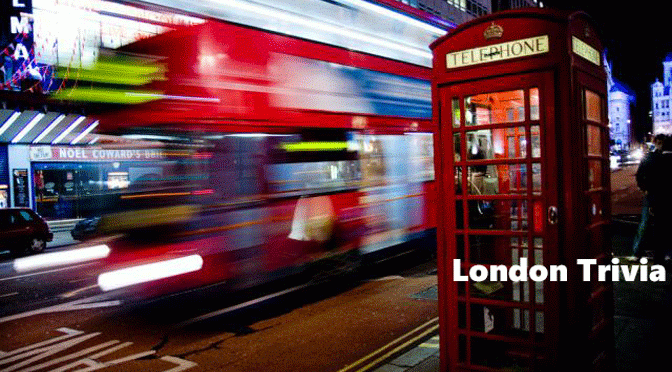
 On 19 May 1649 the Rump Parliament passed an Act to turn England into a Republic, it lasted 11 years before we regained our senses
 In 1678 the body of Sir Edmund Berry Godfrey was found on Greenberry Hill later three were hanged for the murder their names Green, Berry, Hill
 The 19 May is St Dunstan’s Day celebrating the Benedictine Bishop of London who granted a charter authorising the building of Westminster Abbey
 Britain’s first fatal car crash took place on Grove Hill, Harrow. Today a plaque on the spot warns drivers to take heed
 On 19 May 1536 Anne Boleyn, second wife oe Henry VIII, was beheaded at the Tower of London for alleged adultery
 Douglas Adams based characters of Hitchhiker’s Guide to the Universe on Islington where he lived, Hotblack Desiato was an estate agent
 The Apollo 11 crew’s first alcoholic drink back on Earth was the Moonwalk, invented by Joe Gilmore of London’s Savoy hotel
 On 19 May 2007 The new Wembley Stadium ‘officially’ opened for the FA Cup Final between Chelsea and Manchester United (1-0)
 Demonstrating a new crossing in Camden aimed at reducing pedestrian road deaths Transport Minister Hore-Belisha was nearly knocked down
 Many of the streets in the city were named after the particular trade which practiced there, for example Threadneedle Street was the tailor’s district
 When John Noakes climbed Nelson’s Column (removing pigeon poo) for TV’s Blue Peter a sound engineer didn’t record the stunt, Noakes had to reclimb all over again
 CabbieBlog