
Oh, I love London Society! I think it has immensely improved. It is entirely composed now of beautiful idiots and brilliant lunatics. Just what Society should be.

Oscar Wilde (1854-1900), An Ideal Husband

Oh, I love London Society! I think it has immensely improved. It is entirely composed now of beautiful idiots and brilliant lunatics. Just what Society should be.
Oscar Wilde (1854-1900), An Ideal Husband
On 26 April 1908, the windscreen wiper was invented by a Newcastle United fan driving home from London in a blizzard. Gladstone Adams was driving home after seeing his team lose the FA Cup Final to Wolves. His journey was punctuated by repeated stops to clear snow from the windscreen. Adams vowed that when he got back home he’d do something to solve the problem. And so he did.
 On 26 April 1921 the first motorcycle police patrols went on duty on the streets of London, it’s not recorded how many speeding offences were booked that day
 When Scotland Yard’s foundations were being built the headless torso of a woman was found, the murderer was never caught
 Crutched Friars, Tower Hill takes it’s name from Fratres Cruciferi a Roman Catholic religious order that settled in the street in 1249
 St. Bartholomew’s Hospital is the oldest hospital in London having been founded in 1123 by a monk named Rahere
 The first Lord Mayor of London (who is an officer of The City of London) was Henry Fitz-Ailwin de Londonestone who held the position in 1189
 At Guildhall’s Art Gallery the eastern entrance of a Roman amphitheatre can be viewed underneath the artworks
 Princess Elizabeth (before becoming Queen) was first seen with Philip Mountbatten in public at the recently re-opened Savoy Hotel in 1946
 A tennis ball was discovered in 1922 in the rafters of Westminster Hall dating from before 1520 it was stuffed with dog hair
 The Ryde to Shanklin train line on the Isle of Wight uses for its rolling stock 70-year-old London Tube trains from the Northern Line
 Performed at 10 pm for 700 years The Tower of London’s The Ceremony of the Keys is the world’s oldest surviving continuous military ceremony
 Over 25 per cent of all people living in London were born in another country and more languages are spoken than any city in the world
 Trivial Matter: London in 140 characters is taken from the daily Twitter feed @cabbieblog.
A guide to the symbols used here and source material can be found on the Trivial Matter page.
What is the connection between these numbers?
2 and 4 at the same time, then 3; 3574; C395ZY; 2088; and 1975
Here’s a clue: The numbers are all useful in the Tottenham Court Road area should you have an urgent need to use them.
When as a cab driver of advancing years, much of my thinking time was taken up looking for these facilities which these numbers allow access.
A young pressure group have produced an essential Twitter feed, and considering their needs would be far less urgent than we septuagenarians, they should be applauded.
Apparently, any establishment with an alcohol licence is mandatorily required to allow anyone to use their toilets, and offer a glass of water, isn’t stipulated in what order. This stipulation, of course, is never complied with.
How many times have you gone into an establishment to find a sign reading “For patrons use only”, or my favourite “Out of order, awaiting Plummer”, and if that is the case, just how to their employees take a comfort break or maybe they are not allowed to take a break during their working hours.
@LDNloocodes with nearly 7,000 followers aim to give everyone who gets caught short a selection of entry codes to the local toilets.
The five locations and their codes are:
Change Please, above the Halifax Bank, corner of Tottenham Court Road; Pret, New Oxford Street; Waterstone’s, Tottenham Court Road; Pret, Centre Point; Five Guys, next door to the Dominion, Tottenham Court Road.
With the rush to go electric, the AA has warned that the National Grid will have trouble coping with the demand of the electric cabs ‘plug- in’. A report by the National Grid concluded that another 30 gigawatts would be needed to power all future electric vehicles. That’s almost 10 times the total power output of nuclear power station Hinckley Point C now under construction after decades of debate regarding the advisability having it built.
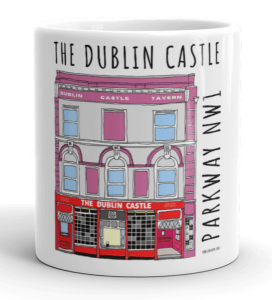
In these straitened times, my cabbie colleagues cannot rely solely on their traditional income. One who has several strings to his bow is Robert Lordan. Not only has he a degree in English, passed The Knowledge, is a qualified tour guide, and an author, he also is an amateur artist (see featured image). Putting the last to use he has produced several London themed mugs.
These four mugs are available from Robs London.

James Bond’s nemesis Goldfinger was named after architect Ernõ Goldfinger who was synonymous with designing Brutalist London tower blocks. Three have been given Grade II listing: Alexander Fleming House at the Elephant and Castle renamed Metro Central; Balfron Tower near the northern entrance to the Blackwall Tunnel; and Trellick Tower in north Kensington.
Although many residents of his soulless post-war developments might have cause to dislike the man; or a disgruntled employee, some of which could not tolerate his flamboyant bullying nature – he had been known for sacking his assistant if they were inappropriately jocular; or even the odd miffed client who was frog-marched out of his office after disagreeing with his proposals; of all people, it was Ian Fleming the author of James Bond who clashed with him after writing his latest blockbuster novel.
You can bet Fleming never lived in a high-rise flat designed by Goldfinger, nor was he an employee. The encounter was to be more prosaic.
In the 1950s, Ian Fleming’s regular golfing partner was a businessman called John Blackwell. One day, at the St George’s Golf Club in Sandwich, Blackwell mentioned that his cousin’s husband was the architect Ernö Goldfinger. Fleming liked the name ‘Goldfinger’ and thought he might be able to use it: he was always on the look-out for new or unusual names and had given several of his previous characters the names of real people and in fact, in the final text of Goldfinger he used John Blackwell’s name (he was related to the Cross & Blackwell family) for a minor character.
Ian Fleming had also been an objector to Ernõ Goldfinger’s proposal to build a home at 2 Willow Road and probably delighted in creating Auric Goldfinger a 5ft imperious megalomaniac. When Ernõ Goldfinger’s business associate Jacob Blacker was asked for his opinion on the similarity between the fictional Goldfinger and his partner, he could only find one substantial difference “You’ve called Ernõ and he’s called Auric”.
Goldfinger threatened to sue, Fleming in a clash of egos was livid. He asked Cape, the publishers to insert an erratum slip in the first edition changing the character’s name to ‘Goldprick’. Lucky for Shirley Bassey – who sang the title song in the film – Cape demurred.
Common sense prevailed and Cape agreed to call the villain Auric Goldfinger throughout the book and insert the standard disclaimer at the front stating that all characters were fictional. They also paid all Ernõ Goldfinger’s legal costs.
However, Ian Fleming was to have the last laugh. When the film was released starring Sean Connery wags would ring 2 Willow Road singing the title song or worst would intone in a Scottish accent: “Goldfinger? Thish ish Dobble Oh Sheven”.

On 2 April 1884 Marshalsea Prison the last of the London debtor’s prisons closed. A parliamentary committee reported in 1729 that 300 inmates had starved to death within three months. The prison became known around the world through the writings of Charles Dickens, whose father was sent there in 1824 for a debt to a baker. Dickens was forced to leave school at the age of twelve for a job in a blacking factory to help keep his family at the Marshalsea.
The men who constructed the rail network radiating out of London were called navvies from the ‘navigators’ who built the first navigation canals.
Tramping from job to job, navvies lived without adequate housing or sanitation and worked in appalling conditions.
After a difficult and dangerous day, if they had avoided injury, cholera or typhoid their evening were spent together boozing and gambling with the inevitable fist-fight, which on some occasions necessitated the army being sent in the break-up the combatants.
An urban myth, which alas has been proved to be incorrect, has it that bitterly divided along nationalistic and sectarian lines navvy interlopers in a pub would be summarily dealt with. As the London-Birmingham railway line was being constructed in the north of the capital, ever anxious to attract customers while keeping trouble at bay four pubs located in today’s Camden Town, were named after castles located in each part of Britain. The Edinboro’ Castle, The Pembroke Castle, The Windsor Castle and The Dublin Castle, each worker would, therefore, know he was welcome and could drink with his fellow countrymen. As the pubs were built at different times and the navvies had a plethora of boozers in Camden to slake their thirst, they probably mingled with each other with the inevitable results.

Green Cab Shelters have been providing shelter and sustenance to cabbies for over 140 years.
Apart from banning political discussion, the rules governing the use of shelters were once as follows: