Previously Posted: I don’t Adam and Eve it

For those new to CabbieBlog or readers who are slightly forgetful, on Saturdays I’m republishing posts, many going back over a decade. Some will still be very relevant while others have become dated over time. Just think of this post as your weekend paper supplement.

I don’t Adam and Eve it (06.08.2010)

The Oxford English Dictionary claims that the first use of the word cockney as a reference to native Londoners was in 1521, and since I did The Knowledge I’ve been telling anyone who cares to listen that I’m a cockney, blithely ignoring the fact that I was brought up in a leafy North London suburb.

For to be a cockney you have to have been born within the sound of Bow Bells, and contrary to the widely held belief the bells in question are not from Bow Church in East London, but St Mary-le-Bow on Cheapside in the City of London. Being born in Fitzrovia, I thought, erroneously, I easily came within its audible catchment area.

A church has existed on the site since Saxon times, and the subsequent Norman church was known as St Marie de Arcubus or Le Bow because of the bow arches of stone in its Norman crypt. The current building was built to the designs of Christopher Wren, 1671–1673, with the 223-foot steeple completed 1680. It was considered the second most important church in the City of London after St Paul’s Cathedral, and was one of the first churches to be rebuilt by Wren for this reason.

On 10 May 1941 a German bomb destroyed the Wren church including its bells made famous in the children’s nursery rhyme Oranges and Lemons.

Restoration was begun in 1956 and the bells only rang again in 1961 to produce a new generation of cockneys, a full 14 years after my birth.

Now according to research at Lancaster University a cockney accent will soon no longer be the hallmark of Londoners. The distinctive accent now known as Estuary Speak is more likely to be found in the Home Counties of Essex and Hertfordshire. The linguists claim that ever-increasing numbers of people in the capital are speaking Jafaican. The hybrid speech, created by successive waves of immigration is a mixture of cockney, combined with Bangladeshi, African and West Indian.

The London dialect could have disappeared within another generation and cockneys in their 40s will be the last generation to speak like stars from BBC soap. Now the dwindling ranks of cockney speakers are being asked to record their voices for posterity.

But hope is at hand, the newly built Kings Place Arts Centre near King’s Cross has posted a downloadable recording of Bow Bells on its website so that cockneys that have moved away can still let their children be born within the sound of its famous chimes..

August’s monthly musings

🚓 What Cab News

For 14 years I’ve been posting a daily piece of trivia on Twitter – sorry now X under @cabbieblog. Well, the 1st August’s: ‘The London Cab Trade is the oldest regulated land passenger service in Britain licensed in 1654 – 150 years before the horse-drawn bus #LDNTrivia’ managed, at the time of writing, to garner 3,369 views; 44 likes; 18 retweets, sorry reposts; and 4 comments. Possibly a record for this scribe.

🎧 What I’m Listening

We’re four days from Ulez and I’ve been listening to LBC’s Nick Ferrari. I know each presenter has a political bias, with an audience of like-minded listeners. It has to be said that Sadiq Khan isn’t the flavour of the month with this broadcaster, but I’ve yet to hear a caller agreeing with Ulez – or Khan.

📖 What I’m Reading

I’m now on book three of Christopher Fowler’s Bryant and May books: Seventy-Seven Clocks: It’s late in 1973, strikes and blackouts ravaged the country during Edward Heath’s ‘Winter of Discontent’, and sundry members of a wealthy, aristocratic family are being disposed of in a variety of grotesque ways – by a reptile, by a bomb and by a haircut. Bryant & May, the irascible detectives of London’s controversial Peculiar Crimes Unit have little time to catch the culprit.

📺 What I’m watching

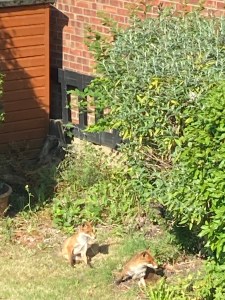
Our new neighbours have rewilded their garden (that’s a euphemism), and as a consequence of the overgrown vegetation a pair of foxes have taken up residence. It’s great to watch them every day.

❓ What else

Within hours of August’s start my wife received: ‘It broke fell and broke mum im so stressed out i dont know what to do i need your help x’. These spam merchants really need to improve their grammar.

📆 What date?

One hundred and fifty years ago on 23rd August 1873, the Albert Bridge opened. A toll bridge meant even pedestrians had to pay to cross. The toll houses, two at each end, remain, as does the notice to tell soldiers to break step.

Rough sleeping

When I started The Knowledge I was shocked to see so many rough sleepers in shop doorways. Now a cross-party group of London Councils report that nearly 170,000 people in London are homeless, i.e. they’re living in hostels, bedsits, or other temporary accommodation. That’s an increase of about 17,000 from last year and means that one in 50 people in the city are now classed as homeless. Most depressingly, “the organisation estimates that this includes more than 83,000 children”.

Johnson’s London Dictionary: Pie and Mash

PIE AND MASH (n.) Traditional East London delicacy topped by a green liquid described as liquor despite the absence of alcohol.

Dr. Johnson’s London Dictionary for publick consumption in the twenty-first century avail yourself on Twitter @JohnsonsLondon

London’s first photo

This is thought to be the earliest surviving photograph of London. It was taken in 1839 by Monsieur de St. Croixin, a Frenchman who had set up his camera behind the statue of King Charles I. The featured image is from approximately the same position nearly 200 years later.

M. Croixin’s choice of location brings us to the vexing question of just where is London’s centre. It is a quandary that has perplexed geographers, cartographers and general town-planning nerds for generations. In the strictest geographical sense, it should be where lines intersect between the four furthermost locations which would, surprisingly, make the Shell Centre buildings on the Thames riverside just outside Waterloo Station London’s actual epicentre.

The official point, according to The Carriage Office, which is the arbitrary starting point for The Knowledge is the King Charles I Statue in Trafalgar Square, the very spot chosen by the photographer.

In 1649 John Rivett, a brazier, was ordered to destroy the King’s statue by Cromwell, but he buried it in his garden and made a fortune by selling souvenirs allegedly from the metal. He gave it back to Charles II upon the Restoration of the Monarchy, and presumably, he was rewarded for his loyalty.

The image shows the statue behind railings (presumably to protect it from Republicans), these have since been removed and the surrounding pavement turned into a mini-roundabout.

A ghostly form of a Hansom cab driver (the vehicles had only appeared on London’s streets some five years earlier) is seen on the right, waiting outside what is now the Trafalgar Theatre. Was this cabbie the first Londoner ever to be photographed?