
Tag Archives: Telephone boxes
Protected: The world’s most famous telephone
Ringing the changes
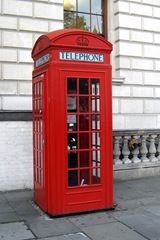
Atraditional red phone box is to be auctioned tomorrow with a guide price of £45,000. The K2 Kiosk is located at the west end of Austin Friars on its junction with Cophall Avenue and Throgmorton Avenue. It is outside the offices of BlackRock who once had George Osborne as a director, as his colleague David Cameron bought a shepherd’s hut to write his memoirs, George might require its nine square feet.
Between 1926 and 1935 1,700 examples of the K2 were installed with the total number of surviving K2 kiosks being only about 224 in the UK.
In addition to this one, there are four more in Central London, all expected to go for around £40,000 – £45,000.
As iconic as my black cab, the K2 telephone boxes have since 1936 been an intrinsic part of London’s urban landscape. But who actually uses telephone boxes these days or even notices them? With almost universal mobile phone ownership, you could say that red telephone boxes are hidden in plain sight. Their original function has been overtaken by several uses its designer couldn’t have imagined possible.
Their use as a rather well-designed notice booth for call-girls (or boys) is now falling by the wayside as they find more effective ways of advertising their services and using it as a public urinal has its limitations, not least that its cramped compartment renders the user in danger of watering their shoes.
With brilliant originality they named it K2 for Kiosk No. 2, it was, of course, preceded by K1 which was constructed in concrete. The new design – this time in cast iron – by Sir Giles Gilbert Scott had won a Post Office competition three years earlier and started a whole series of similar-looking telephone boxes.
Its distinctive domed roof and all-over red make it the prototype of the classic K6, which was introduced nearly ten years later. Ventilation was provided via the crown in the roof section – it was made up of small, round holes!
Legend has it that the dome was Scott’s homage to the 18th Century architect Sir John Soane, R.A. (1753-1837) whose family tomb is surmounted by a very similar feature. Unlike the tops of modern British phone booths, Scott’s Soanian dome is a proper roof, dealing effectively with rain and litter while also being aesthetically pleasing.
But what makes K2 special is that it was mostly restricted to the London area and considerably bigger than its successors.
In London kiosks positioned by tourist locations have survived BT’s desire to replace them with utility ‘shower cabinets’ and stand as an iconic feature of London, for many kiosks, their purpose now would seem only to be as a photo opportunity for visitors and Japanese girls modelling bridal wear.
Many entrepreneurs have found a new use for these beautiful structures, and for the remaining unsold kiosks, the London Tourist Board should come to an arrangement with BT to pay for their maintenance and cleaning, covered in grime they’re a disgrace.
I am indebted to wallyg at Flickr for permission to use his photo of K2; his pages contain a wealth of images and background information on London.

Red and Dead
The old red telephone box is an icon of Britain from days gone by, used nowadays only by tourists and Japanese girls modelling bridal wear. They were very popular if only because they were the only method we had to have a distance conversation but believe me, I can recall the time when most households in Britain never had a phone anyway.
Is There Anybody There?
One of my earliest memories is standing in a kiosk in a cold Saturday night, trying to persuade a doctor to come and look at my infant son who had a high fever.
Numbers Game
It wasn’t all numbers back in those days either. Phones were given acronyms depending on where they were. So if you lived in Barnet, that town came under a series of districts. The first three letters would make up part of the phone number, so you would call BAR 123456. That’s why the dial had letters as well as numbers.
Morse is your Man
Decades before digital, the telephone system had a rotary dial which interrupted the line current repeatedly, very briefly disconnecting the line 1 to 10 times for each digit. When the receiver was placed on the cradle a bar at its base disconnected the current until the receiver was again lifted by a new caller.
Kids these days don’t know the half of it, said with a big smile on my face. Lifting the receiver and emulating the wireless operator on the Titanic by tapping the bar would mimic the dial turning, so to phone my friend for free on Enterprise 5041 all that was needed was to quickly depress the bar in a series of bursts, each corresponding to the numbers on the dial.
It all sounds a million miles from today’s technology with Zoom, Facebook Messenger, Skype and with mobile phone contracts costing up to £93 a month.
Button A or Button B
Assuming you actually were prepared to pay for your call, then you had two large silver pushbuttons, namely, Button A and Button B. You put four copper pennies (some showing Queen Victoria in her prime) in the slot and when someone answered your call, you pushed Button A. If they didn’t answer, you pushed Button B and you would get your money back.
Then there were the pips. Your hard-earned four coins would last maybe two minutes if you made a local call or one minute if it was a long-distance call. Upon hearing the pips you had seconds to fumble about finding coins before you were cut off. If you are under 40 I hope you are keeping up!
K6 is King
Now everyone in the world owns a mobile phone, making the famous K6 phone box redundant. There are even subsistence farmers in Africa sharing a mobile so they can know when to sell their crop to get the best price.
Some towns and villages have kept their red telephone boxes and turned them into libraries or for storing defibrillators for emergencies, the majority of phone boxes though have been sent to a scrapyard in West Yorkshire where the general public can buy them.
Expensive shed or very small office
Purchasing one of these icons is expensive, anywhere between £1,500 and £2,500, but it’s good to see recycling rather than scrapping.
And on that note – and bear with me on this – I return to London. William Stanhope, 1st Earl of Harrington built Harrington House in Craig’s Court in 1702 hoping he would be adjacent to Whitehall Palace once the palace had been rebuilt after a disastrous fire. Unfortunately, Whitehall Palace was never reconstructed. The royals migrated westward, depriving Stanhope of the opportunity to call the monarch his neighbour and rendering his grand home an isolated white elephant (although the family remained there until 1917).
Today, the 18th-century building houses a telephone exchange and allegedly harbours an entrance shaft to a large, top-secret government bunker dubbed ‘Q Whitehall‘. Now I wonder whether I am on their watch list for defrauding the General Post Office, BT’s predecessor?
Featured image: Antoine Motte dit Falisse (CC-BY-SA 3.0)
 CabbieBlog