Restore Trust

We have held a family National Trust membership for over 40 years. We want to support and enjoy the historic and modern houses, estates, and gardens, and to help purchase land for the Neptune Coastline Campaign which has protected 780 miles of our coast to date.

The first signs we noticed of a profound change in the Trust, was whilst holidaying in Jersey, a couple told us they were asked to leave after 10 years of volunteering after refusing to wear badges promoting a liberal political view of which they disagreed.

Since then the Trust has accelerated this egregious wokery, lecturing us on the evils of the colonialism which enabled the Trust’s properties to be built, trying to make the charity more ‘inclusive’, when anyone with an interest can join, and now they’ve produced a calendar excluding Christian festivals whilst including the Hindu festival of Diwali, Islam’s Eid and Ramadan. What next, leaflets in the tearoom explaining how white middle-class it is to eat scones?

Johnson’s London Dictionary: Fortnum and Masons

FORTNUM AND MASONS (n.) Ancient purveyor of vittles to the wealthy and creator of the hard-boiled egg in sausage meat, coated in fried breadcrumbs which hath as a London-based purveyor for reasons unknown doth name it ‘Scotch egg’.

Dr. Johnson’s London Dictionary for publick consumption in the twenty-first century avail yourself on Twitter @JohnsonsLondon

The London Grill: Metro Girl

We challenge our contributors to reply to ten devilishly probing questions about their London and we don’t take “Sorry Gov” for an answer. Everyone sitting in the hot seat they will face the same questions ranging from their favourite way to spend a day out in the capital to their most hated building on London’s skyline to find out what Londoners think about their city. The questions are the same but the answers vary wildly.

I am a London blogger and former journalist – now working in comms. First generation ‘Sarf’ Londoner born to Irish parents. I have fond memories of hanging out on the South Bank as a child in the ’80s when there was nothing much except booksellers and ‘Cardboard City’ and spotting weird-looking ‘dinosaurs’ in Crystal Palace Park (every Londoner should visit at least once!). These days, I love cocktail bars, street art, galleries, museums, photography and history. I launched Memoirs of a Metro Girl, my London culture and history blog in 2012, but my blogging productivity (and leisure time) has taken a hit thanks to parenting a toddler and renovating our flat in the past 2 years.

What’s your secret London tip?

Somerset House runs a historical highlights tour where you get to see inside some of the building’s spaces usually off limits to the public, like the ‘deadhouse’ underneath the courtyard and the Miles staircase.

What’s your secret London place?

Bonnington Square in Vauxhall is a special neighbourhood. A square of Victorian terraces built for railway workers, it has two community gardens, a deli café and a friendly vibe. It has a fascinating history, having escaped demolition and was rescued by squatters in the 1980s, who eventually set up a cooperative and bought the houses from the council.

What’s your biggest gripe about London?

The housing market is depressing. There are many reasons why, but I think short-term holiday-letting sites like AirBnB should be restricted. There’s a shortage of rental properties and so many properties are being let for high rates to tourists instead. So many Londoners can’t afford to live in their own city and for those fortunate enough to buy, are having to move further and further out. The thought of potentially being priced out of London one day fills me with dread.

What’s your favourite building?

St. Pancras station and the adjoining Renaissance Hotel. Stunning inside and out. Can’t resist the starry grand staircase and the clock tower.

What’s your most hated building?

Architecturally, the Walkie-Talkie (despite enjoying the view from inside). It’s too top-heavy and completely ruins the view of the London skyline from Shad Thames looking through Tower Bridge.

What’s the best view in London?

The top of Gipsy Hill has a great view of St Paul’s and the City skyline.

What’s your personal London landmark?

Dulwich Picture Gallery. It’s a lovely building designed by Sir John Soane and was the first public art gallery in London. They have great exhibitions, as well as their permanent collection and I love the gift shop.

What’s London’s best film, book or documentary?

The best documentary was The Secret History of Our Streets on BBC in 2012. The best book (this is a hard one as there are so many!) is Lost London by Philip Davies, full of photos of London buildings which no longer exist.

What’s your favourite restaurant?

SushiSamba in the Salesforce (aka Heron) Tower. Bit pricey, but worth it for the views, the cocktails and the fusion menu are pretty special.

How would you spend your ideal day off in London?

I would start the morning off with a fry-up in a proper neighbourhood café, head to the river, the City or Spitalfields with my camera to get some photos before the crowds arrive, lunch at a street food market like Vinegar Yard or Borough Market, afternoon at a Tate or V&A exhibition, then dinner at SushiSamba followed by late-night cocktails at one of my favourite bars (admittedly 3 meals out, cocktails and an exhibition would be an expensive day!).

London in Quotations: Anna Quindlen

It is the glory of London that it is always ending and beginning anew, and that a visitor, with a good eye and indefatigable feet, will find in her travels all the Londons she has ever met in the pages of books, one atop the other, like the strata of the Earth.

Anna Quindlen (b.1953), Imagined London: A Tour of the World’s Greatest Fictional City

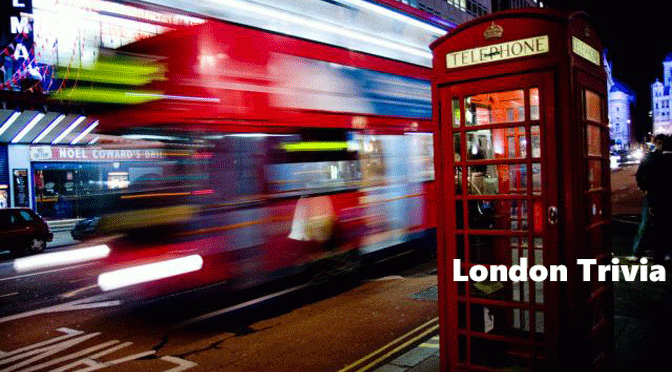
London Trivia: Pigs can fly

On 3 December 1976 London witnessed proof that pigs really can fly when Algie, a inflatable pig, broke free from his moorings near Battersea Power Station. Algie was being photographed for a forthcoming Pink Floyd Animals album cover. Curiously being near the flight path the Civil Aviation Authority issued a warning that a flying pig had been set loose, the ensuring publicity didn’t do any harm either for Pink Floyd.

On 3 December 1976 an estimated 3 million people applied for the 11,000 available tickets for Abba’s Albert Hall concerts

During the Jack the Ripper investigation the police paid £100 for two tracker bloodhounds but they got lost and needed the police to find them

Bevis Marks Synagogue in the City of London, is the only European synagogue which has held regular services continuously for over 300 years

In 1829 with London running out of space to bury its dead architect Thomas Wilson proposed a 94 storey pyramid on Primrose Hill to house 5 million corpses

The last execution to take place at the Tower of London was that of German spy Josef Jacobs, shot by firing squad in 1942

In 1747 William Hogarth painted ‘The Stage Coach’ at the former Angel Inn, 1 Islington High Street, rebuilt and now occupied by Co-op Bank

Soho is named after a medeival hunting cry (‘So-Ho’). No unlike Tally-Ho today. Until the late seventeeth century the area was open fields

Charlton means ‘homestead belonging to the churls’. Churls were the lowest rank of freeman during medieval times

In 1878 over 640 died when the crowded pleasure boat Princess Alice collided with the Bywell Castle in the River Thames

John Spilsbury invented the world’s first jigsaw puzzle at his print shop in Russell Court (near Street), Drury Lane, Covent Garden in 1766

Bow Street police light changed from blue to white as colour upset Queen Victoria when visiting Royal Opera House, Albert had died in Blue Room, Windsor

CabbieBlog-cab.gifTrivial Matter: London in 140 characters is taken from the daily Twitter feed @cabbieblog.
A guide to the symbols used here and source material can be found on the Trivial Matter page.

Taxi Talk Without Tipping