
LONDON TAXI (n.) Cockney slang for ‘jacksie’ doth which in turn is slang for buttocks, an appropriate term one might say.
Dr. Johnson’s London Dictionary for publick consumption in the twenty-first century avail yourself on Twitter @JohnsonsLondon

LONDON TAXI (n.) Cockney slang for ‘jacksie’ doth which in turn is slang for buttocks, an appropriate term one might say.
Dr. Johnson’s London Dictionary for publick consumption in the twenty-first century avail yourself on Twitter @JohnsonsLondon
We challenge our contributors to reply to ten devilishly probing questions about their London and we don’t take “Sorry Gov” for an answer. Everyone sitting in the hot seat they will face the same questions ranging from their favourite way to spend a day out in the capital to their most hated building on London’s skyline to find out what Londoners think about their city. The questions are the same but the answers vary wildly.
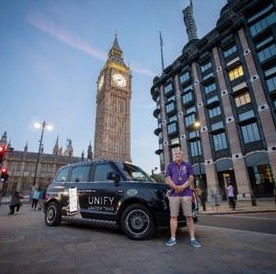
I was born in Lavender Hill South London in 1961. As a child, I had the good fortune of growing up on the streets of London slowly heading Southeast with my parents each time we moved home. Camberwell, New Cross, Deptford, Charlton & Woolwich. Yes, ladies and gentlemen, I am a Charlton Athletic fan. I met my wife in Charlton and as our own family grew (we were blessed with four beautiful children), we continued the migration southeast, Woolwich, New Eltham and recently a big step into the wilds of Kent, we moved to Gravesend. Pocahontas territory.
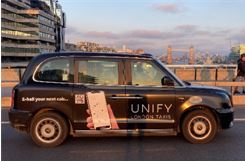
My wife (Barbara) and I started a company to raise money for charities close to the hearts of many. We decided to launch a ride-hailing app for London Taxis “UNIFY”, which is completely free of charge to drivers. Customers pay a regulated fixed £2 booking fee which we use to support our many charities. The customers pay the driver the metered fare. No surge pricing or hidden charges and our Taxis can’t cancel thus we ensure that once a ride is booked it will turn up. Sadly, my wife passed away with breast cancer just before we launched so she did not get to see her idea put into action. This app is now her legacy to all taxi drivers, and they need only sign up and register to become a part of this new style platform. No more exploitation of customers or drivers, and our profits go towards helping the communities in which we operate. You can find out more on our website www.unifylondon.com. Our company has reached the eyes and ears of people at the top and as such we received a “Point of Light Award” from the Prime Minister’s Office. Our company is going from strength to strength and no doubt you will see more of us in the coming months and years.
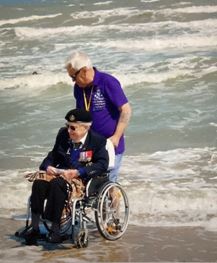 Picture of me taking Roy Smith, a veteran back to Sword beach because he always felt guilty about landing there in 1944 on D-Day and not getting his feet wet.
As a cabbie, I get to drive all over London visiting many of our beautiful landmarks on a regular basis. My tip for anyone visiting our streets, whether tourist or local, is to look up. The architecture on offer covers a range of historical times going back many Centuries and even a Millennium or two. So, if you find yourself on cobbled streets, remember to look up.
We have a long a varied history established as Londinium by the Romans 2,000 years ago and there are many sites dotted around reflecting this. But for me, it must be a monument to one of our greatest playwrights, renowned around the world for his craft and to this day still unmatched. Shakespeare’s Globe Theatre south of the river (where cabbies fear to tread) on Bankside. A must for any visitor to London.
Asking a Cabbie to gripe about London is going to bring forth a tirade of faults with the ever-changing road network. The current ethos of pedestrianisation, cycle routes & segregated lanes to reduce traffic and our reliance on the car, is causing total havoc on our streets. Restricted access and heavily congested roads are helping to contribute towards stagnating our once glorious city. We are now the slowest capital for traffic movement. People expect London Taxis to have full access to the road network as we are the only fully accessible form of public transport. Gripe over.
That really is a tough one to answer. I particularly like stained glass windows and there are many beautiful examples in our city. One that captured my soul was on an early Sunday morning at Westminster Abbey, the sun shining through the windows illuminating a colourful display of ancient artwork. There is truly something magical about stained glass.
As a child growing up in South London, I often had the pleasure of visiting Greenwich Park. The view from the top of the hill by the Royal Observatory was always a favourite then. Alas, one day someone built a monstrosity of a monument smack bang in the middle of the vista. Canary Wharf. A pointed brick monolith with zero character that had no place in our glorious city. Sadly, it was only the first of many that followed, and the London skyline has been developing upwards ever since.
This was easy to answer. Alexandra Palace of an evening in Springtime before the leaves are on the trees. The panoramic view over the city sweeping from east to west as the Sun settles down for the night. The lights all over the city start to come on, giving the viewer a show of London in its full majesty.
Two words, TOWER BRIDGE. It must be the most iconic image of the UK known all around the world. In truth, there is only one other iconic image that comes close to generating in our minds, this magnificent city, The London Black Cab.
There are hundreds to choose from in all these categories. For me an old film (1966) called Blow Up. This film captures images of the late 60’s and the explosion of the fashion industry. Some epic scenes as the Mystery Thriller unfolds. Plus, I grew up playing in the field where the murder in the film took place. No spoilers from me about the plot.
This may surprise you. BOROUGH MARKET. Here you can wander among stalls and shops which offer speciality foods from around the world. The cuisine is very much street food rather than fine dining, but being there among the hustle and bustle of life is a privilege.
For me, it’s a pleasure boat cruise along the lifeblood of our city, the River Thames. Starting at Westminster Pier, passing under the iconic Tower Bridge, Which looks even more spectacular from below, on our way to Greenwich. A stroll around the old Naval College, visiting the old sailing ship & tea cutter The Cutty Sark, The Maritime Museum, The Royal Observatory, or strolling among the stalls and shops in Greenwich Market. One day to do all this is not enough and as ever I always vow to return another day before returning back to Westminster as the evening draws in.

London? It’s a city full of sleepwalkers chasing other people’s dreams.

Steve Merrick (b.1965)
On 3 March 1943 the worst loss of life during World War II in a single event took place at Bethnal Green Station when a mother carrying a child was hurrying down the steps to shelter during an air raid. She fell and an elderly man tripped on top of her. In the panic 178 people died including the baby. News of the disaster was withheld for 36 hours. It was not until 50 years after the disaster that a discreet plaque was erected at the site.
 On 3 March 1982 the Queen opened the £153 million Barbican Centre, the largest arts centre in western Europe built on the site of Cripplegate, which was destroyed by Nazi bombers in World War II
 In 1809 audiences at the Covent Garden Theatre rioted for 60 nights when the management increased ticket prices
 Westminster Catholic Cathedral stands on the foundations of Tothill Fields Prison demolished in 1884. The prison’s foundations were re-used for the cathedral
 Writer and Garrick member AA Milne left part of his estate to the club, in 2001 the club sold its interest (incuding Winnie the Pooh) to Disney
 In 1972 William Whitelaw (Northern Ireland Secretary) secretly met Martin McGuiness and Gerry Adams at 96 Cheyne Walk, Chelsea
 It was at The Criterion Long Bar where Dr Watson first met Sherlock Holmes (in Colan Doyle’s – A Study in Scarlet)
 Author George Bernard Shaw once spent an evening dancing around Fitzroy Square after watching an Italian dancer at the Alhambra Theatre
 The highest temperature recorded at the London Marathon 21.7C degrees on 22 April 2007: coldest 13 years previously in 1994 at 7.6C degrees
 Approaching J15 on the M25 it has two six-lane carriageways, the widest stretch of motorway in the country, and yet it still gets jam-packed
 Alexander Graham Bell made Britain’s first telephone call from Brown’s Hotel in 1876, the hotel to this day honours Bell’s legacy with the Alexander Graham Bell Room, with its antique telephone
 In 1912 workmen found a chest buried on the corner of Cheapside and Friday Street, containing jewellery, gemstones, gold, rings and brooches
 Trivial Matter: London in 140 characters is taken from the daily Twitter feed @cabbieblog.
A guide to the symbols used here and source material can be found on the Trivial Matter page.
For those new to CabbieBlog or readers who are slightly forgetful, on Saturdays I’m republishing posts, many going back over a decade. Some will still be very relevant while others have become dated over time. Just think of this post as your weekend paper supplement.
Every day thousands rush past a hideous grill attached to an empty 1960’s building awaiting redevelopment not realising that behind the ironwork set into a niche is one of London’s oldest landmarks, known to have been in The City since 1198.
While on The Knowledge it took me some considerable time to track down the so-called lonenstan or London Stone, an unprepossessing piece of Clipston limestone or oolite. With its round-shouldered top and twin grooves, measuring about 18 inches across, if found in a field, one would ignore it.
The discovery of remains beneath Cannon Street Station led archaeologists to believe that a Roman Governor’s Palace once stood on the site. It is known that during the reign of Augustus, a central stone was placed in the Forum in Rome, this measured 8ft tall and was covered in bronze. The obelisk was used to mark the starting point for the measurement of Roman highways. When London became the capital of Britannia a similar point would have been needed. Could this be the top part of the golden milestone that was used to measure the straight Roman roads that radiate out from Londonium?
Edward III made London Stone the axis of London’s trade and granted rights to hold markets within a 7-mile radius and Jack Cade during the 1450 Kentish peasants’ revolt struck London Stone with his sword and declared himself Lord Mayor of London, he was subsequently killed and his head ended up on a pike adorning London Bridge.
London Stone has been the subject of various legends including that Brutus brought it here from Rome; the stone marks the site of Druidic sacrifices; that it sits on a Ley line connecting significant places and marks the mystical centre point of London or even the British Isles; that the stone one formed stone circle of King Lud (whence came Ludgate); and that the City’s prosperity depends on its safekeeping.
The London Stone is pure history, there are so many amazing stories and theories behind it, yet thousands of people walk past it every day not even realising there is anything there. This lump of ancient and mystical limestone must be the most the most unnoticed and unloved tourist attractions in the City of London – and all you have to do is search for it. To point you in the right direction follow this link.

 CabbieBlog