
There cannot be many post-war buildings which have stoked up as much controversy as Centre Point. Designed by Richard Seifert this brutalist building was completed in 1966 and at 398ft was the second-highest in London.
[T]HE CONTROVERSY did not stop at its uncompromising design as the building remained empty long after its completion. Centre Point’s developer, Harry Hyams, sat on a rising asset as its capital appreciation far outweighed the rental income with the added bonus that the un-let office block did not attract rates.
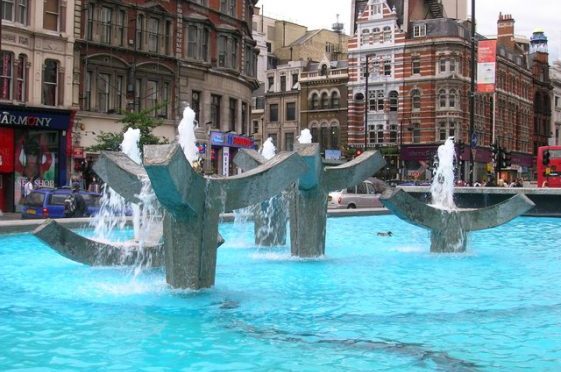
The fountains, nestled at the windy base of this building, caused by the downdraft as the wind hits its upper floors, once stood a blue mosaic lined pool with five triple-tined-Y-shaped fountains.
Operators of these fountains had an idiosyncratic approach to when they should be turned on. On hot summer evenings, girls waiting for the Astoria to open would sit on the fountain’s parameter wall staring at an empty pool safe in the knowledge they would remain dry. On windy winter nights, aided by the downdraft from 35 storeys above them, hapless pedestrians walking past would get soaked.
Wonky pyramids
Now where these iconic Grade II listed fountains once stood stands the gleaming new station for CrossRail, with its two wonky glass pyramids which the designers describe as crystal sculptural forms. Apparently, the fountains were removed to make way for the ventilation shafts for the new enlarged ticket hall, Transport for London refused to return the fountains to their original location because it was ‘simply not relevant to put something back that does not function.’
The Centre Point fountains were the work of German artist Jupp Dermbach-Mayen who built the fountains at his Swiss Cottage studio in 1963. The fountains, inspired according to Mireille Burton, the artist’s daughter, by designs he had seen at Alhambra, Grenada in Spain, were of different heights and were installed in a blue mosaic pool beneath the Centre Point tower. An integral part of the overall Centre Point design; the ‘Y’ flower shape of the fountains reflected the same ‘Y’ form as the pre-cast concrete inverted and faceted external mullions of the tower block above. The Twentieth Century Society claims the removal of them was symptomatic of a wider problem of post-war art being separated from its architectural context.
Public campaign
When the fountains’ removal was threatened, a public campaign was launched in 2009 to find them a new home. Various locations were suggested including Whitestone Pond in Hampstead where Dernbach-Mayen had been resident. Finally, however, through the intervention of the artist’s daughter and her husband the fountains were given to the Architectural Association. They are now being restored and will be installed at the site of the Association’s school for rural architecture at Hooke Park in Dorset, whether the fountains will be available for the public to view, and positioned in a blue-tiled pool remains to be seen.
Those infamously-sporadic concrete flower fountains will be missed, though . . .
 On 11 August 1897 Enid Blyton was born at 354 Lordship Lane, she would go on to sell more than 600 books and have been translated into 90 languages
 Marc Brunel invented a tunnelling machine to bore the first Thames Tunnel after watching the common shipworm while in a debtors’ prison
 The site of the previous New Scotland Yard was originally to be an opera house, after spending £103,000 they couldn’t afford the roof and it was pulled down
 In 1878 Britain’s worst river disaster happened on the Thames when the paddleboat Princess Alice was struck by a collier with the loss of 640 lives
 Fearing its gold would illuminate Kensington Palace at night the Albert Memorial was painted black during World War I, it wasn’t restored until 1998
 In 1970 Dan Crawford founded The King’s Head Theatre, Islington the first pub theatre in the England since the time of Shakespeare
 In 1905 millionaire George Kessler flooded the Savoy’s courtyard to float a gondola, a birthday cake on an elephant’s back and Caruso singing
 Wisden were one of the original office tenants above Leicester Square station their name is still there in Cranbourn Street side of building
 The 1695 London to Harwich Roads Act allowing country justices to collect tolls is to be repealed – traffic cameras have made the law obsolete
 The former headquarters at 1 Cockspur Street of The White Star Line, owners of the Titanic, is now a US restaurant the Texas Embassy Cantina
 In one of our favourite derivations, Chiswick is Old English for ‘cheese farm’, and was first recorded as Ceswican around the year

