
The man who can dominate a London dinner table can dominate the world.

Oscar Wilde (1854-1900) A Woman of No Importance, 1893

The man who can dominate a London dinner table can dominate the world.
Oscar Wilde (1854-1900) A Woman of No Importance, 1893
On 12 January 1789 with the Thames frozen due in part to the river being both broader and shallower than today, a frost fair was in full swing. The ‘Little Ice Age’ lasting from 17th to 19th-century ice fairs were regularly held, the first being in 1608. Frost fairs were often brief as rapid thaws swiftly followed as it did on that day when melting ice dragged a ship anchored to a riverside public house pulling the down and crushing five people to death.
 On 12 January 1828 whilst under construction Isambard Brunel’s Thames Tunnel flooded and 6 men died. Brunel himself was fortunate to escape
 John Bishop and Thomas Williams who lived at 3 Nova Scotia Gardens, Spitalfields were notorious 19th century body snatchers
 The Monument stands on the site of St Margaret’s, the first church to burn down during the Great Fire of 1666
 In 1926, suicide pits were installed beneath tracks due to a rise in the numbers of passengers throwing themselves in front of trains
 In 1536 in consideration to his wife Henry VIII converted Anne Boleyn’s sentence of death by burning to that of beheading at Tower Hill
 A young David Robert Jones went to Burnt Ash Junior School, Bromley in the mid fifties, he is better known today as David Bowie
 In 1830 Michael Boai, aka the ‘chin chopper’, gave a concert at the Egyptian Hall, Piccadilly playing tunes by tapping his chin
 Arsenal (originally opened on 15 December 1906 as Gillespie Road) on Piccadilly line is the only station named after a football team
 On 12 January 1866 The Royal Aeronautical Society was formed in London, the society’s objectives were “for the advancement of Aerial Navigation and for Observations in Aerology connected therewith”
 19th Century Spitalfields was world famous for silk weaving, so much so that Pope Pius IX ordered a seamless silk garment from there
 Nineteenth century parish records show Fanny Funk (1859) and Eleazer Bed (1871) as being born In Whitechapel
 Trivial Matter: London in 140 characters is taken from the daily Twitter feed @cabbieblog.
A guide to the symbols used here and source material can be found on the Trivial Matter page.
The inability of Transport for London at taking on a project cannot be better demonstrated than the work to replace the 160 yards long Ardleigh Green Bridge on the A127 in Romford. Work began on the 24th September 2014, after interminable delays and changes of builders, the bridge was finished on 30th March 2019, four-and-a-half years of construction chaos, in comparison is a project nearby that TfL didn’t manage. The QEII Bridge, when completed at Thurrock, was the longest cable-stayed single-span suspension bridge in Europe. A four-lane road deck carried by two pairs of steel and concrete masts 276ft tall, founded on 175ft high concrete piers sunk into the Thames. At an overall length of nearly 2 miles, it took only 3 years to build. We should never let the hapless TfL near another bridge project again.
With all this talk of air pollution I would like you to consider another pollution, also found in London – light pollution.
When I was young the Milky Way was easily visible at night above our heads. In fact, I even managed to gain a boy scouts astronomy badge.
Today the moon is barely visible and during a lunar eclipse, the glorious red hue is almost washed out.
This video by Nicholas Buer shows how the Universe could look above London without light pollution. Here city shots were captured during the day and processed to appear to be night, then night sky shots from a dark sky location, taken at the correct latitude to London merged to give these spectacular views.
But there is a serious issue here, apart from the aesthetics. When working nights I would regularly hear blackbird song near petrol stations, they were confused as to the time of day; clearly, without sleep, their life expectancy would be impaired.
For it has been proved that artificial light is having a detrimental effect upon the natural world. Evidence shows that artificial light at night (‘ALAN’) interferes with insect development: movement, foraging and their reproductive success; and is one of the factors contributing to the 75 per cent loss of insect life over the last 30 years. Light pollution has also been shown to affect fish, birds (as with the blackbird), and mammals.
As you might expect, nocturnal creatures are badly affected, just try to recall the last time you saw a hedgehog.
Near cities, cloudy skies are now hundreds, or even thousands of times brighter than they were 200 years ago. We are only beginning to learn what a drastic effect this has had on nocturnal ecology.
Christopher Kyba, light pollution research scientist.
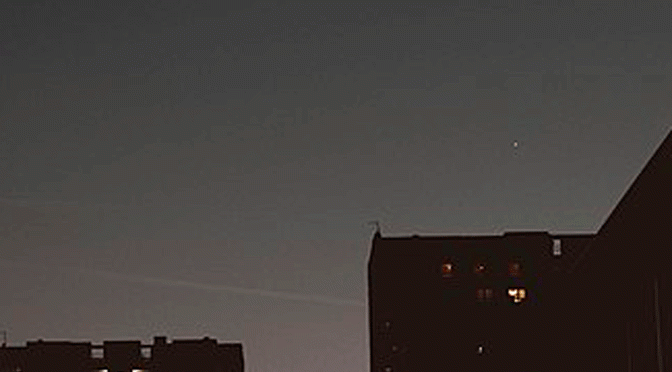
Featured image: London Night Sky Tower Blocks by Stephan Guttinger (1.0 Universal (CC0 1.0)

 CabbieBlog