Returning from a break in Dorset, surely the most quintessential of English counties, on the doormat was my annual subscription to the National Trust. I have been a member for at least 40 years and this year is the only time not one of the Trust’s properties has been visited by us.
The letter magnanimously informed me that due to COVID-19 the subscription had remained at last year’s rates (£126), but valued members were essential to ‘keep on caring for the places, collections and nature that unite and sustain us all’.
Over the years a trip to an NT property, with a scone for lunch, has been a regular day out. London alone has dozens worth a visit from the beautifully restored Ightham Mote to Churchill’s Chartwell.
But I’m seriously considering leaving my favourite charity, as far from being run, as in the past, by the Women’s Institue Countryside Diaspora, it is now been overtaken by the urban elite – all but one of its council members live in towns.
First, they spent our subscriptions on encouraging ‘ethnic minorities’ to visit the countryside owned by them. Patronising in the extreme. Not content they persued what historian Sir Roy Strong described as “being obsessed with ticking the boxes of the disabled, the aged, LGBT and ethnic communities”.
Now the Trust has inaugurated what they call ‘Re-Set’, a programme to offset the £200 million loss due to the COVID-19 pandemic and have made what they describe as a ‘Curation and Experience’. This has entailed the removal of all senior curatorial posts and their lead curators in the regions, thus dropping the Trust’s excellence in scholarship and conservation at a stroke. In total 1,200 staff are being made redundant, and how many volunteers have been told their services are no longer required has not been disclosed.
However, the Trust has found the resources to have a year-long audit on all its 300-odd properties to find which were built using the proceeds of slavery or colonialism. Incredibly they are also to examine the source of each of the Trust’s 1.5 million antiques, artworks and artefacts, a daunting and pointless exercise at the best of times.
They have form for moving away from the original motive of their founding fathers and the National Trust Act of 1937, which gave the explicit aims of ‘preservation of buildings of national interest along with their furniture and pictures, and the preservation of beautiful landscapes’. This Act has, in the past, given the Trust special privileges which now seem to be abandoned in favour of a ‘woke’ ethos.
Guides at Felbrigg Hall staged a revolt after being ordered to wear rainbow-coloured lanyards to celebrate the 50th anniversary of the legalization of homosexuality, in fact, I met with NT volunteers when holidaying in Jersey, who had resigned after a lifetime of service to the Trust due to a similar edict.
Avebury Manor decided that Christianity might be offensive to their ‘target’ audience and dropped the abbreviations BC and AD from their signage.
Cadbury’s Easter Egg Hunt has now been downplayed to become just an egg hunt, should the most important date on the Christian calendar be mentioned.
All this is what they call a repurposing to remove the outdated mansion experience and being British. It’s just a pity none of this relates to their core members, be they white middle-class or ethnic minorities wanting a pleasant day out with their children.
One of its senior curators announced that it should stop emphasizing the role of families in the history of stately homes because this: ‘privileges heterosexual lives’. So will many families now be discouraged from entering their sacred portals, whatever their religion, gender, sexuality or ethnicity?
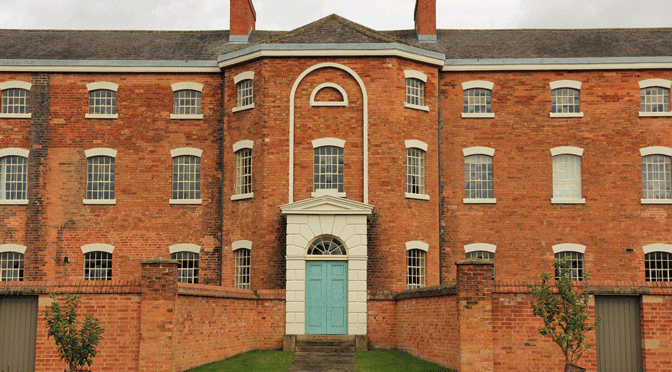
Featured image: Detail of the South front of Southwell Workhouse owned by the National Trust by Richard Croft (CC BY-SA 2.0).
Built in 1824 as a union workhouse for the villages around Southwell, it was originally known as the Thurgarton Incorporation Workhouse. Southwell had its own smaller workhouse at that time (now the Baptist Chapel), but joined in 1834 when it became the Southwell Union Workhouse.
The design was based on the ideas of the Rv. J.T.Becher, a local man, with segregation of the various classes of inmates, and it became the model for the hundreds of workhouses erected as a result of the 1834 Poor Law Amendment Act.
In the latter part of the 19th century, many workhouses developed into Hospitals. At Southwell, a new infirmary wing was built in 1871 to house the sick and infirm, with the original building continuing to provide residential accommodation for the poor. This function continued in the modified form right up until the 1980s, and as a result, the interior remained remarkably little altered. As such it provides a remarkable example of an early 19th-century workhouse. It is currently run by the National Trust.
The main building is Listed Grade II*, and the range of outbuildings on the northern side is Listed Grade II. The gardens to the front of the building have been partly restored to their original use as a vegetable garden and are also Listed Grade II*.

 On 11 October 1919 on a flight from London to Paris passengers enjoyed the first in-flight meals – lunch boxes a three shillings (15p) each
 HMP Pentonville built in 1842 at a cost £84,186 12s 2d was intended to be a holding prison for convicts awaiting transportation
 Cowcross Street is so named after the cows crossing on their journey to the slaughterhouses and butchers at Smithfield Market
 Idol Lane, off Great Tower Street was formerly Idle Lane denoting an area of the city where loiterers would congregate
 Christ Church Lambeth’s spire is decorated with stars and stripes commemorating the abolition of slavery, half the cost was borne by America
 The album cover for David Bowie’s The Rise and Fall of Ziggy Stardust and the Spiders from Mars was shot outside 23 Heddon Street
 Tossing the pie which apprentice boys tossed a coin to win a pie, if the pieman won he kept the 1d and the pie, losing he gave the pie away
 On 11 October 1940 Centre Court at Wimbledon was hit by five 500lb German bombs, 16 bombs hit the club during the war
 Transport for London Byelaw 10(2): No person shall enter through any train door until any person leaving by that door has passed through it!
 Friday Street (Fridei Strete in 12th Century) was named after the Friday market of fishmongers selling fish in memory of Good Friday
 Covering in total 620 sq miles London is the biggest city in Europe and with 4,699 people per sq kilometre has Britain’s highest density
 Trivial Matter: London in 140 characters is taken from the daily Twitter feed @cabbieblog.