

London in Quotations: William Dunbar

London, thou art of townes A per se. / Soveraign of cities, seemliest in sight, / Of high renoun, riches and royaltie; / Of lordis, barons, and many a goodly knyght; / Of most delectable lusty ladies bright; / Of famous prelatis, in habitis clericall; / Of merchauntis full of substaunce and of myght: / London, thou art the flour of Cities all.

William Dunbar (c.1456-c.1513)
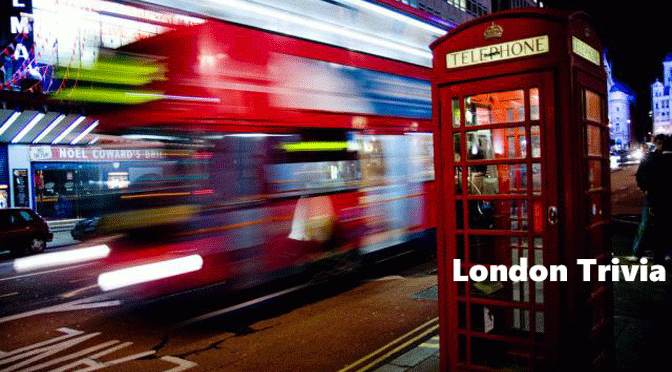
London Trivia: King Edward abdicates
On 11 December 1936 King Edward VIII explained his decision to abdicate in a radio broadcast in order to marry his mistress, Mrs Wallis Simpson, a twice-divorced American socialite, the marriage was opposed by the government on religious, legal, political, and moral grounds.
 On 11 December 1987 Charlie Chaplin’s cane and bowler hat, used in his iconic films, were sold at Christie’s for £82,500
 The 17th century Seven Dials monument was removed as the thieves and prostitutes used to hang around it. The current replica dates to 1989
 There were eight deep-level shelters built under the London Underground in the Second World War. One of them in Stockwell is decorated as a war memorial
 Livingstone’s heart was buried under a tree where he died, now the site of the Livingstone Memorial, his remains buried at Westminster Abbey
 Only two MPs have run the London Marathon under 3 hours, best Matthew Parris at 2:32.57 in 1985 and Doug Henderson achieved 2:52.24 in 1989
 Author A. A. Milne found the original Winnie-the-Pooh for his son Christopher Robin in the Toy Department of Harrod’s on Christmas Eve
 Harrod’s opened in 1849 as a single room grocery shop, a fire gutted the building in 1883 and in 1898 installed the world’s first escalator
 London has 108 golf courses, to play every hole would require walking just over 300 miles (assuming you kept out of the rough) and crossing a covered reservoir in Honor Oak
 During the Second World War, part of the Piccadilly line (Holborn – Aldwych branch), was closed and British Museum treasures were stored in the empty spaces
 Billingsgate Market (old) was originally opened in 1016 selling food and wine, with fish becoming the sole trade later
 The dog listening to the gramophone in the HMV logo has a road named after him, near his burial site in Kingston on Thames: Nipper Alley
 Trivial Matter: London in 140 characters is taken from the daily Twitter feed @cabbieblog.
A guide to the symbols used here and source material can be found on the Trivial Matter page.

Previously Posted: Blue Sky Thinking
For those new to CabbieBlog or readers who are slightly forgetful, on Saturdays I’m republishing posts, many going back over a decade. Some will still be very relevant while others have become dated over time. Just think of this post as your weekend paper supplement.
Blue Sky Thinking (27.10.09)
Driving past The London Dungeon recently I noticed that they charge £50 for a family ticket to have that gruesome experience, but with queues around the block willing to pay there must be an insatiable appetite for death.
So for you, dear reader, who like that sort of thing, I have done some research on Tyburn Gallows.
Erected in 1571 condemned prisoners were driven there in a cart, via St. Giles in the Fields where they received a mug of ale, dressed either in mourning or in the dress of a bridegroom if they could. Unfortunately, the clothes, post-mortem, were the property of the hangman. Well, cabbies still expect a tip! In 1447 five men had already been hanged, cut down while still alive, stripped, and marked out of quartering when their pardon arrived, but the hangman declined to give them back their clothes and they were obliged to walk home naked.
Hanging days were public holidays, as it was considered that the sight of execution would prove a deterrent. Twenty-one prisoners could be hanged at once (time and motion consultants were even around in the 16th century), and convention dictated the order of precedence so that highwaymen as “the aristocrats of crime”, and the most popular were despatched first, then common thieves, with traitors being left to bring up the rear. With over 300 offences carrying the death penalty, there was never a shortage of participants.
The site of the gallows is marked by a stone in the traffic island at Marble Arch. But some historians suggest that the original site is on a spot near the southwest corner of Connaught Square.
Now recently Connaught Square, which was once known as Tyburnia, has gained another form of notoriety in the shape of one of its residents. Number 29 only five doors from the gallows site is now the London residence of ex-Prime Minister Tony Blair.
Now if only some of the old traditions were revived that would really pull in the punters.
 CabbieBlog