
BILLINGSGATE (n.) Piscatorial premises where men compete to balance baskets upon their heads.
Dr. Johnson’s London Dictionary for publick consumption in the twenty-first century avail yourself on Twitter @JohnsonsLondon

BILLINGSGATE (n.) Piscatorial premises where men compete to balance baskets upon their heads.
Dr. Johnson’s London Dictionary for publick consumption in the twenty-first century avail yourself on Twitter @JohnsonsLondon
We challenge our contributors to reply to ten devilishly probing questions about their London and we don’t take “Sorry Gov” for an answer. Everyone sitting in the hot seat they will face the same questions ranging from their favourite way to spend a day out in the capital to their most hated building on London’s skyline to find out what Londoners think about their city. The questions are the same but the answers vary wildly.

Dan Simpson is a writer, facilitator, and creativity coach. An accomplished poet, he has been Poet-in-Residence at Glastonbury Festival, Waterloo Station, National Trust Stowe, Imperial College London, and St Albans Cathedral. His work has been featured at Southbank Centre, the Royal Academy of Arts, and on the BBC. In 2022 he created On the Cotton, a project pairing poets with London’s black cab drivers and writing poems about the historic trade. His other work can be found here.
Don’t stare at your phone whilst travelling around. London is a city of architectural oddities, interesting pieces of history, and semi-hidden goings on all just there for the keen observer. I’d go so far as to say this even applies on the Underground – you never know who you might spot, or what stories you might overhear.
Postman’s Park. Though made a little more famous by the play and film Closer, every time I’ve visited it’s very quiet. It’s a little shrine dedicated to those who lost their lives saving others, tucked away near St Paul’s. A sombre place to reflect on the best of the human spirit – something that sometimes feels lacking in our city.
The seemingly never-ending knocking down of council estates and iconic places for expensive flats that force communities and local people out. That, and the cost of a pint.
The Natural History Museum – a Victorian cathedral to science and the natural world. Going inside and my eyes are drawn upwards, noticing the details of stone monkeys climbing the pillars, painted plant adorning the ceilings, the sheer volume of stuff from around the globe. As a building, it’s incredibly of its time, but the atmosphere is contemporary: understandable, given it’s also a research institution, and full of excited children discovering the wonders of nature!
The Old War Office (or The OWO, as it’s styled now). Every time I cycle past I cringe a bit at the tagline ‘The home of legends’. I can’t imagine how much it would cost to buy a place there, and who will be doing so – given the location in the heart of Westminster and political power.
Sky Garden. That it’s free – in this expensive city! – to go up 43 floors to look at the view is surely a mistake. Fantastic cocktails too – though those will set you back a few pounds.
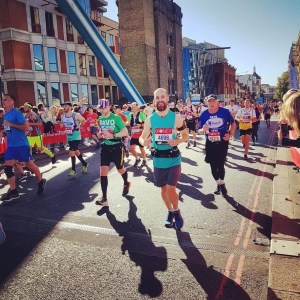
Tower Bridge. During lockdowns, my partner and I (on our one legal outdoor activity per day) often jogged from her place in Stepney Green, over London Bridge, and back via Tower Bridge. We’d barely see a soul – a strange thing for the middle of a usually busy city, and a lockdown experience I’ll never forget. I also have a wonderful memory and photo of me crossing Tower Bridge – almost the halfway point – during the London Marathon.
Kraken, by China Miéville. A page-turning jaunt through the recognisable surface of London – and the weird mystical forces that are happening under the perception of the everyday. It’s a fun mash-up of London and the occult – and to me, speaks to the fact that London really works in ways most of us don’t consider.
Mildred’s – the first one in Soho. One of the original and best dedicated vegetarian places, it felt like a treat as a veggie in the days before vegan food became available everywhere. I like that they don’t make that their selling point – they simply make excellent food (and cocktails!). They’ve quietly switched to a full vegan menu too, and I’ve never had a bad experience there. Shout out to Naifs in my area of Peckham too – it’s incredible.
On a fresh and sunny Spring day, I’d start with a jog around Peckham Rye Common. Then onto my bike, off to the Tate Modern and a wander round wondering about the art. A quick dip into Borough Market for the free cheese samples before lunch at Mildred’s Soho. Then a pedal over to Cambridge Circus and Orc’s Nest to look at boardgames – probably via the huge Brewdog for a beer. Then on to Brick Lane to look at the graffiti and pick up a bag of bagels (Beigel Bake is the better of the two bakeries here!). Then the Old Hackney Baths for a dance before the Overground back to Peckham – stopping for a swift nightcap at Brick Brewery’s taproom.
On The Cotton, celebrating the 200th anniversary of the first licensed Hackney Cab service in London. This short film documents a project that saw seven Black Cab drivers and seven London-based poets co-create poetry that celebrates the iconic Black Cab, London’s cabbies, passengers, and the Knowledge. The film will be introduced by Dan Simpson, who pioneered the On The Cotton project, working in partnership with London Transport Museum. After the film, enjoy a poetry performance and a Q&A with some of the poets, cabbies, and filmmaker Bilal Bounit. Performers will include Duane Colman and Abstract Benna, Adam Gaunt, and Mick O’Flynn with a voiceover by Arji Manuelpillai. Poet Shirine Shah and former cabbie Les Simpson will join the Q&A. Black Cab drivers are eligible for a concession ticket price for this event: simply show your yellow or green badge on the door. Saturday 11th March 2023, tickets are available at The London Transport Museum.

The type of man capable of success in London is more or less callous and cynical. If I had the training of boys, I would teach them to think of London as the last place where life can be lived worthily.

George Gissing (1857-1903)
On 5 March 1879 a coal porter found a wooden box in the Thames near Barnes Bridge. Inside was the remains of Miss Julia Thomas, murdered by her servant, Kate Webster who then disposed of the body by dismembering it, boiling the flesh off the bones, and throwing most of the remains into the Thames. Found guilty and hanged at Wandsworth Prison. In a twist of fate naturalist David Attenborough during building work found the missing skull of the victim.
 On 5 March 1969 the Old Bailey’s most expensive hearing ended after 39-days when Ronnie and Reggie Kray were given 30 years’ for murder
 During the Jack the Ripper investigation the police paid £100 for 2 tracker bloodhounds but they got lost and needed the Police to find them
 The last wolf in the City of London is commemorated at the spot it was killed, where a wolf’s head forms the waterspout of the Aldgate pump
 Fragrance Madeleine was trialled at Piccadilly station in 2001 to make the Tube more pleasant. Stopped after days people said they felt ill
 The last male Prime Minister to wear a wedding ring in public was Harold Wilson, in 1976, in fact the last occupant of No 10 to regularly sport a wedding ring was Lady Thatcher
 Starting in 1908 with a Perrier sign, it now costs £2 million a year to advertise your firm on a Piccadilly Circus neon sign
 The Lamb in Lamb’s Conduit Street had etched glass partitions preventing wealthy drinkers having to watch common men drinking in next bar
 On 5 March 1870 the first ever International Football match was England vs Scotland held at The Oval, the first of many England draws 1-1
 In 1750 the first umbrella used by Jonas Hanway brought back from Persia. Cabbies fearful they’d lose their wet weather called him a Frenchman
 Jack Dee once worked in the Ritz’s kitchen. One night he cooked a doorman dinner, got a 50p tip. Made him realise his life was in a mess
 Ye Olde Cheshire Cheese pub off Fleet Street, built in 1667, has a famous resident – a dead parrot named Polly who swore in many languages
 Trivial Matter: London in 140 characters is taken from the daily Twitter feed @cabbieblog.
A guide to the symbols used here and source material can be found on the Trivial Matter page.
For those new to CabbieBlog or readers who are slightly forgetful, on Saturdays I’m republishing posts, many going back over a decade. Some will still be very relevant while others have become dated over time. Just think of this post as your weekend paper supplement.
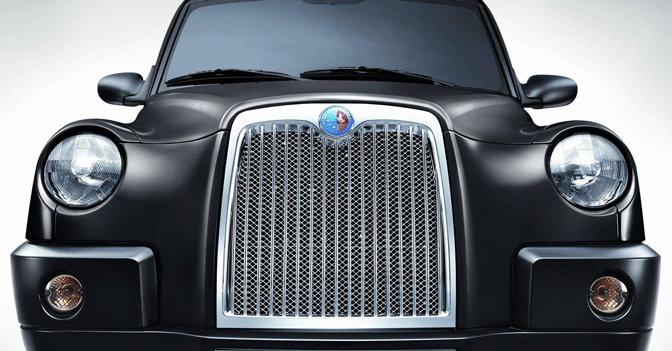
I bet you, like me thought the sole purpose of the iconic London Black Cab was to transport its driver and his passengers from point A to point B.
Well, how wrong can we be? I’ve had Batman and Robin getting changed in the back in preparation to go to a “Fools and Horses” fancy dress party, and girls constantly risk serious eye damage by applying mascara while in the back of my moving vehicle.
In an idle moment you might have Googled on the internet an “adult art movie” filmed in the back of a cab, while The Mail on Sunday in their You supplement regularly purports to interview stars in a weekly feature entitled In a taxi with…
London cabs are a great choice for city tours (well I should know) and what better place to use a London cab than Christchurch, not that rather gentile town on the south coast, but on the other side of the world, New Zealand.
Another company utilising our vehicles are Justsofilms who over the past two years have filmed dozens of musicians, performing in the back of a London licensed cab. Brian Wilson, Ryan Adams and the Doves are among the clips to be found on their site blackcabsessions. If you dig deep enough you can find a duo entitled The Totally Enormous Extinct Dinosaurs playing while one wears a glittering cardboard box on his head, while being driven by a very embarrassed cabbie around London.
And as a footnote they make rather good wedding cars, just a few months ago at my daughter’s wedding a rather splendid white cab took us to the church.

 CabbieBlog