
The sight of London to my exil’d eyes / Is as Elysium to a new-come soul;

Christopher Marlowe (1564-1593), Edward II

The sight of London to my exil’d eyes / Is as Elysium to a new-come soul;
Christopher Marlowe (1564-1593), Edward II
On 7 May 1849 Lady Blessington and her lover, the Comte d’Orsay left for France. The purpose of their hurried departure was to escape their debtors after having been served papers demanding repayment. Phillips, the auctioneer, who gave his name to the famous auction house sold her house with its contents in Kensington. His advertising blurb stated: ‘Grove House . . . required neither substantial repair nor decorations as very large sums have been lately expended thereon’.
 On 7 May 1960 the London Museum opened a reconstruction of an Iron Age settlement found on the site of the BOAC air terminal at Heathrow
 In the 1940s and 1950s Metropolitan Police Officers using their own bicycles to cover police beats were paid an allowance of threepence
 The New Exchange was a kind of early shopping mall which was built on the south side of the Strand in 1608 and stood there until 1737
 All but one of the ravens at the Tower of London died from stress during the Blitz, fortuitously as legend has it that should they leave the Tower England will fall
 London was once the capital of six countries in World War II it was safe haven for the governments of Poland, Norway, Belgium, Holland, France
 Jarvis Cocker, lead singer of band Pulp, wrote a song called 59 Lyndhurst Grove after being thrown out of a party at that address in Peckham
 The first London Eye was erected in Earls Court in 1894 for an Empire of India exhibition, 300ft high, as opposed to 442 for the London Eye
 The foppish son and heir apparent of King George II died in Leicester House as a result of being struck in the throat with a cricket ball
 Cockfosters Underground station was originally going to be called Trent Park or ‘Cock Fosters’ (an early spelling of the area’s name), the original site hoarding displayed the name as a single word
 In 1981 Soho had 184 sex establishments today only Brewer Street the upstairs windows of Old Compton Street and alleys near Berwick Street belie its past
 At 135ft Candover Street off Riding House Street is London’s shortest street, Rotherhithe Street the longest named street at 1.5 miles
 Trivial Matter: London in 140 characters is taken from the daily Twitter feed @cabbieblog.
A guide to the symbols used here and source material can be found on the Trivial Matter page.
For those new to CabbieBlog or readers who are slightly forgetful, on Saturdays I’m republishing posts, many going back over a decade. Some will still be very relevant while others have become dated over time. Just think of this post as your weekend paper supplement.
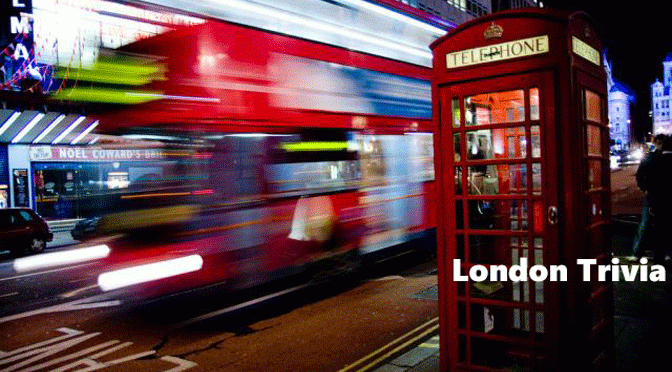
As iconic as my black cab, the K2 telephone boxes have since 1936, been an intrinsic part of London’s urban landscape. But who actually uses telephone boxes these days?
With almost universal mobile phone ownership their original function has been overtaken by a number of uses its designer couldn’t have imagined possible.
Their use as a rather well designed notice booth for call-girls (or boys) is now falling by the wayside as they find more effective ways of advertising their services and using it as a public urinal has its limitations, not least that its cramped compartment renders the user in danger of watering their shoes.
With brilliant originality they named it K2 for Kiosk No. 2, it was a course preceded by K1 which was constructed in concrete. The design this time in cast iron, by Sir Giles Gilbert Scott had won a Post Office competition three years earlier, and started a whole series of similar looking telephone boxes.
Its distinctive domed roof and all-over red make it the prototype of the classic K6, which was introduced nearly ten years later. Ventilation was provided via the crown in the roof section – it was made up from small, round holes!
Legend has it that the dome was Scott’s homage to the 18th Century architect Sir John Soane, R.A. (1753-1837) whose family tomb is surmounted by a very similar feature. Unlike the tops of modern British phone booths, Scott’s Soanian dome is a proper roof, dealing effectively with rain and litter while also being aesthetically pleasing.
But what makes K2 special is that it was mostly restricted to the London area and considerably bigger than its successors.
In London kiosks positioned by tourist locations have survived BTs desire to replace them with utility “shower cabinets” and stand as an iconic feature of London. Their purpose now would seem only to be as a photo opportunity for visitors.
Without ever suggesting their removal, could we not find some new use for these beautiful structures? For a start the London Tourist Board should come to an arrangement with BT to pay for their maintenance and cleaning, covered in grime they’re a disgrace.
Perhaps we could use them as one man internet cafes, or greenhouses with orchid.
Looking to brush up on your royal knowledge ahead of King Charles’ coronation tomorrow? As before the correct answer will turn green when it’s clicked upon and expanded to give more information. The incorrect answers will turn red giving the correct explanation.
Reports in the press claim that the Met is ‘planning to spend £440,000 on mounting certificates and picture frames’ to maintain morale by recognising officers’ ‘bravery in the line of duty, innovative instigations, long service, and for those retiring’. Very worthy I’m sure, but in my day a poster from Athena of a tennis player scratching her bum only cost 50p. Mind you her outfit later sold for £15,000.


 CabbieBlog