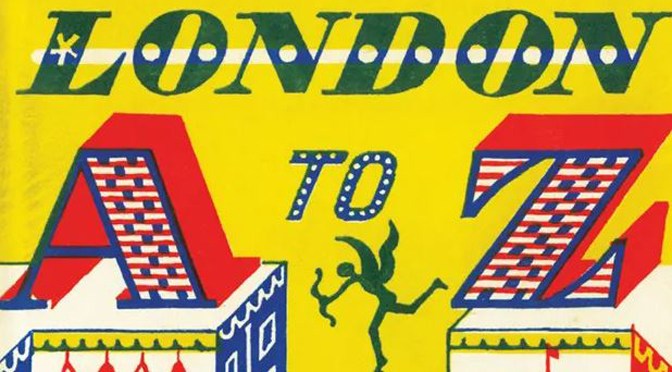
London A to Z Part Two

This is our second visit to John Metcalf’s London A to Z, these snippets show just how much London has changed since the last Coronation.

Under AIRPORTS Northolt is given first for European and internal services, with a telephone number of Ruislip 3355 and Heathrow barely mentioned to say that London Airport as it was then known (tel: HOU 7711) was for all other destinations. London’s other aerodromes (as they were then called) Blackbushe, Bivingdon, Croydon, Gatwick and Lympne. Should you wish to take your car to the Continent Silver City Airways Ltd will fly you and your car there, give them a ring on PAd 7040 for details.

Advice for BOWLER HATS was that ‘the possession of the correct type of bowler, hairy, not too large and curly-brimmed is an essential to the young man about town as a pair of trousers’.

VOILETS were still being sold by flower girls in Piccadilly Circus to the cry: “Lovely Sweet Violets”.

Visit HAMPTON COURT PALACE by Green Line bus, or Tube and trolleybus. Admission is Monday to Friday 1/-, Saturday 6d. Sundays and Bank Holidays are free.

Perhaps the most surprising is the description of POLICEMEN. Long the target for flattering remarks by visiting film stars has earned the right to be called ‘wonderful’ by a deliberateness of gait, a slow helpfulness of manner and a near-divine sense of dignity. Impossible to shock or ruffle, you’ll find them, even in the most unlikely circumstances, your friends.

Adorned throughout with Edward Bawden’s beautiful and distinctive illustrations, John Metcalf’s charmingly idiosyncratic pocket guide brings to life with a dry humour the London and Londoners of the day, and available on Amazon.

Wot no chargers‽

At the beginning of this year, TfL introduced a new regulation that requires all new cabs to be “zero-emissions capable”, i.e. hybrid or electric. But, as the (paywalled) Times reports, even though, “more than 40 per cent of private hire cars and black cabs in the city are now electric,” drivers are still finding it hard to charge them because London only has an average of 131 public charging points per 100,000 people.

Johnson’s London Dictionary: Horse Guards Parade

HORSE GUARDS PARADE (n.) Large open space that doth display horses and those bedecked men who guard the equine animals against peril.

Dr. Johnson’s London Dictionary for publick consumption in the twenty-first century avail yourself on Twitter @JohnsonsLondon

London A to Z

Anticipating a substantial increase of tourists to London for the late Queen’s Coronation, former Spitfire ace and respected literary critic, John Metcalf, wrote a witty London guide. On this 70th anniversary, I bought a copy of this pocket-sized paperback, then priced at a reasonable 2/6d.

The book is a barometer of how much has changed in London during these seven decades. In the coming weeks, CabbieBlog will feature some of the best excerpts and starting with cabs.

TAXIS. London’s taxicabs range from rickety old puffing-billies which seem (and their drivers) to be of pre-World War I vintage, to purring smoothies smelling of leather and metal polish. Cheapest ride (the first mile for 1/3d) has gone up a bit since the pre-war 6d for the first mile; but still remains good value.

A recent innovation is the fleet of a hundred or more Radio Taxis…You telephone TER 8800, give your name and address, and they will ring you back, if you ask them, when your driver reports that he is nearing your door.

London has certainly changed these last 70 years. More of these nostalgic snippets to come from the recently republished paperback.

Adorned throughout with Edward Bawden’s beautiful and distinctive illustrations, John Metcalf’s charmingly idiosyncratic pocket guide brings to life with a dry humour the London and Londoners of the day, and available on Amazon.
London in Quotations: Frederick Engels

A town, such as London, where a man may wander for hours together without reaching the beginning of the end, without meeting the slightest hint which could lead to the inference that there is open country within reach, is a strange thing. This colossal centralisation, this heaping together of two and a half millions of human beings at one point, has multiplied the power of this two and a half millions a hundredfold; has raised London to the commercial capital of the world . . .

Frederick Engels (1820-1895), Condition of the Working Class in England, 1845

Taxi Talk Without Tipping