Previously Posted: Blowing my own trumpet

For those new to CabbieBlog or readers who are slightly forgetful, on Saturdays I’m republishing posts, many going back over a decade. Some will still be very relevant while others have become dated over time. Just think of this post as your weekend paper supplement.

Blowing my own trumpet (05.10.2010)

The next time you get in a London taxi, ignore the driver’s valuable contribution to solving Britain’s debt crisis and try to sit back and relax, because hotel.com in their annual survey on the world’s taxis suggests you are in very safe hands, comprehensively beating its rivals, taking top spot for a third year in a row.

In the poll of 1,900 travellers around the world, London gained 56 per cent of the vote, compared to its nearest rival New York’s 28 per cent in categories including friendliness, cleanliness, driving standards and knowledge of the area.

You won’t be surprised to learn that London’s taxis were also voted the most expensive, though of course financial advice from your driver doesn’t come cheap, but surprisingly considering how quiet the trade is at the moment, London failed to win on availability, where New York, which has occupied a consistent second place over the past three years, polled highest.

For all business travellers the concerns of taking taxis in an unknown city will be familiar. Will you be taken on a tortuous route either through incompetence or malicious intent? Will the fare suddenly shoot up as the meter mysteriously ceases to function? Will your driver’s command of English suddenly fail him when it comes to pay him? Or has your driver got a “cousin” who will give you a good deal for getting you to the airport?

This high poll rating for London is all the more surprising, in a city on the cusp of hosting the Olympics and now making a bid for football’s world cup, when the powers-that-be seem determined to model its transport infrastructure on Mumbai.

The commuter train network system is expensive and overcrowded to such an extent that if it was cattle and not people being crammed into the carriages, the animal rights brigade would be demanding to close it down; the tube system, which hasn’t been upgraded since the old king died and has large sections of its network closed at weekends and which shuts down every night just as people want to make their way home from an evening out; the much heralded and heavily subsidised bus network is slow, cumbersome and runs thousands of empty buses that no one needs for most of the day, just look at Oxford Street, then almost unbelievably at night, when the tube is shut and travel options limited, the profitable bus companies run a ludicrously reduced service to a select few places; the minicab trade, despite being licensed, is manned by a transient workforce, who often resort to illegal and dubious practices to survive in a trade that has no self respect.

To complete the authentic Mumbai ambience the bell ringing and banshee like cries from the army of rickshaw riders, complete the descent of the image and reputation of this once great City into that of third-world status.

I would argue that now the only section of this capital’s transport infrastructure that is professional, reliable and genuinely world class is the Licensed London Cabbies. This worldwide recognition would be an achievement for a cab service anywhere in the World but to obtain it in a City as chaotic as this one, has to be seen as nothing short of miraculous.

We achieved this award despite operating across a road network that is near collapse, as the profit hungry privatised utilities close large parts of it on a daily basis, and as a disjointed network of local authorities implement ludicrous traffic schemes on an ad hoc basis in an attempt to force people off the roads, while running a gauntlet of parking and traffic cameras that constantly hinder and fine us just for doing our job and finally we did it despite having to operate under a licensing regime that is ruthless and draconian where we are concerned, whilst being hopelessly lenient and liberal with our competitors.

But if you are still not convinced on the standard attained by London’s cabbies try Bangkok which rose to fifth place overall, where the dubious pleasure of sitting in a tuk tuk is left to the reader’s discretion or nerve, enter into conversation with drivers in Paris or New York who generously share the distinction of being the world’s rudest cabbies.

And when you’re next enjoying a white-knuckle ride through the streets of Rome, it is perhaps best to avoid considering that the city’s taxi drivers were awarded the lowest quality-of-driving ranking. Instead, recall the opinion of Antonio Martino, an Italian politician—and thank your good luck that you’re not 140 miles south:

“In Milan, traffic lights are instructions. In Rome, they are suggestions. In Naples, they are Christmas decorations.”

Buying a black cab as a private car

Have you ever considered using a black cab as a private car? With vehicles being decommissioned after 12 years, taxis are a great choice (unless you want to drive in a Ulez area!), here are what steps you must take to secure one of your own.

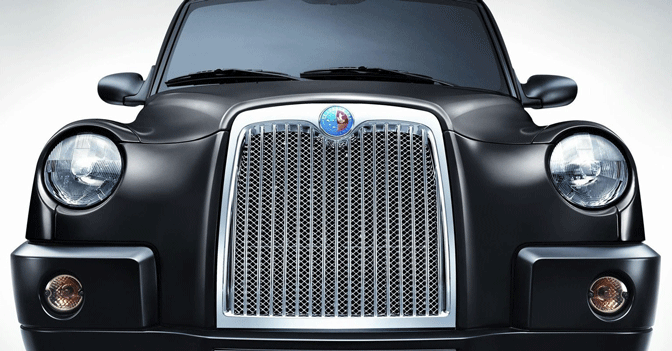
The classic Austin FX3 are likely to set you back as they are bought by enthusiasts, its successor the Fairway is also probably rare. My choice would be the TXI with a Nissen engine, one of the most reliable vehicles to ply London’s streets. The TXII, supposing an improvement, was a disappointment. The last iteration of diesel vehicles, the TX4 are now coming up for sale in some numbers as electric vehicles are replacing the fleet.

Black cabs, come in other colours, can carry five passengers in comfort (six if you add a front passenger seat, which is possible), and can easily turn in 25ft, that’s a boon in congested side streets.

How to modify the taxi so it’s fit for private use

First, you should ensure that you aren’t misleading people into thinking the black cab is for hire, you should remove any signage indicating that it is available for hire. If there is a plate still affixed to the vehicle’s rear this mustn’t be displayed. Paper ‘identifiers’ on the front and rear screens need also to be removed. However, I would caution against removing the roof ‘For Hire’ sign as water would certainly get through.

You may prefer to remove any no-smoking signs or similar from the inside of your vehicle, but it’s up to you. If a tariff notice and interior plate number remain you might like to keep them for the authentic cabbie look, and as they cannot be seen by the public you’ll not get into trouble.

How do I buy a black cab?

A quick search online will reveal that you can buy used black cabs from private sellers, or you might like to approach fleet owners who are now having to downsize, most independent cab garages could put you in touch.

Have a mechanic check the vehicle before you hand over any money, ex-taxis often don’t come with service histories, and the mileage will almost be on the high side.

How much does a black cab cost to buy?

An iconic London taxi can be bought for anywhere between £1,000 to £20,000. The price will depend on several factors, including the black cab’s mileage, age, and engine capacity.

License requirements

You don’t need a special license to drive a black cab unless you’re planning on becoming a cabbie. A standard driving license is all you need.

Taxi insurance for private use

If you’re buying a taxi for private use, you’ll need decommissioned taxi insurance for social, domestic and pleasure. Not all insurance companies offer this though. If you’ve decided that a black cab is the vehicle for you Adrian Flux provide quotes for all sorts of unusual vehicles, from former taxis to modified motors, bespoke vehicles and everything in between.

MoTs and servicing

A black cab will have seen many more miles than other second-hand cars, as such, it’s a good idea to get a service every 6,000 miles, just to make sure you keep your ex-hackney in tip-top shape. While London cabs now require two MoTs a year, only annual check-overs are required for private vehicles.

10 reasons why a black cab is the ultimate people carrier

They’re incredibly roomy – Black cabs have unrivalled passenger headroom and legroom, there’s plenty of space for shopping and luggage. The boot is quite small, but luggage can be stowed in various places in the passenger compartment and beside the driver.

The insurance is cheap – Most insurers will struggle to know how to rate your taxi, go to a specialist broker, you may find it's cheaper than a modern people carrier.

They’re cool – You’ll also be joining the ranks of celebrity cabbies – over the years, Sid James, Laurence Olivier, Stanley Kubrick, the Duke of Edinburgh, Stephen Fry and Kate Moss have all used a black cab as personal transport.

They’re safe – Black cabs are easily one of the safest car models on the road, that’s partly because they don’t go very fast. As a licensed passenger vehicle, safety was clearly of major importance when these cars were designed, and the result was a robust and safe set of wheels.

You can enjoy some peace whilst transporting the family – In a cab, simply close off the driver’s partition and turn off the intercom.

They’re good value – They will have been incredibly well maintained over the years, at one time the engine compartment required steam cleaning before its annual overhaul (the annual required inspection), my cab of choice with its Nissan 2.7 diesel engine, the TX1 is pretty bombproof and the chassis is incredibly robust. You can buy taxis from places like Elite London Taxis.

They’re accessible – All taxis from when the TXI was produced are wheelchair-accessible, and older ones might have been retrofitted. Access to and from the vehicle is good because of the large doors and spacious roof height.

Spare parts are cheap – Being ubiquitous parts are easily found and cheaper than mainstream vehicle manufacturers. Also, the body panels are cheaper than on most cars and bolt on and off, making repairs quicker, easier and cheaper.

They’re great for advertising – Black cabs are now well utilised as advertising mediums, with vast panels available for graphics. Here on CabbieBlog, we have featured vendors ranging from coffee stalls to ice cream vans. So, if you run your own business, black cabs are the perfect way to get about and plug your services at the same time.

Other cabbies give way – If you drive in London, genuine cabbies will let you out from a side turning, just ensure you reciprocate, or face a hard stare.


Too many results

Last Christmas I was given an Ancestry DNA kit. The DNA companies (there are a number) send you a little bottle with a plastic funnel that you have to dribble in. Register online, seal the sample and send it away to Ireland where boffins run it through their algorithms and send you (by email, how else!) the results.

When you register your DNA test you’re given the option of putting your results out into cyberspace or keeping stum, probably a wise choice if you’ve populated the planet with illegitimate offspring.

The results were quite quick, about three weeks and although most of my DNA was derived from a Blighty source, disappointingly as much had derived from Sarf of The River, in fact Kent and Surrey.

Now this is where it gets annoying, even if you discount the Old Testament’s assertion that we’re all derived from the same progenitors, our DNA stretches back through countless permutations of couplings.

The results throw up literally thousands of potential relatives from a cousin once removed to an 8th cousin 4 times removed, and it would seem that a distant uncle of mind was on the Mayflower, as I have dozens of distant relatives in the New World. As a result, I’m getting weekly updates of people I don’t know or care to know.

At my house today

On November 8th 1623, The First Folio, one of the great wonders of the literary world was published, seven years after the death of its author. It was the first printed edition of Shakespeare’s collected plays. Without this achievement, we would have lost half of his dramatic work. Troubadour Stageworks is marking this day in true Shakespearian style with a 12-hour Shakespeare Marathon at Dr Johnson’s House from 10 a.m. today.

Today eight of Shakespeare’s plays will be woven together including A Midsummer Night’s Dream, All’s Well That Ends Well, Macbeth, Much Ado About Nothing, Richard III, Romeo & Juliet, Twelfth Night and ‘Fix Folio’ (36 Shakespeare Plays in 45 minutes).

The performance is free and can be viewed online or in person at Dr Johnson’s House, Gough Square, London.

You can drop in online or in person at @drjohnsonshouse

Dr. Johnson’s London Dictionary for publick consumption in the twenty-first century avail yourself on Twitter @JohnsonsLondon

The London Grill: Don Brown

We challenge our contributors to reply to ten devilishly probing questions about their London and we don’t take “Sorry Gov” for an answer. Everyone sitting in the hot seat they will face the same questions ranging from their favourite way to spend a day out in the capital to their most hated building on London’s skyline to find out what Londoners think about their city. The questions are the same but the answers vary wildly.
Don Brown is a London Blue Badge tourist guide and has been taking people around the capital for the past seven years both in real life and online at uktoursonline.com. He also writes the Stuff About London blog, looking at various things about London that have caught his eye. He recently stepped down as the Director of The London Society, a civic society concerned with trying to make London a better place in which to live and to work.

What’s your secret London tip?

Go off the main streets – dive up the little alleys and side roads that lead off the direct route anywhere. Half the time there’ll be nothing out of the ordinary, but the other half you’ll discover some building, square, green space or something that you would never have known existed. (And if I’m ever guiding visitors from the US I also advise them to spend an evening in a pub, because that’s where you see and hear the real London, because the real London are the people.)

What’s your secret London place?

The Onion Garden in Seaforth Place behind Victoria Street. It’s a tiny little bit of rus in urbe squished between an access road and the tube line that is the work of a garden designer called Jens Jakobson. There’s a coffee stall where you can grab a drink and have ten minutes just recharging in the greenery.

What’s your biggest gripe about London?

Too much traffic! There are too many cars and they’re too big. The best bits of the city are the ones that have made themselves more pedestrian-friendly – the new public square in front of Somerset House on Strand for example, which has turned a six-lane highway jammed with buses into a beautiful, peaceful, calming space.

What’s your favourite building?

It always starts and finishes with St Paul’s Cathedral; it never fails to lift the spirits whether you’re right underneath it or just glimpse it from the train as you rattle into Waterloo.

What’s your most hated building?

I still can’t come to terms with the Walkie Talkie. There are lots of very good tall buildings across the city, but this is overbearing and ugly.

What’s the best view in London?

If you’re on the top deck of a bus on a summer’s evening as you cross Waterloo Bridge you look downriver to St Paul’s and the City, and see the sun gleaming off the glass of the towers and casting a soft light on the dome; upriver, the sky is red behind Big Ben and Parliament. Paradise.

What’s your personal London landmark?

Thirty years ago they were resurfacing Albert Bridge, but it was open to pedestrians. I walked over it just as it was getting dark and as I got to the middle all the lights came on and it seemed like they were illuminating the bridge just for me.

What’s London’s best film, book or documentary?

There’s an old Ealing comedy called Hue and Cry which has a bunch of kids running around the bombsites of the post-Blitz city and provides a glimpse of what London suffered in the war. My favourite book would be Jerry White’s History of London in the 19th century, telling the story of how this place grew to be the world’s first ‘megalopolis’, a city that was so big it became impossible for anyone to know it all.

What’s your favourite restaurant?

I don’t do that much eating out, but places I can’t pass without going in include the Bar Italia (double espresso and a cannolo), Brick Lane Beigel Bake (tuna and sweetcorn), and anywhere that does proper Portuguese Pastel de Nata custard tarts.

How would you spend your ideal day off in London?

A walk, I think. You can stroll down the river from Battersea Park to London Bridge without having to cross a road and all the big sites of London appear as you make your way east. Grab a bit of lunch at the Royal Festival Hall food market at weekends, pop into Tate Modern (or detour across the Millennium Bridge), fill yourself up on samples from the cheese stalls at Borough Market then finish off with a pint in front of the fire in the Parliament Bar at The George.

Taxi Talk Without Tipping