Previously Posted: Requires no skill to operate

For those new to CabbieBlog or readers who are slightly forgetful, on Saturdays I’m republishing posts, many going back over a decade. Some will still be very relevant while others have become dated over time. Just think of this post as your weekend paper supplement.

Requires no skill to operate (24.08.2010)

The man who invented the world’s most intrusive device described his instrument as: “The telephone may be briefly described as an electrical contrivance for reproducing in different places the tones and articulations of a speaker’s voice so that Conversations can be carried on by word of mouth between persons in different rooms, in different streets or in different Towns . . . The great advantage it possesses over every other form of electrical apparatus is that it requires no skill to operate the instrument”.

Alexander Graham Bell (if ever a person’s name was better suited for his invention, I’ve yet to find), couldn’t have imagined what his invention would lead to in the 21st century or for that matter what idiots would make use of it.

So what has the latest reincarnation of Mr Bell’s invention got to do with CabbieBlog I hear you muttering amongst yourselves? Well, driving in London is becoming ever more stressful with pedestrians engrossed in using their i-phones walking into the road, then looking up with a startled expression when they see my cab bearing down on them.

Women are often accused of lacking spacial awareness, but men, sorry chaps it’s usually the male gender, that seems engrossed in their phones, and whatever they are doing on it, certainly excludes any road sense.

So when Alexander Graham Bell informed the populace that his “apparatus . . . required no skill to operate he should have added the caveat – but retraining might be necessary in the art of crossing a road, for how to talk on one’s phone and cross London’s busy roads needs a skill that many have failed to acquire.

FOOTNOTE: Around the mid 1800’s many were trying to invent the telephone, the most unfortunate was the American Elisha Gray who actually filed something called a patent caveat – a sort of holding claim that allowed one to protect an invention that wasn’t quite yet perfected – on the very day that Alexander Graham Bell filed his own, more formal patent, unfortunately for Gray, Bell beat him by a few hours.

Thanks for checking out CabbieBlog just don’t do it while crossing the road.
Hot and Cold Corner

London’s cabbies love to give a moniker to places around the capital. The Resistance was a derogatory nickname given to Harley Street as it was populated by doctors opposed the formation of the NHS, the Dead Zoo for the Natural History Museum. But surely the most inspired must be ‘Hot and Cold Corner.

Royal Geographical Society was formed in 1830 as a professional body to advance, as you might have guessed, geographical studies.

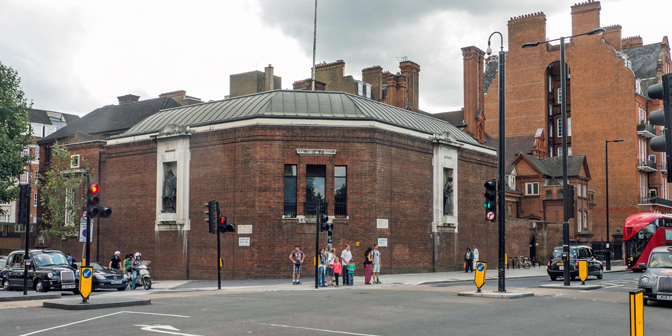
The Royal Geographical Society purchased this [featured] 1874-built property at 1 Kensington Gore, known as Lowther Lodge in 1913 for £100,000. It stands on the intersection of two busy roads, Kensington Road/Kensington Gore going east-west and Exhibition Road/West Carriage Drive north-south.

Ernest Shackleton

In 1932 a statue by Charles Sargeant Jagger of Ernest Shackleton, the polar explorer who led three British expeditions to the Antarctic, was unveiled on the eastern side of the building facing Exhibition Road.

David Livingstone

Some twenty years later in 1953 a statue by Thomas Bayliss Huxley-Jones, of David Livingstone, pioneer medical missionary with the London Missionary Society and Africa explorer was unveiled looking north on the Kensington Gore side of the building.

I suppose both statues should have faced south towards their achievements, but nobody would be able to see them.

So next time you’re in the vicinity of the Royal Albert Hall check out Hot and Cold Corner.

All images courtesy of Statues – Hither & Thither by René and Peter van der Krogt

Tube map comparison for ULEZ

TIt is now two weeks and two days since Ulez came into force and its purpose is commendable, you can certainly smell London as you approach the M25 from the sticks.

The main thrust of criticism is the lack of public transport on the outskirts of the capital. Mayor Khan claims to have solved this issue with the Superloop stating:

The Superloop is the jewel in the crown in our plans to strengthen alternatives to the private car ahead of the ULEZ expanding London-wide and is a game changer for outer London.

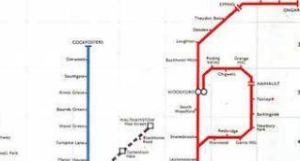
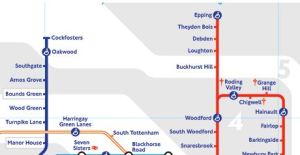
So given we in Havering have seen no new buses, I thought I’d compare Harry Beck’s early map that I grew up with the ‘improved’ network to see what additional rail links have been added some 70 years later.

1960

2020

No Victoria Line, Jubilee Line, London Overground, Waterloo & City Line, DLR, or Elizabeth Line, in fact, no new routes or extensions to existing lines, just the charging zones added.

Johnson’s London Dictionary: Albert Bridge

ALBERT BRIDGE (n.) Nicknamed ‘The Trembling Lady’ due to its tendency to vibrate as people walk over it, after having proffered monies for the toll fee.

Dr. Johnson’s London Dictionary for publick consumption in the twenty-first century avail yourself on Twitter @JohnsonsLondon

Taxi Talk Without Tipping