
Category Archives: Puppydog tails

Johnson’s London Dictionary: Eastenders
EASTENDERS (n., a.) Television species much given to shout for no apparent reason in the name of entertainment
Dr. Johnson’s London Dictionary for publick consumption in the twenty-first century avail yourself on Twitter @JohnsonsLondon
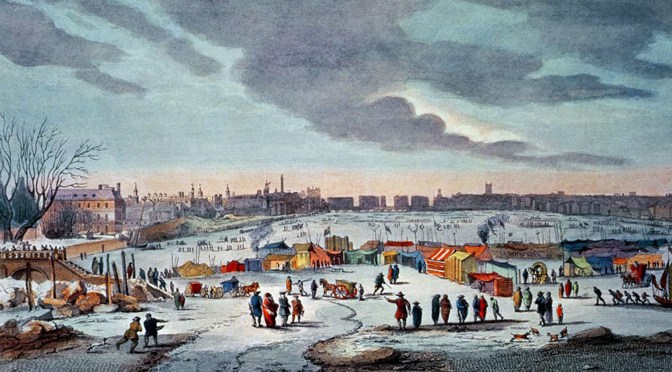
The road that didn’t exist
There is a real street in London that never actually existed, in the sense that one minute it wasn’t there, then it was, and then it was gone again.
It was called Broad Streete, and it appeared on 8th January 1683 in, what is, the most central part of the city. A great many shops opened on it, many thousands of people visited and traders arrived, a bullring was built and there were games and displays of strength and skill. Oxen were roasted and drink was sold, and a great time was had by all along its length.
Broad Streete could only be built because between the 14th and 19th centuries the Thames froze solid more than a dozen times. John Evelyn describes the street thus: “The ice was now become so incredibly thick, as the beare not onely whole streets of boothes in which they roasted meate, & had divers shops of wares…but coaches and horses passed over.”
In early January 1683, the Thames had frozen to a thickness of almost a foot and stayed that way for two months. At other times the ice grew to several feet thick, especially between Blackfriars and London Bridge. There are various reasons for the existence of Broad Streete. One was the ‘Little Ice Age’ that hit England, another was that the Thames had yet to be embanked, so it flowed more slowly and was prone to icing over. At that time London Bridge has several supports, called starlings, sunk into the river bed which also slowed the flow.
Rapid thaws sometimes caused the loss of life and property. In January 1789, melting ice dragged away a ship that was anchored to a riverside pub, pulling the building down and causing five people to be crushed to death.
In the pedestrian tunnel under the south bank of Southwark Bridge, there’s an engraving by sculptor Richard Kindersley made of slabs of grey slate, depicting a frost fair.
The global climate grew milder, the river was banked and flowed faster, and that was the end of Broad Streete.
That is until we get more climate change.
Johnson’s London Dictionary: Cockney
HOUSE OF LORDS (n.) Large congregation of superannuated octogenarians each carrying relaxed countenance while endeavouring to remain awake
Dr. Johnson’s London Dictionary for publick consumption in the twenty-first century avail yourself on Twitter @JohnsonsLondon

Test Your Knowledge: March 2022
Claiming something to be the ‘oldest’ is often fraught with problems, so bear with me on what I think are the correct answers. As with the previous Quizzes, the correct answer will turn green when it’s clicked upon and expanded to give more information. The incorrect answers will turn red giving the correct explanation.
1. Britain’s oldest door can be found in which religious building in London?
Westminster Abbey
CORRECT Westminster Abbey has Britain’s oldest door, dated for the first time in 2005 by the process known as dendrochronology, it showed the wood had been felled after 1032 and the door constructed sometime in the 1050s during the reign of King Edward the Confessor.
Tower of London
WRONG Westminster Abbey has Britain’s oldest door, dated for the first time in 2005 by the process known as dendrochronology, it showed the wood had been felled after 1032 and the door constructed sometime in the 1050s during the reign of King Edward the Confessor.
Fulham Palace
WRONG Westminster Abbey has Britain’s oldest door, dated for the first time in 2005 by the process known as dendrochronology, it showed the wood had been felled after 1032 and the door constructed sometime in the 1050s during the reign of King Edward the Confessor.
2. What is the capital’s oldest mainline train station in Zone One?
Kings Cross
WRONG London Bridge station was opened in December 1836. Kings Cross was opened in 1852 and named after a huge statue of much-derided statue of George IV, removed in 1842. Charing Cross Station was named after a short street near the notional centre of London from which distances from the city are measured and opened in 1864.
London Bridge
CORRECT London Bridge station was opened in December 1836. Kings Cross was opened in 1852 and named after a huge statue of much-derided statue of George IV, removed in 1842. Charing Cross Station was named after a short street near the notional centre of London from which distances from the city are measured and opened in 1864.
Charing Cross
WRONG London Bridge station was opened in December 1836. Kings Cross was opened in 1852 and named after a huge statue of much-derided statue of George IV, removed in 1842. Charing Cross Station was named after a short street near the notional centre of London from which distances from the city are measured and opened in 1864.
3. Which restaurant claims to be London’s oldest?
Rules
CORRECT Established in 1798, Rules is regarded as London’s oldest restaurant. Edward, The Prince of Wales would entertain his mistresses there in a secret room. Established in 1889, Sweetings is London’s oldest seafood restaurant, apparently gangster George Francis once offered one-time owner George Needham £1,000,000 in cash for the restaurant. Wiltons began life as an oyster stall in 1742 before its establishment in St James in the 1840s, they proudly announced in 2017 that it was older than America.
Wiltons
WRONG Established in 1798, Rules is regarded as London’s oldest restaurant. Edward, The Prince of Wales would entertain his mistresses there in a secret room. Established in 1889, Sweetings is London’s oldest seafood restaurant, apparently gangster George Francis once offered one-time owner George Needham £1,000,000 in cash for the restaurant. Wiltons began life as an oyster stall in 1742 before its establishment in St James in the 1840s, they proudly announced in 2017 that it was older than America.
Sweetings
WRONG Established in 1798, Rules is regarded as London’s oldest restaurant. Edward, The Prince of Wales would entertain his mistresses there in a secret room. Established in 1889, Sweetings is London’s oldest seafood restaurant, apparently gangster George Francis once offered one-time owner George Needham £1,000,000 in cash for the restaurant. Wiltons began life as an oyster stall in 1742 before its establishment in St James in the 1840s, they proudly announced in 2017 that it was older than America.
4. Some of the world’s earliest shops can be found in London, but which is the oldest?
Lock & Co
CORRECT Curiously all three are near each other. Lock & Co founded in 1676 is the oldest hatter in the world who invented the bowler. Berry Brothers are next door and have been supplying fine wines since 1698. Founded by a saddler and whip maker in 1750, Swaine Adeney Brigg has been selling leather goods for centuries, supplying luggage for films including the Kingsman movies.
Berry Brothers & Rudd
WRONG Curiously all three are near each other. Lock & Co founded in 1676 is the oldest hatter in the world who invented the bowler. Berry Brothers are next door and have been supplying fine wines since 1698. Founded by a saddler and whip maker in 1750, Swaine Adeney Brigg has been selling leather goods for centuries, supplying luggage for films including the Kingsman movies.
Swaine Adeney Brigg
WRONG Curiously all three are near each other. Lock & Co founded in 1676 is the oldest hatter in the world who invented the bowler. Berry Brothers are next door and have been supplying fine wines since 1698. Founded by a saddler and whip maker in 1750, Swaine Adeney Brigg has been selling leather goods for centuries, supplying luggage for films including the Kingsman movies.
5. We’ve more statues than you could shake a stick at, but which is the oldest?
King Alfred the Great in Trinity Church Square
CORRECT Created in the 14th century in honour of King Alfred, the man who ruled Wessex in the 9th century was originally located at the Palace of Westminster before it was brought to its present location in 1823 at about the time the square was being laid. Credited as being London’s oldest equestrian bronze, King Charles I statue is used to measure all distances from London. Queen Elizabeth I dates from 1586 and was created during her reign.
King Charles I sitting astride his horse on the southern side of Trafalgar Square
WRONG Created in the 14th century in honour of King Alfred, the man who ruled Wessex in the 9th century was originally located at the Palace of Westminster before it was brought to its present location in 1823 at about the time the square was being laid. Credited as being London’s oldest equestrian bronze, King Charles I statue is used to measure all distances from London. Queen Elizabeth I dates from 1586 and was created during her reign.
Queen Elizabeth I standing on the facade of St Dunstan-in-the-West in Fleet Street
WRONG Created in the 14th century in honour of King Alfred, the man who ruled Wessex in the 9th century was originally located at the Palace of Westminster before it was brought to its present location in 1823 at about the time the square was being laid. Credited as being London’s oldest equestrian bronze, King Charles I statue is used to measure all distances from London. Queen Elizabeth I dates from 1586 and was created during her reign.
6. Where is what’s claimed to be London’s oldest house?
Mayesbrooke Road, Barking
WRONG Estimated to have been first built in 1435 this house was known as Walthamstow Tony. Sadly, this isn’t after a 15th century East London ‘Tone’ living in Walthamstow, but the name probably derives from the combination of a Saxon landowner ‘Waltheof’ and the name of a French nobleman called Ralph de Toni. Hidden down a small street in Farringdon lies 41/42 Cloth Fair, built between 1597 and 1614, this is the only house in the City of London to have survived the Great Fire of London. Was the Gunpowder Plot hatched at Eastbury Manor House, Mayesbrooke Road, Barking built in 1557? So says a local tradition supported by the author Daniel Defoe.
Cloth Fair, Smithfield
WRONG Estimated to have been first built in 1435 this house was known as Walthamstow Tony. Sadly, this isn’t after a 15th century East London ‘Tone’ living in Walthamstow, but the name probably derives from the combination of a Saxon landowner ‘Waltheof’ and the name of a French nobleman called Ralph de Toni. Hidden down a small street in Farringdon lies 41/42 Cloth Fair, built between 1597 and 1614, this is the only house in the City of London to have survived the Great Fire of London. Was the Gunpowder Plot hatched at Eastbury Manor House, Mayesbrooke Road, Barking built in 1557? So says a local tradition supported by the author Daniel Defoe.
Church Lane, Walthamstow
CORRECT Estimated to have been first built in 1435 this house was known as Walthamstow Tony. Sadly, this isn’t after a 15th century East London ‘Tone’ living in Walthamstow, but the name probably derives from the combination of a Saxon landowner ‘Waltheof’ and the name of a French nobleman called Ralph de Toni. Hidden down a small street in Farringdon lies 41/42 Cloth Fair, built between 1597 and 1614, this is the only house in the City of London to have survived the Great Fire of London. Was the Gunpowder Plot hatched at Eastbury Manor House, Mayesbrooke Road, Barking built in 1557? So says a local tradition supported by the author Daniel Defoe.
7. You can still worship in London’s oldest Christian church, but which one?
St. Bartholomew-the-Great
WRONG Believed to be one of the oldest sites of Christian worship in England, St. Pancras Old Church was established around the 4th century, on the site of a former Roman temple. St Bartholomew-the-Great in Smithfield might be the oldest intact continuous place of worship, dating back to 1123. Some parts of the original building remain. All Hallows dates back to 625, but very little of the original structure remains.
All Hallows by the Tower
WRONG Believed to be one of the oldest sites of Christian worship in England, St. Pancras Old Church was established around the 4th century, on the site of a former Roman temple. St Bartholomew-the-Great in Smithfield might be the oldest intact continuous place of worship, dating back to 1123. Some parts of the original building remain. All Hallows dates back to 625, but very little of the original structure remains.
St. Pancras Old Church
CORRECT Believed to be one of the oldest sites of Christian worship in England, St. Pancras Old Church was established around the 4th century, on the site of a former Roman temple. St Bartholomew-the-Great in Smithfield might be the oldest intact continuous place of worship, dating back to 1123. Some parts of the original building remain. All Hallows dates back to 625, but very little of the original structure remains.
8. Love it, or loathe it, can you identify the oldest actress to appear on BBC’s Eastenders?
Barbara Windsor
WRONG June Brown joined the show in 1985, the year it was created, and stayed until January 2020, playing Dot Cotton the chain-smoking, quick-witted and loveable character who left the square in 2020 aged 94. Gretchen Franklin played Ethel Skinner’s final scenes at the age of 89, marking the end of her acting career. The late Barbara Winsor was a mere 79 years old when she left The Vic.
Gretchen Franklin
WRONG June Brown joined the show in 1985, the year it was created, and stayed until January 2020, playing Dot Cotton the chain-smoking, quick-witted and loveable character who left the square in 2020 aged 94. Gretchen Franklin played Ethel Skinner’s final scenes at the age of 89, marking the end of her acting career. The late Barbara Winsor was a mere 79 years old when she left The Vic.
June Brown
CORRECT June Brown joined the show in 1985, the year it was created, and stayed until January 2020, playing Dot Cotton the chain-smoking, quick-witted and loveable character who left the square in 2020 aged 94. Gretchen Franklin played Ethel Skinner’s final scenes at the age of 89, marking the end of her acting career. The late Barbara Winsor was a mere 79 years old when she left The Vic.
9. Have you watched a match at London’s oldest football club?
Fulham
CORRECT Their formation in 1879 make Fulham the oldest professional club in London and the second oldest in the world. The oldest senior non-league club is thought to be Cray Wanderers, founded in 1860, currently playing in Bromley.
Chelsea
WRONG Their formation in 1879 make Fulham the oldest professional club in London and the second oldest in the world. The oldest senior non-league club is thought to be Cray Wanderers, founded in 1860, currently playing in Bromley.
Arsenal
WRONG Their formation in 1879 make Fulham the oldest professional club in London and the second oldest in the world. The oldest senior non-league club is thought to be Cray Wanderers, founded in 1860, currently playing in Bromley.
10. Noted for its quintessential squares, but which is London’s oldest?
Charterhouse
WRONG The earliest squares were little more than open grass, surrounded by timber fences. The first square to have a properly laid out garden at its centre was probably Soho Square built in 1681 by the Earl of Macclesfield. Did you know? The body of Oliver Cromwell is said to lie beneath Red Lion Square, dug up from Westminster Abbey in 1666 and dumped in unconsecrated ground.
Soho
CORRECT The earliest squares were little more than open grass, surrounded by timber fences. The first square to have a properly laid out garden at its centre was probably Soho Square built in 1681 by the Earl of Macclesfield. Did you know? The body of Oliver Cromwell is said to lie beneath Red Lion Square, dug up from Westminster Abbey in 1666 and dumped in unconsecrated ground.
Red Lion
WRONG The earliest squares were little more than open grass, surrounded by timber fences. The first square to have a properly laid out garden at its centre was probably Soho Square built in 1681 by the Earl of Macclesfield. Did you know? The body of Oliver Cromwell is said to lie beneath Red Lion Square, dug up from Westminster Abbey in 1666 and dumped in unconsecrated ground.
 CabbieBlog