For those new to CabbieBlog or readers who are slightly forgetful, on Saturdays I’m republishing posts, many going back over a decade. Some will still be very relevant while others have become dated over time. Just think of this post as your weekend paper supplement.
I’m incandescent with rage (18.01.11)
When the motor car was originally invented it was little more than its predecessor, the horse drawn carriage. The light for this new contraption were acetylene lamps, with just enough light to indicate its presence , travelling at walking pace, slower than most vehicle on the road, this weak light was all that was necessary. The earliest headlamps were fuelled by acetylene or oil and were introduced in the late 1880s, among the earliest inventions were the “Prest-O-Lite” acetylene lamps that were popular because the flame was resistant to wind and rain. The first electric headlamps were introduced in 1898 on the Columbia Electric Car from the Electric Vehicle Company of Hartford, Connecticut, but the manufacturers regarded them as superfluous so made them optional extras. Two factors limited the widespread use of electric headlamps: the short life of filaments in the harsh automotive environment, and the difficulty of producing dynamos small enough, yet powerful enough to produce sufficient current.
As cars developed into a shape we would recognise today, and with speeds attaining the dizzy heights of 50mph Thomas Edison’s incandescent light bulbs were necessary for drivers to see and be seen. This lasted until the advent of Ward War II made it necessary for vehicles to take to the road with the barest minimum of illumination but as there were hardly any other vehicles around; the biggest danger was falling down a bomb crater.
From the 1950’s car development has moved on apace, and with it so have vehicles’ headlights. First fog lights were added which, if the manufacturer’s claims were to be believed, would cut a swath through fog with their ethereal yellow beam. A further development was for moving away from the parabolic mirror to a more efficient reflecting shape giving a better and more focussed beam.
For the manufacturers of the prestigious Marques, the humble beam of Edison’s humble bulb was not sufficiently impressive for their discerning (or if you prefer – exhibitionist) customers, and so a brighter light had to be found. As if with perfect timing the HID (high-intensity discharge) Xenon/Bi-Xenon car headlights dropped into their laps at just the time the world was agonizing over global warming. What luck! A high intensity light that shows off the owner’s wealth and his green credentials at the same time. These headlights not only save on the watts, but also light up the streets way better for the driver, but not it has to be said for anyone approaching the vehicle.
Now doctors are becoming aware that the bright and extra headlights are causing stress and many other road users would like to see some action taken to reduce this unnecessary glare. It has been suggested that being confronted with a bright distracting light triggers a fight or flight response, with the result that high blood pressure, stress and blood sugars increase, not to mention the added risk of eye disease.
Unnecessary distracting and blinding lights are a hazard and that you will actually be doing the manufactures a favour by nipping this in the bud soon, as they could be liable for the damage that is resulting from this, to take a blind eye (no pun intended) to this is not only negligent but criminal. The eye is the most sensitive of all our senses; it is easily damaged as well as the most easily distracted. All this extra lighting is causing accidents, not preventing them, many people seem to agree about this issue and I have yet to speak to a single person who was in favour of these lights, although no discussion has yet taken place with a 4×4 driver.
The brightness is made worst as these high intensity lights are fitted on high vehicles whose headlight are at the same height as other driver’s eyes. In addition we now we have a situation that every wannabe boy racer’s car has been installed with these HID lights as well, modifying their current headlights, and driving with HID fog lights to supplement their headlights. All to attain that oh so cool blueish/whitish glow, or to tell their fellow drivers that they’re blind.
The only proper and indeed ethical course of action is to regulate now.

 On 28 January 1953 Derek Bentley was executed at Wandsworth Prison for his part in the murder of PC Sidney Miles. The 19-year-old was hanged after last-minute appeals for clemency were rejected
 The hanging beam from Newgate gaol was taken to Pentonville prison and used for executions there. Now bricked up in the prison’s synagogue
 The IMAX cinema roundabout is the capital’s only winner of the Roundabout Appreciation Society’s prestigious Roundabout of the Year award
 The Sebastopol bell at Westminster Abbey is rung only on the occasion of a sovereign’s death, tolling once for each year of their life
 George VI Reservoir left empty during World War II allegedly a mock Clapham Junction Railway Station was built inside to confuse Luftwaffe bombers
 When Madame Tussaud first brought her waxworks to London they were exhibited at the Lyceum where Lion King now shows
 One of the ‘original’ Disney Herbie cars in red, white and blue-striped with number 53 can be seen in Volkswagen’s west London showroom close to M4
 London Marathon’s youngest male winner was 22-year-old Kenyan Sammy Wanjiru in 2009, he died two years later after falling from a balcony
 The Jubilee Extension was hewn out by two tunnel boring machines called Sharon and Tracy, named after the characters in Birds of a Feather
 Londoner Captain Edward Vernon invented grog-a concoction made from rum, water and lemon juice-the preferred tipple of pirates and old salts
 Named after Samuel Pepys: Street EC3; Road SE14; Crescent E16; Court SE18 ; a Walk; several pubs and . . . A Launderette 1 Grove Street SE8
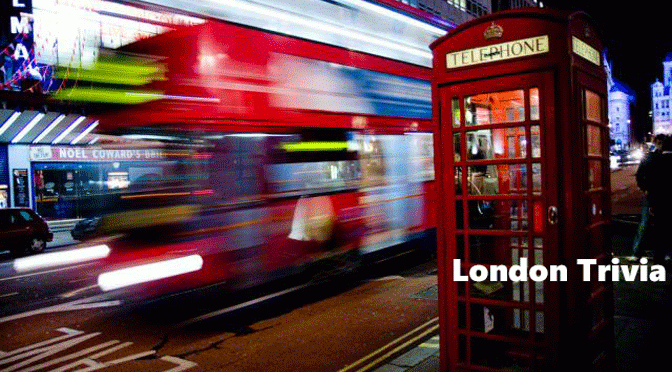
 Trivial Matter: London in 140 characters is taken from the daily Twitter feed @cabbieblog.


 CabbieBlog