Previously Posted: Demographic analysis

For those new to CabbieBlog or readers who are slightly forgetful, on Saturdays I’m republishing posts, many going back over a decade. Some will still be very relevant while others have become dated over time. Just think of this post as your weekend paper supplement.

Demographic analysis (15.10.2010)

This month London’s first French language terrestrial radio station starts broadcasting to the capital’s 400,000 native French speakers as a reminder of their own culture, but why are so many French institutions based around South Kensington?

It’s a subject that has perplexed me for years, if not decades and here I feel I might need some help.

London is often said to be a conglomeration of villages each with its own identity, but also within our City – as with its villages – are islands of immigrant settlements each with their own economic, social and cultural identities.

But here’s the question I would like answered: What attracts ethnic, religious or cultural groups to live in particular areas?

For instance why have the Chinese moved into Chinatown; why are a few streets at the north of Stamford Hill the home to Europe’s largest Hasidic and Adeni Jewish communities. The Greeks frequent Green Lanes and why would you find Little Lebanon, with its large Arabic population along the southern stretch of Edgware Road.

When I first started working in London my company was located in Clerkenwell known then as Little Italy, there was to be found an Italian delicatessen, restaurants serving pasta and pizza, an Italian church, it even had (and still does) an Italian driving school, presumably to teach you Italian driving skills.

Earls Court is known as Kangaroo Court due to the large number of antipodeans students in digs there.

The Irish once populated Kilburn while the Whitechapel Road supports an almost exclusive population of Muslims.

For while I can understand later arrivals setting up home near people of their own ethnic mix for language, security or cultural reasons but what makes the first settlers adopt a particular area?

For the large Afro-Caribbean community in Brixton David Long in his book The London Underground suggests:

During the war a series of deep level air raid shelters were built designed in such a fashion they could eventually be linked up to form a super underground railway, but lack of money after the war meant this scheme was abandoned. So in 1948 the Clapham Common Deep Level Shelter became briefly home to several hundred Commonwealth citizens who arrived on the SS Empire Windrush, laying the foundations for nearby Brixton’s Afro-Caribbean community.

So why have different divergent communities decided at random to live in different areas of London, any theories are to be welcomed?
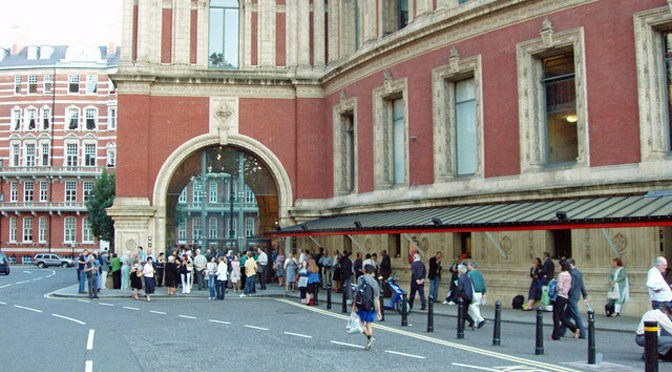
Has Berty Popped?

It is not surprising that an ancient profession such as black cabbies has developed a rich private vocabulary some of the most common are featured here on CabbieBlog.

If you are cruising empty around Kensington it would be helpful knowing when the Albert Hall is emptying.

With over 5,000 concert-goers beginning to exit the auditorium, hailing a taxi home or to their subsequent destination becomes a priority, in fact, I’ve seen punters walking away from the concert venue in the hope of catching oncoming cabs heading towards the West End.

It is during this short critical post-concert period that the term ‘Berty Popped’ – paying homage to the world-famous Royal Albert Hall – finds relevance, alerting cabbies to the potential influx of customers around the South Kensington area.

So, the next time you find yourself stepping out of a memorable performance at the Albert Hall, keep in mind that you are ‘Berty Popping’.

Cabbie Lingo

Market strategy

Romford Market was awarded a licence to trade in 1247 by King Henry III. Originally a sheep and cattle market, in fact before the War my uncle sold second-hand cars there alongside cattle pens. Apart from being a viable crossing over the River Rom (hence the name), the market contributed to the development of the town with up to 150 traders selling a wide range of goods.

When a proposal to open on Sundays was taken, 83 per cent were in favour, prompting Havering’s Leader to announce “Romford Market is the jewel in the crown for Romford”.

Now the current inept Labour-run council are proposing: closing the Sunday market, increasing parking charges by up to 16 per cent, closing libraries, reducing funding for five Metropolitan Police officers, reducing Christmas decorations and outsourcing services.

Johnson’s London Dictionary: Speaker of the House of Commons

SPEAKER OF THE HOUSE OF COMMONS (n.) The presiding officer of the Lower House, who, despite the title doth say very little.

Dr. Johnson’s London Dictionary for publick consumption in the twenty-first century avail yourself on Twitter @JohnsonsLondon

Grumpy, London’s cabbies?

London’s cabbies are renowned for having forthright opinions, many of which are just moans about the job/passengers/mayor or as diamondgeezer has given its unique title: Grumpytutters. Here are 50 top cabbie grumps:
1. Eating food in the cab
2. Lack of civility when stating the destination
3. Putting feet on the seats
4. Kamikaze cyclists
5. Telling the driver they’ve missed the destination when they could have mentioned it earlier
6. Being asked, “How long have you been a cabbie?”
7. Potholes
8. When TV interviews drivers in their cabs they’ll always broadcast the one who talks like the late Len Goodman
9. Pedestrians crossing the road just yards from a crossing
10. “Do you go Sarf of The River?”, Yes!
11. Boris Bikes riders wobbling down the road
12. Idiots who cross the street whilst watching videos on their phones
13. LTNs
14. Drop off charge at airports
15. Other drivers sounding their horns as the traffic lights change, look we’re not in the Middle East!
16. Drivers who won’t indicate
17. TfL – naturally
18. Unregulated Uber
19. Pedicabs blaring music, or just pedicabs period
20. Passengers who only use a cab occasionally who ‘just know’ the driver took the wrong route
21. Festive passengers emanating fluids
22. “Who have you had in your cab?” Are you really interested?
23. Banning cabs from Bank Junction
24. “Do you know my bestfriend’s/brother’s/son, he’s a cabbie? No, but with the number giving up the profession, I’ll soon know them all by name
25. Worrying you’re travelling at 20.1 mph
26. Bilkers
27. Confusing signage. Are cabs allowed or not?
28. The BBC conflating private hire with black cabs
29. Poor editing in a drama, when the protagonists jump in a cab and the driver goes the wrong way or covers the distance in impossibly record time
30. Cabbies whose vehicle is filthy
31. When ITV’s London Today does a piece about pollution, they use for an establishing shot, cabs – usually electric ones
32. Roadworks lasting ages to complete
33. Lack of toilets
34. Hotels banning cabbies from entering their foyer
35. Being told condescendingly that The Knowledge is just a memorisation test, inferior to a bachelor’s degree
36. Not finding a charger that doesn’t charge charging an extortionate price
37. Cabbies who ‘broom a job’, refusing to take a passenger and telling them to get the next cab in the rank
38. Being told you’re just a minicab driver
39. Punters who ask for Suffolk Street, near Trafalgar Square when they mean Great Suffolk Street, Southwark
40. Fare £4.80 “Do you have change of £50?” If my name was Lloyds I would
41. Leaving litter in the back of the cab, or the half-eaten fish and chips once left in my cab
42. Being told before getting in that private hire charge less
43. Having an old cabbie prefacing a conversation with “Back in the day…”
44. Hire light not showing in daylight on the LEVC TX
45. Speed humps, especially in Islington
46. Being asked to go faster to catch a train
47. Scruffy cabbies
48. Being told the address of a hotel, and the Ritz is in Arlington Street, not Piccadilly
49. BMW drivers, don’t we all?
50. Oh! And did I mention Sadiq Khan? Thought not