

A few years ago Time Out (when it appeared in printed form) ran a series: Bloggers picks:15 things to do in London this Autumn, naturally CabbieBlog made a contribution and this was my take on Autumnal London.
See Victorian London blaze into life
There aren’t many places left in the capital where you feel like you may be in Dickensian London, but Kensington Palace Gardens is one of them. At night you’ll notice the soft glow emanating from the street lights: they’re a handful of the 1,500 Victorian gas lamps remaining in the city. Just five lamplighters maintain them – it’s a job so popular that vacancies are rarely advertised by British Gas. As dusk falls and the birds start to roost in the trees, a clockwork device inside each lamp turns on the gas jet, which is ignited by the continually burning pilot light. The flame then heats a silk casing coated in lime oxide which turns white-hot and gives off that misty glow. For a short time, modern-day London is but a memory.
Now if it wasn’t for the pressure group The London Gasketeers, Westminster would have replaced the last of these lamps with LEDs. The council had argued that repairs on the lamps were difficult and expensive, and led to dangerously darkened streets. The local authority will now consult with Historic England, with Cllr Rachael Robathan, the leader of the council, stating:

We all want to preserve these beautiful heritage lamps for the future, but in order to do that we need to make sure they can continue to operate going forward.

We shall be keeping a close watch on this authority’s ambitions for modernity.


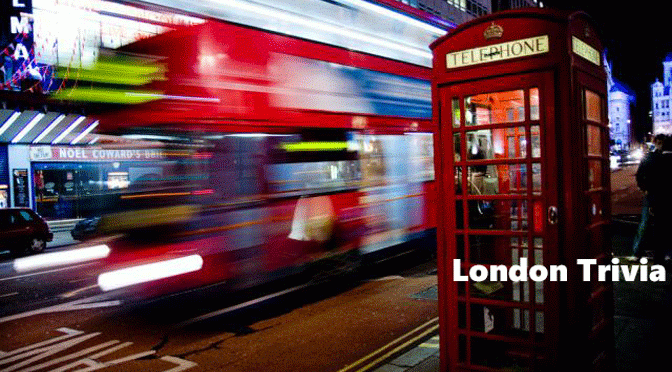
 On 2 October 1899 the first two motorised double-decker buses ran from Victoria to Kennington Park, they were red!
 There are five prisons in London and four of them were built by the Victorians (Wormwood Scrubs, Wandsworth, Pentonville and Brixton). Brixton is the oldest prison in London still in use
 It was Lord Byron’s valet – James Brown – who established Brown’s Hotel in 1837. Agatha Christie’s At Bertram’s Hotel is based on Brown’s Hotel
 Mayfair’s most eccentric dentist was Martin von Butchell, when his wife, Mary, died in 1775 he had her embalmed and turned her into a visitor attraction to drum up more business
 ‘So hour by hour, be thou my guide, that by thy power, no step may slide.’ The words to Big Ben’s chimes known as the Westminster Quarters and is the most common clock chime melody
  A blue plaque commemorates the site of the Tabard Inn, immortalised in Chaucer’s Canterbury Tales, in Talbot Yard, Southwark
 The George Inn is a National Trust-owned, medieval pub in Southwark and one of the few Grade I listed public houses in England
 For the London 1908 Olympics there was the first purpose-built Olympic swimming pool, at the Paris Olympics of 1900 the competitors had to race through sewage in the River Seine
 A spiral escalator was installed in 1907 at Holloway Road station, but linear escalators were favoured for the rest of the network. A small section of the spiral escalator is in the Acton depot
 In 1809 as part of a hoax a resident of 54 Berners Street was visited by hundreds of maids requesting jobs and tradesmen delivering goods
 Medieval London’s streets moral impurity was underlined by their names: Codpiece Lane, Sluts’ Hole, Cuckold Court, Whores’ Nest, Maiden Lane
 CabbieBlog