
Monthly Archives: July 2020

The Ugly, The Bad and The Good!
This little anecdote starts at the Hilton Metropole. A family come out and demand Westfield, I take them to Wood Lane, “No this is not the entrance”. Then it’s off to the second entrance in Wood Lane, “No take us to the cab rank”, next it’s on to Shepherds Bush Station cab rank, “No this not this entrance we want – take us back to the hotel”. If they though with £16 on the meter I was going to retrace my steps they were sorely disappointed. I ask them to get out, suspecting it was a ruse used before leaving them – without paying – having to waddle all of 150 yards into the shopping emporium. Driving on to the Hilton Kensington a Swedish woman gets in “Please take me to Hilton Olympia” (there are a lot of Hiltons in London). She has apparently been taken to the wrong Hilton by the private hire driver. “You cabbies are marvellous”, she intones. I drop here off and receive a generous tip. One hundred yards later a hand goes out and two ladies ask for Gibson Square, it’s the first ‘run’ of The Knowledge. You could say it was: The Ugly, The Bad and The Good!
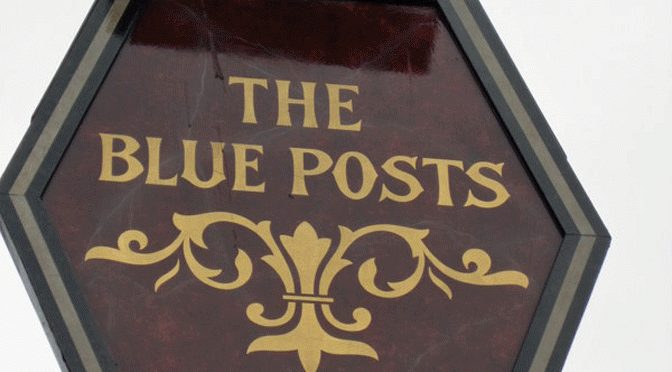
The last post
Have you noticed the preponderance of pubs named the Blue Posts? A simple tally shows at least five plus, as is inevitable in London nowadays, there are others which have closed to allow yet more ’executive apartments’ to be built.
For many years it was thought that while barber/surgeons sported a red and white striped pole outside their premises, a pair of blue posts denoted that this was a sedan rank.
So how many blue posts pubs are, or were, in London?
Cowcross Street (now called Jacomo’s); Berwick Street; Rupert Street; Kingly Street (now a gastropub); Hanway Street (closed); Old Bond Street (called Two Blue Posts, now closed); Cork Street (called Old Blue Posts, a famous dining room, closed in 1911); Newman Street and Shoe Lane. The Blue Posts in Bennet Street has the following sign hanging above this St James hostelry featuring a sedan chair and two brilliant-blue bollards:
Although the existing ’Blue Posts‘ replaces the one which was destroyed during World War II, a pub of this name, on this site, was mentioned by the Restoration dramatist George Etheredge as early as 1667. The poet Lord Byron lived next door in 1813. The ‘Blue Posts’ (two azure painted poles) once stood in the tavern’s forecourt and served as an advertisement for a fleet of sedan chairs which used to ply for hire in Bennet Street.
In 1634 the first rank for horse-drawn cabs was the brainchild of Captain John Baily, situated on the Strand near Somerset House. Unlike the old sedan ranks with their tiny blue posts this nascent rank was next to a 100ft maypole, no wonder they usurped the sedan chairs.
Horse-drawn vehicles for private hire had been around in one form or another since medieval times. But no one had attempted to operate from a designated waiting place, or rank, until the 17th century, pioneer Captain John Baily, was a veteran of one of Sir Walter Raleigh’s expeditions.
He managed a rank of four horse-drawn carriages, Baily’s cabmen wore a distinctive livery and charged customers a fixed tariff depending on the distance. The rank was positioned close to the Strand maypole, a prominent medieval landmark. This towered 100ft high, making it one of the tallest structures in London at the time. It must have made the cab rank very easy to find.
Baily’s cab rank scheme appears to have worked well, and others soon appeared. The cab profession was given official approval in 1654 when one of the first Acts of Parliament under Oliver Cromwell set up the Fellowship of Master Hackney Carriages, under the control of a court of aldermen in the City of London, and initially restricted to 200 cabbies.
Featured image: The Blue Posts on Eastcastle Street by Ian S (CC BY-SA 2.0)(CC BY-SA 2.0)
London in Quotations: A. H. Beavan

The City of London, whose resident population hardly equals that of Dover, but whose precincts over a million persons enter daily, Sunday excepted, on business bent.

A. H. Beavan, Imperial London
London Trivia: First black player to win Wimbledon
On 5 July 1975 American tennis player Arthur Ashe became the first black man to win the Wimbledon singles’ championship. Ashe beat defending champion Jimmy Connors three sets to one on Centre Court. Ashe would use his profile protesting against apartheid in South Africa and US treatment of refugees arriving in the country from Haiti. He died in February 1993 after contracting Aids from tainted blood.
 On 5 July 2012 The Shard, standing at 1,016ft, the tallest building in the European Union was inaugurated, three weeks before the London Olympics
 It is illegal to die in the Palace of Westminster on the grounds that anyone who dies in a royal palace is technically entitled to a state funeral, unfortunately, this has been proved to be a myth
 The world’s first underwater tunnel was the Thames Tunnel opened in 1834 between Wapping and Rotherhithe was until 1866 used by pedestrians
 The Museum of London has in its collection 6,500 skeletons comprising for study every period in London’s 2,000-year history
 Charles I, rather ungallantly it has to be said, after his own nuptials declared that “you can get used to anyone’s face in a week”
 The figure of The Old Lady of Threadneedle Street on the facade of the Bank of England has a model of the bank on her lap
 On 5 July 1969, the Rolling Stones gave a free concert in Hyde Park following Brian Jones’ death two days earlier
 On 5 July 1957 the men’s final at Wimbledon was interrupted by a polite protester against the banking system
 Before motorised vehicles, horses were involved in an average of 175 fatal accidents a year in London and eat over 1 million tons of fodder
 The Press Association was formed from an idea hatched in the back of a Hansom Cab stuck in a London smog in 1868
 On 5 July 1799 the first streaker was arrested when a man run naked from Cornhill to Cheapside for a wager
 Trivial Matter: London in 140 characters is taken from the daily Twitter feed @cabbieblog.
A guide to the symbols used here and source material can be found on the Trivial Matter page.
 CabbieBlog