

Just returned from a short break in Norway. Bergen a small city of less than 1 million, has up to 3 cruise ships disgorging 5,000 passengers each every day. Hardly any litter in the streets or rubbish left on trains, the eating areas and beauty spots are, well, spotless. Back in London rubbish litters the gutters, bins overflow and there’s graffiti everywhere. Why?
Monthly Archives: April 2020
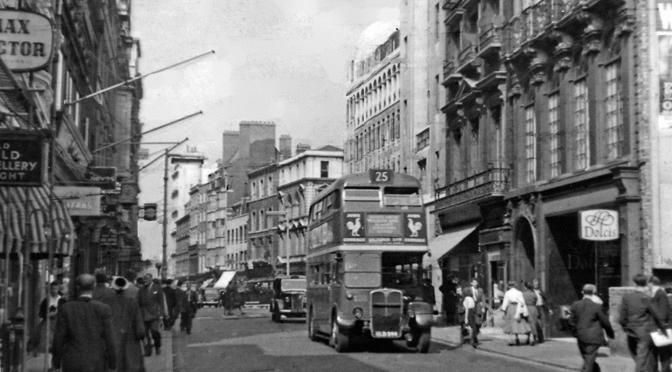
A Journey by a 1950’s London Bus
I came across this production by the Colonial Film Unit which tells those who find themselves in a foreign land, just how to identify a bus, the reasons we have a conductor, how to buy a ticket, and importantly how to queue. It’s just the sort of essential information our cousins from Africa would have needed in 1950 to assimilate themselves into British society. It also reinforces the perception that everyone speaks in either a plummy received pronunciation BBC accent or is a cockney urchin.
Opening scenes show Piccadilly Circus teeming with buses and cabs, some looking to be pre-1914 models. No cars or lorries are to be seen.
In case you haven’t realised, we are told that these “splendid” buses will transport you out of “the largest city in the world”, and yes, they will actually retrace their route back to the Metropolis, but we are told that one must ensure the bus is travelling in the correct direction for one’s needs.
The narrator describes how two “African students studying in London”, who’ve been walking across fields in the badlands of Potters Bar, now need to get back to their studies and prepare to catch the bus. They remarkably manage to join a queue at the bus stop, presumably having been told by the upper-class documentary makers at just what end of the queue to stand.
The Cockney conductor, after ensuring everybody is safely seated, collects the fares. The film is at pains to show even our African students are capable of purchasing a ticket, but our guinea pigs don’t have the correct change, which the narrator tells us that it’s just not the British way.
Later in the journey, as if to reassure the public, the bus manages to stop for schoolchildren at an early pedestrian crossing.
At the end, the students alight from the bus to a cheery wave from the conductor, before unhurriedly crossing the road, presumably the subject of another documentary to teach bright African students how to traverse England’s highways.
Wonderfully politically incorrect, and evocative of post-war Britain, when only those with the correct accent had the brains to use buses and a much-needed teaching aid for Johnny Foreigner.
Featured image: Northward up Old Bond Street from Piccadilly, the 25 bus, the only route on Bond Street, is bound for Victoria from Becontree Heath by Ben Brooksbank (CC BY-SA 2.0)
London in Quotations: Dennis Farina

Yes, London. You know, fish, chips, cup o tea, bad food, worse weather, Mary-f**king-Poppins. London!

Dennis Farina (1944-2013)
London Trivia: London smallpox epidemic
On 5 April 1973, the Department of Health & Social Security declared London ‘a smallpox-infected area’, after a laboratory technician working part-time in the pox virus laboratory at the London School of Hygiene and Tropical Medicine became ill on 11 March and saw her own family doctor. A patient at the London hospital subsequently proved positive, he died the next day. Three cases of the contagion were confirmed.
 On 5 April 1968 Flight Lieutenant Alan Pollock became the first pilot to fly a jet aircraft (Hawker Hunter) under the span of Tower Bridge
 Bollards near Tate Britain were used to tie up barges alongside Millbank Penitentiary used to house prisoners destined for deportation
 When tunnelling for the Jubilee Line extension St. Stephen’s Tower – which houses Big Ben – shifted over an inch it had to be shored up
 St. Bartholomew’s Hospital was founded in 1123 and is the oldest hospital in England still on its original site
 On 5 April 1967 fans of The Monkees walked from Marble Arch to the US Embassy, Grosvenor Square to protest at Davy Jones’ planned call-up
 London street artist or graffiti dauber depending on your view comes from Bristol, famously secretive, he could come from, well — anywhere
 Birdcage Walk derives its name from the aviary owned by King Charles I containing exotic species including a crane with a wooden leg
 On Shrove Tuesday charity teams race up and down Dray Walk, Spitalfields flipping pancakes. The winning team receives an engraved frying pan
 On Tower Hill is an entrance to the 1870 Tower Subway. You could ride under the river in a carriage pulled by cable
 Lionel Logue who cured King George of his stammer had his practice at 146 Harley Street from 1926 to 1952 in the film Portman Place was used
 Plaque on house by the Globe Theatre which claims that Wren lived there was put up by past owner Malcolm Munthe who made it up!
 Trivial Matter: London in 140 characters is taken from the daily Twitter feed @cabbieblog.
A guide to the symbols used here and source material can be found on the Trivial Matter page.
 CabbieBlog