
Monthly Archives: January 2020

Bridging the Gap
The inability of Transport for London at taking on a project cannot be better demonstrated than the work to replace the 160 yards long Ardleigh Green Bridge on the A127 in Romford. Work began on the 24th September 2014, after interminable delays and changes of builders, the bridge was finished on 30th March 2019, four-and-a-half years of construction chaos, in comparison is a project nearby that TfL didn’t manage. The QEII Bridge, when completed at Thurrock, was the longest cable-stayed single-span suspension bridge in Europe. A four-lane road deck carried by two pairs of steel and concrete masts 276ft tall, founded on 175ft high concrete piers sunk into the Thames. At an overall length of nearly 2 miles, it took only 3 years to build. We should never let the hapless TfL near another bridge project again.
At the Midnight Hour
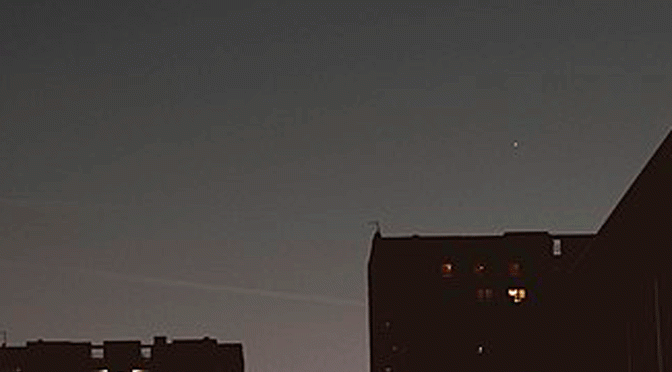
With all this talk of air pollution I would like you to consider another pollution, also found in London – light pollution.
When I was young the Milky Way was easily visible at night above our heads. In fact, I even managed to gain a boy scouts astronomy badge.
Today the moon is barely visible and during a lunar eclipse, the glorious red hue is almost washed out.
This video by Nicholas Buer shows how the Universe could look above London without light pollution. Here city shots were captured during the day and processed to appear to be night, then night sky shots from a dark sky location, taken at the correct latitude to London merged to give these spectacular views.
But there is a serious issue here, apart from the aesthetics. When working nights I would regularly hear blackbird song near petrol stations, they were confused as to the time of day; clearly, without sleep, their life expectancy would be impaired.
For it has been proved that artificial light is having a detrimental effect upon the natural world. Evidence shows that artificial light at night (‘ALAN’) interferes with insect development: movement, foraging and their reproductive success; and is one of the factors contributing to the 75 per cent loss of insect life over the last 30 years. Light pollution has also been shown to affect fish, birds (as with the blackbird), and mammals.
As you might expect, nocturnal creatures are badly affected, just try to recall the last time you saw a hedgehog.

Near cities, cloudy skies are now hundreds, or even thousands of times brighter than they were 200 years ago. We are only beginning to learn what a drastic effect this has had on nocturnal ecology.
Christopher Kyba, light pollution research scientist.
Featured image: London Night Sky Tower Blocks by Stephan Guttinger (1.0 Universal (CC0 1.0)
London in Quotations: Samuel Johnson
You find no man, at all intellectual, who is willing to leave London. No, Sir, when a man is tired of London, he is tired of life; for there is in London all that life can afford.

Samuel Johnson (1709-1784)
London Trivia: Duke of York
On 5 January 1827 Frederick, second son of George III, died at Rutland House in Arlington Street. The Duke of York’s Column in Waterloo Place commemorating his life and paid for by British troops, each forced to donate a day’s pay was said to be so high to escape his creditors for his £2 million debts. After an ineffectual campaign against the Dutch Frederick was mocked producing the rhyme: “The Grand Old Duke of York”.
 On 5 January 1944, the Daily Mail became the first ‘transoceanic newspaper’ launching the Transatlantic Daily Mail a digest of London’s paper
 In January 1965 Freddie Foreman abducted Ginger Marks outside Repton Boxing Club, Cheshire Street, Bethnal Green, he then murdered him
 Etched into the frosted windows of the Albert Tavern in Victoria Street is an image of Prince Albert’s penis. Grade II listed it was built in 1862 and is the only remaining building from the original phase
 The tomb of Lord Nelson stands in the crypt of St Paul’s Cathedral directly below the centre of the dome. His sarcophagus had been commissioned by Cardinal Wolsey in around 1524 before he fell from favour
 Immediately before and two months into World War II Bank of England Governor, Montagu Norman supported transfers of Czech gold to Hitler’s Germany
 The cover for Oasis’ second studio album (What’s The Story) Morning Glory was shot in Berwick Street, Soho
 Fortnum and Mason was the first store in England to sell Heinz’s tinned foods in 1886. In 1901 Heinz Baked Beans were first sold at in their food hall
 Whilst a pupil at Rugby School, William Webb Ellis is thought to have invented rugby football. He became the rector of St Clement Danes church in Strand
 On 5 January 1964 Stamford Brook was the first tube station on the network to have an automatic ticket barrier installed
 Before Anthony Trollope started work at the General Post Office, St Martin’s-Le-Grand each morning he would rise at 5:30am and pen 1,000 words
 In his time, founder of Sutton’s Hospital in Charterhouse Square, Sir Thomas Sutton (1532-1611) was the richest commoner in England
 Trivial Matter: London in 140 characters is taken from the daily Twitter feed @cabbieblog.
A guide to the symbols used here and source material can be found on the Trivial Matter page.
 CabbieBlog