
With thousands of acres of farmland and woodland in every direction, it’s great to see this festive decoration from Sadiq, unfortunately very few will see it as it’s pretty unpopulated around this edge of London.
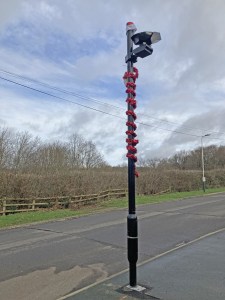

With thousands of acres of farmland and woodland in every direction, it’s great to see this festive decoration from Sadiq, unfortunately very few will see it as it’s pretty unpopulated around this edge of London.
TRAFALGAR SQUARE CHRISTMAS TREE (n.) Gift from Oslo that doth is displayed in London bedecked with single rows of lights that make the specimen resemble a rocket rather than a celebration of unity at Christmas.
Dr. Johnson’s London Dictionary for publick consumption in the twenty-first century avail yourself on Twitter @JohnsonsLondon
Today of all days, while you’re still digesting your Christmas dinner, the last thing you want to read is about food, but here goes.
Not so long ago, Britain’s national meal was probably a roast dinner. Chicken or on special occasions a capon or turkey, likely sliced thinly and served up with plump roast potatoes and various spoonfuls of veg, all covered in thick gravy with a dollop of cranberry sauce on the side. The perfect roast dinner would be served up by Lynda Bellingham, an OXO-crumbling Mum ladling out gravy every Sunday to a smiling family sitting around a bountiful dining table.
As a change (and to give Mum a rest) on Friday nights, the national takeaway meal was fish and chips. Plump white cod fried to within an inch of its life in thick crispy batter, packed together with a mountain of greasy thick chips, unwrapped from a semi-transparent fat-stained sheet of grease-proof paper, rolled up in last week’s news. Dolled out by Dad and sprinkled liberally with brown malty vinegar and salt.
That was in the days when the family meal was a regular feature in our homes and yesterday might be the only time everyone sat down together this year.
I posted some months ago about how London’s high street is changing from a place to shop for essentials to somewhere we can graze, when my local had 24 fast food outlets since then more have arrived from a vegan ice cream parlour to a purveyor of waffles.
I blame that 1970s invention, the chicken tikka masala. A meal so convincingly Indian that legend tells it was probably invented in Glasgow. De-feathered meat from battery farm hell, already pre-chunked to save effort should you choose to hurl it all up later. The perfect chicken tikka masala would arrive in a thick liquid gloop that’d stain your carpet orange should you spill a drop, and stain your intestine orange if you didn’t.
The orange gloop spelt the end for mobile grazers, it’s not easy to walk, check out your socials and shovel rice immersed in the sauce at the same time.
Enter the Holy Grail of takeaways, Chicken-in-a-Box. It’s quick to cook, easy to get hold of, and extremely portable. It slips off the fingers with ease, and it slips down the throat in seconds. You can see the evidence on the streets – generally littered all across them. It’s Chicken-In-A-Box. And it’s everywhere, all over London you’ll find signage above these outlets, many with slightly different names, but all with a similar corporate identity.
As cheap and nasty fast food goes, there’s little to compete with Chicken-in-a-Box. In fact, our local NatWest Bank has become an outlet, who would think there’s more money to be made in selling the very dodgiest scrapings of scrawny poultry, recombined in over-salted water, and given a greasy overcoat of soggy breadcrumbs, than making money from, well money?
Naturally, this isn’t eaten in a restaurant but served with a liberal portion of thinly chopped potato sticks, similarly fat-soaked, dumped into a cardboard box and topped off with artificial squirtings of slimy red sauce. Throw in a can of sugared fizzy water for good measure and there you have a balanced meal. No wonder the nation is in the grip of an obesity crisis.
Now because this food is cheaper today than the roast dinner of our grandparents’ day, a new tradition has gripped our Nation. This ‘food’ is so indigestible that it is rarely entirely consumed, but disposed of upon the pavement for the foxes. Will we soon see overweight canines roaming our towns?
Featured image: Roasted Chicken Dinner Plate, Broccoli, Stuffing, Potatoes, Demi-Glace by Michael J. Bennett (CC-BY-SA-3.0)

It’s a sad fact of modern life that if you drive long enough, sooner or later you must leave London behind.

Ben Aaronovitch (b.1964), Moon Over Soho
On 24 December 1997 Home Secretary, Jack Straw’s 17-year-old son was given police bail after a Daily Mirror journalist following an anonymous tip-off had met him in a pub and been offered a small chunk of cannabis resin for £10 claiming it was “good strong hash”. The editor of the Mirror had phoned Jack Straw to confront them with the story and the minister apparently insisted that his son received no special privileges.
 On 24 December 1832 thirteen-year-old Princess Victoria recorded in her diary at Buckingham Palace ‘we then went into the drawing room . . . on tables were placed two trees hung with lights ad sugar ornaments’
 The first man to wear a top hat in public caused so much hysteria and commotion in St. James’ that he was arrested for disturbing the peace
 During World War II number 77 Baker Street was requisitioned by the Special Operations Executive, using it as a homing station for message-carrying pigeons
 Aldgate tube station is built on the site of a plague pit mentioned by Daniel Defoe in Journal of a Plague Year in which over a thousand were buried
 The Penderel Oak, High Holborn is named after yeoman farmer, Richard Penderel, who helped Charles II escape by hiding him in a wood
 The opening scene in The Beatles’ movie A Hard Day’s Night was shot at Marylebone Station not Liverpool’s Lime Street as depicted
 In the mid-19th century Thomas Barry was famous for sailing between Westminster and Vauxhall Bridges in a tub towed by four geese
 Smithfield was once the play area of London, where jousting and tournaments took place, later it would be where William Wallace was hanged, drawn and quartered
 The Thames still handles more material by tonnage annually than all of London’s airports combined, the equivalent to 400,000 lorries every year
 As a boy Charles Dickens worked in a boot polish or blacking factory on Villiers Street off the Strand. Embankment station now occupies the site
 Diarist Samuel Pepys buried his parmesan cheese and wine in his garden to protect them from the Great Fire of London in 1666
 Trivial Matter: London in 140 characters is taken from the daily Twitter feed @cabbieblog.
A guide to the symbols used here and source material can be found on the Trivial Matter page.


 CabbieBlog