

For those new to CabbieBlog or readers who are slightly forgetful, on Saturdays I’m republishing posts, many going back over a decade. Some will still be very relevant while others have become dated over time. Just think of this post as your weekend paper supplement.
Bog standard (16.03.11)
No matter how glum I may feel driving around London the sight of a Pimlico Plumbers’ van with their amusing number plates: W4TER, DRA1N, BOG 1 or my favourite 701LET is guaranteed to put a smile on my face, and if you want one for your home they have now even produced a diecast model of their iconic blue and white livered vans that you can buy. I doubt if these miniatures announce “This Pimlico Plumbers van is reversing” as the full sized version does but I guarantee that when you purchase the model it will be as immaculately clean as the originals are maintained.
The company’s founder and Managing Director, Charlie Mullins, is the archetypical London boy made good. Bunking off school at the age of nine to help a local plumber, he couldn’t wait to stop his education early to become an apprentice plumber.
Once he became a journeyman plumber, and after a couple of false starts, he founded Pimlico Plumbers. His the success, and this should be memorised by every aspiring business leader, isn’t through any special business plans, strategies or forecasts, the core values established from the outset are still the key drivers to the business’ success today. Quality of service.
Charlie looked at all the bad things people think about the plumbing industry: the ripping off, looking scruffy, dirty old van, making out that you can’t get the part, not finishing the job, never turning up on time. He reckons that if you just do the opposite to all the bad things you can’t fail.
Another unusual aspect of Pimlico Plumbers is their willingness to employ older staff; something that many of my generation have found to their cost, that employers are unwilling or unable to take on middle aged staff. Pimlico’s have gone way beyond that age demographic. George Gibbs, aged 83 of Snodland, sent an appeal out in his local newspaper and some of Pimlico Plumbers employees who lived in the area brought the paper in for Charlie to read. The boss, who has appeared on Channel 4’s The Secret Millionaire, was impressed and hired Gibbs as a van driver. Pimlico’s have in the past employed even older staff, Buster Martin, who sadly passed away in April, was Britain’s oldest employee at 104.
Now Pimlico Plumbers is on the search for classic ‘Crappers’ and plumbing icons for its new museum featuring bathrooms from the past 150 years; Victorian toilets, art-deco basins from the 1930s and of course Thomas Crapper originals.
Charlie Mullins whose client list includes Harry Hill, Jack Dee and Helena Bonham Carter is always keen to promote his trade, claims that plumbing is the world’s second oldest profession and the skills and innovations of the industry have touched everyone’s lives. His new museum intends to showcase a range of quirky exhibits that will demonstrate the ingenuity of pluming engineers and bring back memories for visitors.
Entry to the museum in Sail Street will be free with a collection box for nominated charities and it has to be near the top of London’s most quirky museums.



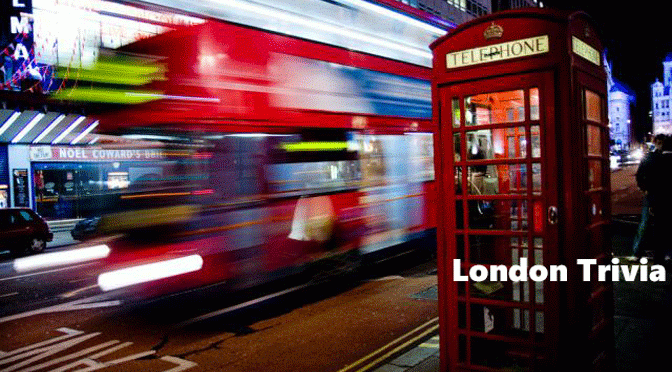
 On 7 April 1908 Herbert Henry Asquith’s Liberal Party won the General Election. Edward VIII was abroad, the only time the elected Prime Minister had the official ‘Kissing of the Hands’ abroad
 In Oliver Twist Charles Dickens sited Fagin’s Lair in the notorious area that existed around the current Saffron Hill
 In the 11th century, Brixton was known as ‘Brixistane’ meaning ‘the stone of Brihtsige’. Locals used the stones as a meeting place
 Behind the stalls of Islington’s Sadlers Wells Theatre is the well containing medicinal water which Thomas Sadler found in 1684
 On 7 April 1968 after previously accompanying Princess Margaret and The Queen Mother King Freddie of Buganda was found living on the dole
 George Orwell used Senate House in Bloomsbury as the inspiration for The Ministry of Truth in his book 1984
 Birdcage Walk was the site of the 17th century Royal Aviary. Diarist John Evelyn spotted “many curious kinds of poultry” here
 In 1922 in the rafters of Westminster Hall was found a tennis ball dating from before 1520 made of leather and stuffed with dog’s hair
 In between Golders Green and Hampstead the tube slows down for the ghost station “Bull and Bush”, a station which was never built
 In the early 80’s comic Jo Brand worked as a psychiatric nurse at the Maudsley Hospital, Denmark Hill, a fact of her life she will often talk about
 Chains from Brunel’s Hungerford Bridge, demolished in 1864, were re-used as part of the Clifton Suspension Bridge in Bristol

 CabbieBlog