
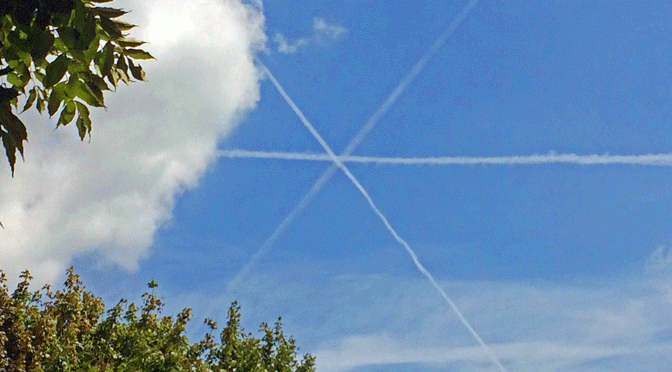
With skies bluer than at any time in living memory, the lack of pollution turning it a deeper shade of blue, normally found on remote tropical islands, this week’s quiz turns to above our heads and London’s air.
Questions
1. Heathrow’s first passenger terminal was opened by the Queen in which year?
(a) 1955
(b) 1957
(c) 1959
2. England’s first manned balloon flight by Vincenzo Lunardi on 15th September 1784 took off from which London location?
(a) St. James’s Park beside what is now Buckingham Palace
(b) The Artillery Ground in Moorfields
(c) Outside St. Paul’s Cathedral
3. What was ‘The Skylon’ which once stood on the South Bank between Waterloo Bridge and Hungerford Bridge?
(a) A sculpture
(b) An aeroplane
(c) A skyscraper
4. From where in London did A. V. Roe launch the first powered flight in Britain by a British citizen in a British plane?
(a) Hyde Park
(b) Green Park
(c) Walthamstow Marshes
5. Why did a performance of La Traviata at Sadler’s Wells Theatre have to be abandoned in December 1952?
(a) Smog drifting into the theatre was so thick that the audience could scarcely see the performers
(b) A burst of hailstones brought down part of the ceiling
(c) Rain caused the nearby New River Head to flood the area
6. Much like today in December 1976 all planes at Heathrow were grounded. For what reason?
(a) Intelligence that the IRA were to hijack a passenger plane
(b) A flying pig
(c) A freak electrical thunderstorm
7. The weathervane of Liberty department store depicts what?
(a) The Statue of Liberty
(b) The Pilgrim Fathers’ ship the Mayflower
(c) Hermes the Greek God of Merchants
8. 7 Bruce Grove was the last home of Luke Howard, but for what is he known?
(a) He is known as the namer of clouds
(b) He deduced why the sky is blue
(c) He invented the modern weather station
9. In the film Mary Poppins, how much money does it cost to acquire ‘paper and strings’ to Go Fly a Kite?
(a) One penny
(b) Tuppence
(c) Thrupence
10. As my picture, taken above Romford, shows, plane contrails were once a familiar sight above London, as these ephemeral trails mark flight paths that criss-cross the city. The planes causing these vapour trails are held in holding stacks, but how many stacks does Heathrow have?
(a) Twelve
(b) Eight
(c) Four
As a bonus what is the cabbie speak for: A frarney?
Answers
1. Heathrow’s first passenger terminal was opened by the Queen in which year?
(a) On 16th December 1955 unveiled The Queen’s Building at London Airport, its name only revealed at the end of Her Majesty’s speech. Later renamed Heathrow, the original site was opened on 31st May 1946, with its first arrival a BOAC Lancastrian from Australia.
2. England’s first manned balloon flight by Vincenzo Lunardi on 15th September 1784 took off from which London location?
(b) Taking off in an impressive red-and-white silk balloon from Moorfields Artillery Ground, now the Honourable Artillery Company in City Road, Lunardi was lauded as the ‘idol of the whole nation’. Later balloons became a fashionable addition to London’s pleasure grounds, Charles Green’s party trick was to ascend from Vauxhall Gardens on horseback.
3. What was ‘The Skylon’ which once stood on the South Bank between Waterloo Bridge and Hungerford Bridge?
(a) A futuristic, 300ft high cigar-shaped aluminium sculpture with, as people joked at the time, ‘no visible means of support’, the Skylon was constructed as part of the Festival of Britain in 1951. Dismantled the following year, it was made into commemorative paper-knives and artefacts.
4. From where in London did A. V. Roe launch the first powered flight in Britain by a British citizen in a British plane?
(c) In 1909 Alliott Verdon Roe, who had been inspired by watching albatrosses in flight during his time in the merchant navy, constructed an early aeroplane under a viaduct and flew his Avro Triplane for 306 yards across the Marshes. A blue plaque marks the arches that he used as a workshop.
5. Why did a performance of La Traviata at Sadler’s Wells Theatre have to be abandoned in December 1952?
(a) The Great Smog of 1952 was the worst in the twentieth century, caused mainly by coal fire smoke, visibility in the city was reduced to inches. Several thousand would die from associated bronchial and cardiovascular illnesses associated with its inhalation. The reduction in air quality would bring about the Clean Air Act of 1956, and the imposition of the use of smokeless fuels.
6. Much like today in December 1976 all planes at Heathrow were grounded. For what reason?
(b) A pink pig had been strung between the chimneys of Battersea Power Station for the cover shoot of Pink Floyd’s album Animals. When the pig broke its moorings and floated away, all planes were grounded and the RAF was scrambled to chase it to ground in Kent.
7. The weathervane of Liberty department store depicts what?
(b) The weathervane has a detailed replica of The Mayflower, the ship that carried the Pilgrim Fathers to North America. The shop itself is made of ships: its mock Tudor facade was fashioned from the timbers of HMS Hindustan and HMS Impregnable (formerly known as HMS Howe and once the largest ship in the world). Liberty is also the size of a ship: The Great Marlborough Street frontage is the same length as the Hindustan.
8. 7 Bruce Grove was the last home of Luke Howard, but for what is he known?
(a) Luke Howard died on 21st March 1864 at 7 Bruce Grove, Tottenham. He proposed the nomenclature system that we still use today to identify clouds. He was also the first person to observe and measure the fact that London is warmer than the surrounding countryside. His Blue Plaque at Bruce Grove states: ‘Luke Howard 1772-1864 Namer of Clouds Lived and Died here’.
9. In the film Mary Poppins, how much money does it cost to acquire ‘paper and strings’ to Go Fly a Kite?
(b) Bert (Dick Van Dyke) sings: With tuppence for paper and strings/You can have your own set of wings/With your feet on the ground/You’re a bird in flight/ With your fist holding tight/To the string of your kite.
10. As my picture, taken above Romford, shows, plane contrails were once a familiar sight above London, as these ephemeral trails mark flight paths that criss-cross the city. The planes causing these vapour trails are held in holding stacks, but how many stacks does Heathrow have?
(c) Forming a web across its six international airports, the routes that planes take into, out of, and across London are designed to cause the least disturbance to the fewest number of people. Heathrow has four holding stacks above Bovingdon, Ockham, Biggin and Lambourne. Incoming planes circle above navigation beacons until they get the green light from air traffic control to begin their final approach.
As a bonus what is the cabbie speak for: A frarney?
A frarney is rain or a rainstorm, from rhyming slang ‘France and Spain’. Also known as Mushers Lotion, rain bringing more work to those owning their cab, or mushers.


 On 3 May 1968 the United Kingdom’s first heart transplant was undertaken at the National Heart Hospital in Marylebone, it was the 10th procedure of its kind in the world
  Lady Elizabeth Hatton leaving a ball was found in a yard blood still pumping from her torn body Bleeding Heart Yard commemorates her murder
 In the cloisters of Westminster Abbey is Britain’s the oldest door, in good nick, considering it was made in 1050 before the Norman Conquest
 In 1739 Thomas Coram supported by Handel set up the Foundling Hospital for abandoned babies it was the world’s first incorporated charity
 Christopher Wren built St Paul’s from both ends at same time so funding wouldn’t run out – money would have to be found to join halves up
 The Trafalgar Square lions were sculpted from life Landseer used dead lions supplied by London Zoo until neighbours complained of the smell
 Elizabeth Taylor spent part of her 7th honeymoon in 17th century Old Battersea House, home of her friend Malcolm Forbes
 Wembley Stadium is filled with Middlesbrough FC shirts and scarves. There are also old season tickets, match programmes and various other items of memorabilia, placed in the arch by the steelworkers
 And we think everything was so much better back then . . . early Tube maps asked passengers to refrain from spitting in the carriages
 When St Pauls Cathedral neared completion its elderly architect Sir Christopher Wren was hauled to the roof by bucket and rope to inspect it
 Clerkenwell is named after the medieval Clerk’s Well where Parish Clerks performed Mystery Plays, the well can still be seen


 CabbieBlog