
Last January I wrote Parting company with TfL, laying out the demise, as I saw it, of the London black cab.
Little did I realise then just how successful Transport for London would be in reducing the number of wheelchair accessible vehicles on London’s streets.
On 1st August TfL published its fortnightly statistics covering the number of vehicles and licences in service on London’s streets.
The previous week there was a decrease of 20 licences (22 surrendered and 2 issued}, while 13 vehicles were taken off the road and 14 new vehicle licenses issued.
On the face of those figures not much seems any different from any previous week in August.
Until you drill down to the cumulative figures. Comparison with 10 years ago show a very different story: 2011: 22,558 vehicles (2021: 13,461), all London drivers’ licences 2011: 21,499 (2021: 18,341). Private hire record an even more dramatic change with operators numbering 3,111 in 2011 (2021: 1,955) and drivers recording a dramatic rise to 61,200 in 2011 (2021: 105,329).
All this has not gone unnoticed in the national press. The Daily Telegraph ran a piece by Oliver Gill, their chief business correspondent with the headline ‘Black cab slump to the lowest level since 1983 as a quarter of drivers quit’.
The transport union RMT have called on ministers to work with London Mayor Sadiq Khan to introduce emergency support measures following Department of Transport figures showing a catastrophic 29 per cent drop in the number of licensed vehicles, the lowest since 1983. From that, they extrapolated there has been a drop of more than 5,000 wheelchair accessible vehicles operating in the capital.
So there you have it. Get caught on a TfL vehicle without a face mask, and a valid excuse, you get fined or refused transportation. Find yourself in the vulnerable position of needing some kind of aid (wheelchair accessibility, low steps or swivel seats), and I’m afraid you’ll have to wait some considerable time.



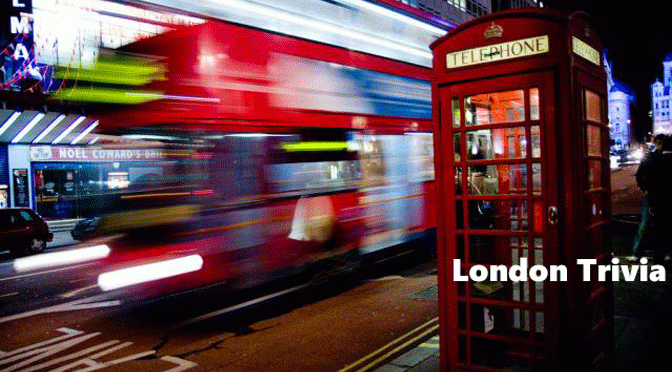
 On 22 August 1854 magistrates spent three hours dealing with cases arising from the fair at Camberwell, including numerous children, as young as nine or ten, who were charged with pickpocketing
 Robert Peel’s new Metropolitan Police Force nicknamed ‘Blue Devils’ wore blue to avoid confusion with the red coats of the army
 St Bartholomew’s Hospital is the oldest hospital in London having been founded in 1123 by a monk named Rahere
 Covent Garden is believed to be haunted by the ghost of William Terris who met an untimely death near the station in 1897
 In 1966 Russian spy George Blake escaped Wormwood Scrubs and a 42 year stretch by making use of a ladder made of knitting needles
 During World War II a branch of the Piccadilly line Holborn/Aldwych was closed and British Museum treasures were stored in the empty spaces
 18th century Shepherd Market Mayfair was home to courtesan Kitty Fisher who, insulted by a low value note given for services given, ate it!
 West Ham’s I’m forever blowing bubbles was inspired by trialist schoolboy Billy Murray who resembled the boy used to advertise Pears soap
 When Paddington Underground Station, as the western terminus of London’s first underground, opened in January 1863 it was called Bishop’s Road
 Marc Isambard Brunel came up with his idea on how to dig the Thames’ Tunnel whilst in debtors’ prison watching a shipworm bore through wood
 In 1792 Lady Braddock and Mrs Elphinstone duelled Braddock’s hat got shot off and Elphinstone wounded in the arm by a sword – later they had tea
 CabbieBlog