
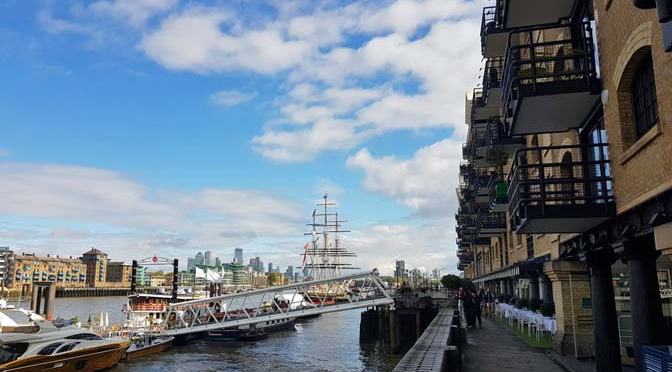
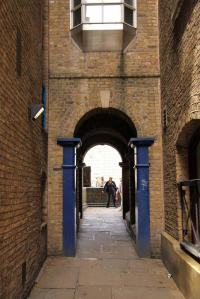
Maggie Blake’s Cause is a small alleyway connecting the Victorian cobblestoned Shad Thames with the riverfront alongside Butler’s Wharf.
So who was Maggie Blake and what, or when, was her cause?
Butler’s Wharf was a large Victorian warehouse complex built in the early 1870s, so successful at the time it earned the sobriquet: London’s Larder. I can remember the area, before gentrification, still smelling of the spices stored in its warehouses.
Containerisation and the development of large, deep-water docks downriver at Tilbury spelt the end of London’s wharves and warehouses, including those at Butler’s Wharf. The last cargo ship sailed away from Butler’s Wharf in 1972.
The warehouses became empty and partly derelict until Sir Terence Conran and his backers won planning permission in 1981 to redevelop them into restaurants and apartments by the London Docklands Development Corporation, with their plans sealing off the riverside frontage, making more space for their restaurants.
As with all these developments for the rich exclusivity was demanded.
Enter Maggie Blake a local community activist who, together with other Bermondsey residents, successfully campaigned to retain access to the riverfront for both locals and visitors.
There is one oddity though, early documents call it Maggie Blake’s Causeway, while today it seems to have dropped the ‘way’.
In a way, that makes the causeway better named, as it was the cause that she fought for.
Featured Image: The Thames Path near Butler’s Wharf Pier by Tim Heaton (CC BY-SA 2.0). This part of the Path’s access to the Thames was made possible by Maggie Blake and other local residents: Developers of the derelict warehouses along Butler’s Wharf “… wanted to limit riverfront access to the owners, occupiers and guests of Butler’s Wharf [new] restaurants and apartments. Maggie Blake and her supporters thought otherwise. They fought a spirited and eventually successful campaign which saved the historic riverfront and its wonderful views of Tower Bridge for ordinary folk”.
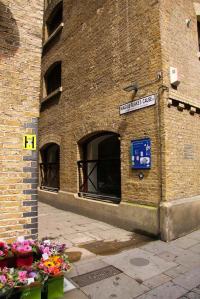
Maggie Blake’s Cause by Steve Daniels (CC BY-SA 2.0). Alley that connects Shad Thames with the waterfront. Maggie Blake, along with other activists wanted to ensure that local people and the general public could walk freely along the south bank of the Thames.




 On 12 September 1878 Cleopatra’s Needle was installed on the Embankment, after nearly being lost at sea
 In his novel Moll Flanders Daniel Defoe described Newgate Prison as “that horrible place”, he should know he was imprisoned there in 1703
 The circumference at the Gherkin’s widest point is 178 metres, which is only two metres less than its height of 180 metres
 In 1926 suicide pits installed due to passengers throwing themselves in front of trains only Jubilee line has glass screens to deter jumpers
 In Parliament in 1981 a private member’s bill (Control of Space Invaders (& other Electronic Games) Bill) tried to ban Space Invaders
 The wedding in the movie Four Weddings and a Funeral was filmed at the Augustinian priory church of St. Bartholomew the Great
 The first HMV store at 363 Oxford Street was opened by composer Edward Elgar in 1921. HMV stands for ‘His Master’s Voice’
 Boxing legend Sir Henry Cooper trained in the gym above the Thomas a Becket pub previously at 320 Old Kent Road, Walworth
 The Underground’s longest journey without change is on the Central line from West Ruislip to Epping – a total of 34.1 miles
 Prostitutes around Southwark worked in the many brothels or ‘stews’ licensed by the Bishop of Winchester and were known as the Bishop’s Geese
 Wildlife observed on the Tube network includes woodpeckers, deer, sparrowhawk, bats, grass snakes, great crested newts, slow worms
 CabbieBlog