
SHAKESPEARE’S GLOBE (n.) Eponymous playhouse that’s neither owned by the Bard, nor doth appear spherical.
Dr. Johnson’s London Dictionary for publick consumption in the twenty-first century avail yourself on Twitter @JohnsonsLondon

SHAKESPEARE’S GLOBE (n.) Eponymous playhouse that’s neither owned by the Bard, nor doth appear spherical.
Dr. Johnson’s London Dictionary for publick consumption in the twenty-first century avail yourself on Twitter @JohnsonsLondon

London has changed enormously and so have the English in the past decade. They’re more like Americans and more like Europeans, too. They’re always eating out, and when they’re at home they don’t cook the way they did ten years ago. They’re all sitting around in cafés, like the Continentals, drinking coffee and chattering and watching the world go by.

Doris Lessing (1919-2013), interview, The Progressive, June 1999
On 26 June 1868 today a Blue Plaque to Napoleon III was affixed at 1c King Street, SW1, it was the first ‘Blue’ Plaque to be erected and the first plaque to survive. The plaques made by Minton Hollins were originally brown, but blue became the norm.
 On 26 June 1857 the first investiture of the Victoria Cross by Queen Victoria took place in Hyde Park on this Friday. Sixty-two Crimean veterans had the cross pinned on by the monarch
 In 1736 gravedigger Thomas Jenkins received 100 lashes for selling dead bodies from St Dunstan & All Saints, Stepney High Street
 Dr Johnson had lived at 8 Bolt Court, from 1776-1784, on 26 June 1819 this house which had survived a blaze in 1807 was completely gutted by fire
 On Westminster Bridge Road is the entrance to an old station from where passengers took their last journey to Brookwood Cemetery
 The Ayrton Light atop Parliament’s Elizabeth Tower (known as Big Ben) shines to show that the House is sitting
 When Ellen Terry visited Whistler’s Chelsea studio Oscar Wilde described seeing her arrive in the full regalia of Lady Macbeth
 King James I kept elephants in St James’s Park. They were allowed a gallon of wine a day each to get through the English winter
 When Queen filmed Bicycle Race promotional video at Wimbledon Stadium with 65 naked female cyclist, cycle hirers demanded saddle replacement
 Jubilee Line trains have been decorated for the Jubilee – appropriate really, as line originally named for 1977 one (hence silver on map)
 The Castle pub in Farringdon holds a pawnbrokers licence granted by George IV when he left a heirloom in lieu of a gambling loan
 During the Great Fire of London, Samuel Pepys buried his prized possession, a chunk of parmesan cheese, in his back garden
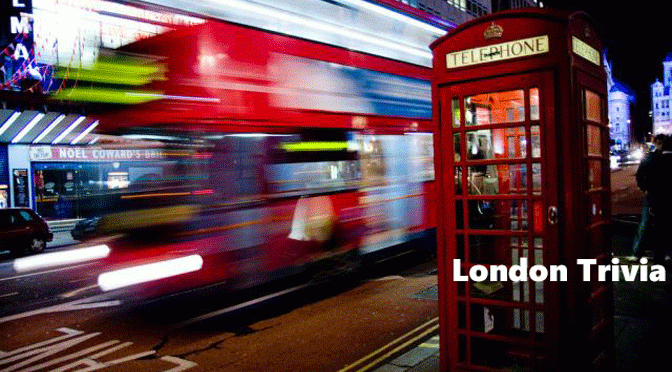
 Trivial Matter: London in 140 characters is taken from the daily Twitter feed @cabbieblog.
A guide to the symbols used here and source material can be found on the Trivial Matter page.
For those new to CabbieBlog or readers who are slightly forgetful, on Saturdays I’m republishing posts, many going back over a decade. Some will still be very relevant while others have become dated over time. Just think of this post as your weekend paper supplement.
The early churches of New England are based almost entirely on the design of St. Martin in the Fields. Completed in 1724 its revolutionary design of having its steeple at the east end of the church, not the west end was the brainchild of architect James Gibbs who decided to turn convention on its head and build the steeple where we see it today. He also built it above an imposing portico that looks like the grand entrance to a Greek temple. Critics marvelled at the audaciousness of the new church and despite the innate conservatism of churchgoers and the church authorities, the new design soon became very popular, so much so that several members of Gibbs’ architectural practice were enticed to American by the offer of large sums of money. With the design of St. Martin’s packed in their bags they moved west as the American settlers moved west, building identical or near-identical copies of St. Martins as they went.


 CabbieBlog