
SCOTLAND YARD (n.) Law agency named after small cul-de-sac for reasons doth unknown.
Dr. Johnson’s London Dictionary for publick consumption in the twenty-first century avail yourself on Twitter @JohnsonsLondon

SCOTLAND YARD (n.) Law agency named after small cul-de-sac for reasons doth unknown.
Dr. Johnson’s London Dictionary for publick consumption in the twenty-first century avail yourself on Twitter @JohnsonsLondon
London Bridge is falling down,
Falling down, falling down.
London Bridge is falling down,
My fair lady.
London’s most famous bridge has never fallen down, but it has been replaced several times over the centuries, and the latest incarnation was opened by the Queen 50 years ago this week on 16th March 1973.
Whether by accident or a deliberate nod to the late Queen’s age, Operation London Bridge was the code name for the funeral plan for Queen Elizabeth II, which of course swung into action a few months ago.
London Bridge’s predecessor, famously shipped off to the Arizona desert, had been there since 1831 when it replaced ‘Old’ London Bridge, the medieval one with the houses down it.
Where London Bridge is today is 50 yards upstream from its predecessor.
Have you ever wondered why the Monument feels off-centre and Gracechurch Street terminates with an awkward curve? This piece of poor urban planning is because this was the original alignment of the former bridge, and the introduced curve aligned the road to the modern bridge.
In particular, the northern roadway used to pass the west door of St Magnus the Martyr, a church which for six centuries was the spiritual guardian of this crucial bridgehead. It was one of the first churches to be destroyed in the Great Fire of London so what now occupies the site is Wren’s magnificent replacement. Its clock once projected out above the roadway, and when traffic increased a pedestrian walkway had to be cut through the bottom of the tower.
St Magnus’s importance vanished when the bridge shifted, and its churchyard is now a flagstoned dead end, barely trodden, with a small flowerbed at one end. It’s still worth a visit, though, to see two chunky stones from the Old London Bridge which were relocated here in 1921.
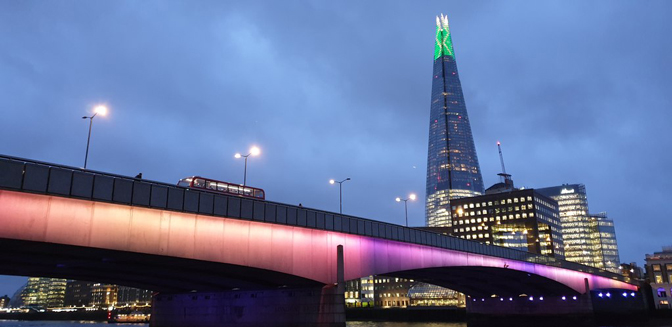
London Bridge and the Shard by Christine Matthews. The top of the Shard is being decorated with different coloured lights designed by local children. (CC BY-SA 2.0)

With the possible exception of New York, there is no place like London for versatility in eating.

James Huneker (1859-1921)
On 12 March London seems to have held its collective breath and done nothing. To liven up the date in 1969 Paul McCartney, then aged 27, married Linda Eastman at Marylebone Register Office with Miss Eastman’s six-year-old daughter in attendance. Hundreds of distraught fans gathered outside seeing their chance of marrying their idol slip away. The ceremony was delayed because the best man, McCartney’s brother Mike McGear of the Scaffold pop group, arrived late.
 On 12 March 1836 pioneering cookery writer Mrs Beeton was born in Cheapside, her Book of Household Management is still in print
 Wife selling in Smithfield didn’t become illegal until the early 20th century. One of the last reported instances, a woman in 1913 claimed that she had been sold to one of her husband’s workmates for £1
 London’s smallest statue can be found on Philpot Lane – a mouse – a memorial to two builders who were killed working on the Monument
 In 1985 eight people were killed in a gas explosion at Manor Fields Estate Putney Police found bags stuffed with £20 notes in the debris
 Edward VI punished Westminster Abbey (St Peter’s) by diverting their funding to St Paul’s hence the phrase robbing Peter to pay Paul’
 When the Coliseum Theatre opened in 1904 it featured a private elevator to transport the King to the royal box. It broke down!
 The Hoope and Grapes, Aldgate has a listening tube which runs from the bar to the cellar so the landlord can listen for treasonable gossip
 When Billy (the police horse who controlled spectators at the 1923 FA Cup final) died, his rider was given one of his hooves as an inkwell
 The Jubilee Line was initially named the Fleet Line after the River Fleet; however it was changed to celebrate the Queen’s Silver Jubilee
 When Odham’s publisher Julius Elias died in 1946 his successor claimed Elias continued to run the Long Acre firm through him as a medium
 We know six ravens are kept at the Tower to keep London safe from invasion, but in 1981 one escaped and flew into a pub in East London
 Trivial Matter: London in 140 characters is taken from the daily Twitter feed @cabbieblog.
A guide to the symbols used here and source material can be found on the Trivial Matter page.
For those new to CabbieBlog or readers who are slightly forgetful, on Saturdays I’m republishing posts, many going back over a decade. Some will still be very relevant while others have become dated over time. Just think of this post as your weekend paper supplement.
According to most politicians if we don’t cycle everywhere (leaving our electric car in the garage), buy our food at “the farm gate” and live like a Hobbit in a woodland setting you’re not eco friendly. From this they extrapolate that living in the countryside benefits the environment, while we urban dwellers are virtually killing polar bears with our bare hands.
This perception of Londoners could be set to change as a result of a recent book by David Owen entitled Green Metropolis. The American urbanologist proposes you move to a city, the biggest you can find, if you want to save the planet.
Building of new eco towns with zero VAT and the opportunity to show their green credentials might be an attractive proposition to many builders, but David Owen asserts that building new in the form of energy-guzzling steel and glass boxed and towers, which are usually unadaptable for later re-use, on Green Belt land has a carbon footprint that’s a disaster.
For we Londoners on the other hand, have a carbon “sink” of buildings, many dating from the Victorian era needing only central heating upgrades or new windows and a lick of paint to transform them into houses, flats, schools, shops or offices that will last for years, and as these long ago constructed buildings share walls, roofs, ceilings and heating systems they are more economical en masse than stand alone structures in the middle of a Norfolk field.
Our politicians with their “green” credentials have all but obliterated public transport from rural areas, forcing the population to use a car for almost every journey, many making two journeys each way to drop children at school or fetch a partner from the station.
Londoners cycle, walk or use public transport to get around the capital; we have more buses in the capital than you can shake a stick at, while after work we crowd into local shops, restaurants, pubs or theatres without having to travel vast distances to enjoy our leisure pursuits, and as I keep telling my customers, they are blessed with the world’s finest taxi service, taking up to six people per vehicle, making it one of the most green public transport vehicles on the road, but then I would say that wouldn’t I?

 CabbieBlog