We challenge our contributors to reply to ten devilishly probing questions about their London and we don’t take “Sorry Gov” for an answer. Everyone sitting in the hot seat they will face the same questions ranging from their favourite way to spend a day out in the capital to their most hated building on London’s skyline to find out what Londoners think about their city. The questions are the same but the answers vary wildly.
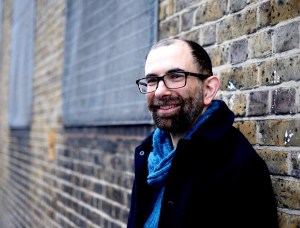
Niall Kishtainy is a London-based writer and the author of The Infinite City: Utopian Dreams on the Street of London (2023), a history of London’s utopian visionaries from the 16th century to the present, and A Little History of Economics (2018). He helps budding writers get their projects off the ground at A Desk By The Window. Niall is a former academic, journalist, civil servant and aid worker. He was born in south London and has lived in the city for most of his life. You can find out more about him at niallkishtainy.com.

What’s your secret London tip?
The tour of the archive at the Postal Museum in Islington is brilliant – a quirky exploration of London’s history through the letters and objects that people have sent over the centuries. Afterwards, you can go for a ride on the old mail rail.
What’s your secret London place?
When I was a kid growing up in Wimbledon I once stumbled on an ornate golden building surrounded by woods and water near the common. It’s the Buddhapadipa Temple and you’d never think you’d find such a thing hidden away behind a leafy residential street in south London.
What’s your biggest gripe about London?
The poor quality, expensive housing. The housing crisis will strangle the city if we don’t get a grip on it.
What’s your favourite building?
The 1940s Spa Green Estate in Islington was designed by the Russian architect Berthold Lubetkin. It’s modernism with a human face – sleek and futuristic but warm and welcoming too. It’s a living monument to the dream of social housing and a little fragment of utopia in the heart of the city.
What’s your most hated building?
Grandiose and overly extravagant apartment blocks like One Hyde Park in Knightsbridge, status residences are often used as financial assets rather than as the real homes that the city so badly needs.
What’s the best view in London?
From the garden of the Horniman Museum in south London, you have central London spread out before you, interestingly juxtaposed in the foreground with Dawson’s Heights, a striking council block designed by Kate Macintosh in the 1960s, which looks like a 20th-century version of some ancient citadel.
What’s your personal London landmark?
The Crystal Palace transmitting station, the tall tapered tower with the red light on top. As a boy, I used to gaze out at it at night from my bedroom window on the other side of south London. Now I live close to it so it tells me when I’m getting home.
What’s London’s best film, book or documentary?
I like Mike Leigh’s High Hopes, a bittersweet depiction of a disappearing working-class community around King’s Cross and the emergence of a new moneyed London. There’s a great scene in which one of the main characters, a frustrated working-class socialist, visits Karl Marx’s grave in Highgate Cemetery and tries to explain Marxist theory to his forbearing girlfriend while Japanese tourists jostle around them. The final scene has the couple and the man’s old mum high on a rooftop looking out awestruck over the railway lines and gasworks down below.
What’s your favourite restaurant?
My local Italian, the magnificent, family-run Trattoria Raffaele on Sydenham Road, which has incredible mozzarella-filled dough balls.
How would you spend your ideal day off in London?
A long walk exploring a neighbourhood, maybe one like Silvertown where you see different layers of London history, before ending with a pint at the Prospect of Whitby in Wapping. Alternatively, my kids’ favourite: doing a circuit involving every form of public transport – train, then tube, DLR, cable car, riverboat, bus. Haven’t yet managed to find a way of incorporating the tram!





 On 1 October 1985 police in riot gear closed off parts of Peckham in an effort to contain continued outbreaks of violence and vandalism as gangs of youths threw petrol bombs and set shops alight
 Robert Peel’s new Metropolitan Police Force nicknamed ‘Blue Devils’ wore blue to avoid confusion with the red coats of the army
 St Bartholomew’s Hospital is the oldest hospital in London having been founded in 1123 by a monk named Rahere
 Covent Garden is believed to be haunted by the ghost of William Terris who met an untimely death near the station in 1897
 In 1966 Russian spy George Blake escaped Wormwood Scrubs and a 42 year stretch by making use of a ladder made of knitting needles
 During World War II a branch of the Piccadilly line Holborn/Aldwych was closed and British Museum treasures were stored in the empty spaces
 18th century Shepherd Market Mayfair was home to courtesan Kitty Fisher who, insulted by a low value note given for services given, ate it!
 West Ham’s I’m forever blowing bubbles was inspired by trialist schoolboy Billy Murray who resembled the boy used to advertise Pears soap
 When Paddington Underground Station, as the western terminus of London’s first underground, opened in January 1863 it was called Bishop’s Road
 Marc Isambard Brunel came up with his idea on how to dig the Thames’ Tunnel whilst in debtors’ prison watching a shipworm bore through wood
 In 1792 Lady Braddock and Mrs Elphinstone duelled Braddock’s hat got shot off and Elphinstone wounded in the arm by a sword – later they had tea

 CabbieBlog