
Category Archives: Thinking allowed
Protected: Pseudonyms and Me
I’ve lost my Trust
Returning from a break in Dorset, surely the most quintessential of English counties, on the doormat was my annual subscription to the National Trust. I have been a member for at least 40 years and this year is the only time not one of the Trust’s properties has been visited by us.
The letter magnanimously informed me that due to COVID-19 the subscription had remained at last year’s rates (£126), but valued members were essential to ‘keep on caring for the places, collections and nature that unite and sustain us all’.
Over the years a trip to an NT property, with a scone for lunch, has been a regular day out. London alone has dozens worth a visit from the beautifully restored Ightham Mote to Churchill’s Chartwell.
But I’m seriously considering leaving my favourite charity, as far from being run, as in the past, by the Women’s Institue Countryside Diaspora, it is now been overtaken by the urban elite – all but one of its council members live in towns.
First, they spent our subscriptions on encouraging ‘ethnic minorities’ to visit the countryside owned by them. Patronising in the extreme. Not content they persued what historian Sir Roy Strong described as “being obsessed with ticking the boxes of the disabled, the aged, LGBT and ethnic communities”.
Now the Trust has inaugurated what they call ‘Re-Set’, a programme to offset the £200 million loss due to the COVID-19 pandemic and have made what they describe as a ‘Curation and Experience’. This has entailed the removal of all senior curatorial posts and their lead curators in the regions, thus dropping the Trust’s excellence in scholarship and conservation at a stroke. In total 1,200 staff are being made redundant, and how many volunteers have been told their services are no longer required has not been disclosed.
However, the Trust has found the resources to have a year-long audit on all its 300-odd properties to find which were built using the proceeds of slavery or colonialism. Incredibly they are also to examine the source of each of the Trust’s 1.5 million antiques, artworks and artefacts, a daunting and pointless exercise at the best of times.
They have form for moving away from the original motive of their founding fathers and the National Trust Act of 1937, which gave the explicit aims of ‘preservation of buildings of national interest along with their furniture and pictures, and the preservation of beautiful landscapes’. This Act has, in the past, given the Trust special privileges which now seem to be abandoned in favour of a ‘woke’ ethos.
Guides at Felbrigg Hall staged a revolt after being ordered to wear rainbow-coloured lanyards to celebrate the 50th anniversary of the legalization of homosexuality, in fact, I met with NT volunteers when holidaying in Jersey, who had resigned after a lifetime of service to the Trust due to a similar edict.
Avebury Manor decided that Christianity might be offensive to their ‘target’ audience and dropped the abbreviations BC and AD from their signage.
Cadbury’s Easter Egg Hunt has now been downplayed to become just an egg hunt, should the most important date on the Christian calendar be mentioned.
All this is what they call a repurposing to remove the outdated mansion experience and being British. It’s just a pity none of this relates to their core members, be they white middle-class or ethnic minorities wanting a pleasant day out with their children.
One of its senior curators announced that it should stop emphasizing the role of families in the history of stately homes because this: ‘privileges heterosexual lives’. So will many families now be discouraged from entering their sacred portals, whatever their religion, gender, sexuality or ethnicity?
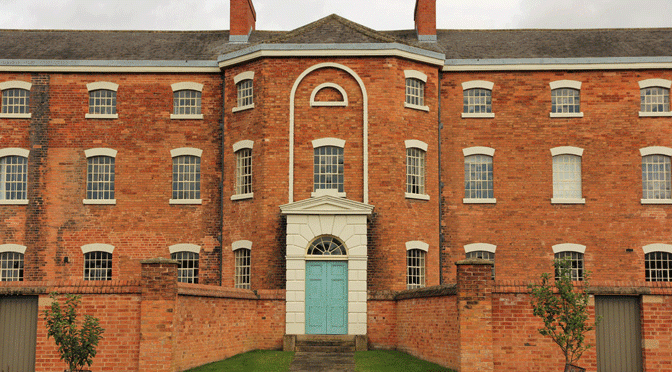
Featured image: Detail of the South front of Southwell Workhouse owned by the National Trust by Richard Croft (CC BY-SA 2.0).
Built in 1824 as a union workhouse for the villages around Southwell, it was originally known as the Thurgarton Incorporation Workhouse. Southwell had its own smaller workhouse at that time (now the Baptist Chapel), but joined in 1834 when it became the Southwell Union Workhouse.
The design was based on the ideas of the Rv. J.T.Becher, a local man, with segregation of the various classes of inmates, and it became the model for the hundreds of workhouses erected as a result of the 1834 Poor Law Amendment Act.
In the latter part of the 19th century, many workhouses developed into Hospitals. At Southwell, a new infirmary wing was built in 1871 to house the sick and infirm, with the original building continuing to provide residential accommodation for the poor. This function continued in the modified form right up until the 1980s, and as a result, the interior remained remarkably little altered. As such it provides a remarkable example of an early 19th-century workhouse. It is currently run by the National Trust.
The main building is Listed Grade II*, and the range of outbuildings on the northern side is Listed Grade II. The gardens to the front of the building have been partly restored to their original use as a vegetable garden and are also Listed Grade II*.

Blogger grumbles
In a city of over eight million people, why should one voice be more important?
London is full of opinions and opinion-makers, indeed, particularly with coronavirus changing our urban world, the future of our capital depends on it. But whereas some opinions have a proper status, for example, because their proponent has been duly elected or appointed to a position of power, others are simply unfounded. Indeed certain people simply pretend to speak for the masses, whereas in truth their ramblings are little more than outspoken anger, based on baseless prejudice and outright negativity. Why should we even bother listening?
An exponent in the past of this hot air is CabbieBlog. This retired London cabbie who publishes five posts, yes, five posts a week at precisely ten to two in the afternoon, speaks out on a wide range of topics. Here, for example, is today’s. The blog does not have Facebook, Instagram, WeChat, TicTok or Snapchat feeds but remains relatively widely read via other means.
London blogs are extremely hard to maintain because there’s not a great deal of financial reward to be had blathering on about trivia, lost rivers or heritage alleyways. Various talented London bloggers, such as Pete Stean’s The Londoneer or Flora Tonking’s The Accidental Londoner have fallen by the wayside over the years, worn down by the pressure of writing words hardly anyone will read, as the tumbleweed of social media indifference passes them by.
In contrast, CabbieBlog has made a genuine attempt to generate a proper sequence of original or plagiarised content and is what a daily blog ought to be. Or was.
At some point, which readers still find hard to pinpoint, CabbieBlog became an outpouring of a cabbie’s whingeing, something any passenger in a black cab could listen to daily.
No petty inadequacy was too small to moan about, no minor failing left uncovered, as his blogging switched from celebrating the capital to pulling it apart.
There’s a fine line between thoroughness and obsession, and many commentators could say the line has now been firmly crossed. So does the stream of bitterness run deep, or is this simply posturing to gain attention, and thereby increase the rankings? What do you think?
To find out, I dug back into the CabbieBlog archives to last August 2011- well before the downward spiral of negativity kicked in. I analysed all the daily posts to see what kinds of things were being talked about, what levels of obsession were apparent, and how biased the general slant of the writing had become.
During that month 13 posts were published, with titles ranging from Bashing the Bishop to Gold Shoulder and James Bond. Only two of which could be regarded as polemical posts: Where do The City’s extremities lie today which argues against putting a ‘road’ in The City of London, and an old trope of CabbieBlog’s: Hidden from View, questioning the whereabouts of the Centre Point fountains. All the remaining posts cover history, hidden sightings and four London trivia posts.
Compare and contrast with this August’s posts. The four Weekly Whinges could hardly be described as impartial, while the weekly London in Quotes is, in reality, only plagiarised criticisms and comments.
Apart from five Trivia posts, of the remaining eight posts, one – Comfort Breaks – returns to the subject of a dearth of toilets in the capital and another, I don’t Adam and Eve It, questions the demise of spoken cockney.
In total 21 posts were published this August, ranging from How Conkers Founded the State of Israel to When a Dot is a Diamond.
Let’s also consider tone. Four of the 21 were intrinsically positive, that’s just under 20 per cent of the total. Of the remainder, only seven took a less than unfavourable approach to the topic under discussion, which is barely a third. Of these one was a guest post, so I suppose when writing How Coronavirus Has Affected Taxi Services, they were on their best behaviour.
The blog’s output is now firmly under the influence of unbridled gloom, and I’m surprised how biased the general slant of the writing had become. An astonishing 10 posts launched a direct attack on the subject in question or had some mumbling undertone, which is clearly not a healthy state of affairs and reflects badly on the author’s mental state.
What’s caused this sudden sour shift isn’t immediately apparent. Maybe the author of CabbieBlog, Gibson Square, is having a rough time retired, or getting stir crazy during the lockdown, perhaps he’s been unlucky in love, or maybe we’re simply not giving diddums enough attention.
Whatever the reason, it’s clearly unfair to take out this anger on those who work in our great capital, all of whom are trying the best they can. Let’s hear more about how everything’s great, rather than petty nitpicking at every opportunity, because there’s enough gloom these days in our lives without adding more. London is a truly great city, and no single voice is so big that it deserves our attention.
Unless we focus our attention on the current London Mayor, who has announced the full-time closure of main roads and says he intends to create ‘one of the world’s largest car-free zones’, to encourage more cycling and walking. Bang goes White Van Man, bang goes the black cab trade, already reeling from lack of business because of the lockdown. This Mayor who, due to the current crisis, has managed to get a further 12 months in power, blames the current government for all of London’s woes, rather than offering constructive ideas to resuscitate the capital post-Covid-19.
CabbieBlog, for once, almost managed to get back to its old laudatory ways.
 CabbieBlog