
Category Archives: Puppydog tails
Protected: London’s secret languages

Watching wildlife
One compensation for these lockdowns has been the increase in spotting wildlife. Living on London’s north-eastern extremity, a country park is but a short walk away, with less human activity or more time to observe, the increase in wildlife is noticeable.
At night we now have a chorus of toads trying to hook-up, at the last count five were sitting, and mating, on my lawn.
Foxes ever-present, have managed to destroy my watering system whilst playing one night, then last weekend, one of the parents dropped a dead cub on my neighbour’s (artificial) lawn.
We now have a flock of about 50 sparrows nesting in my neighbour’s pyracantha bush, I know the number as these were counted during the RSPB’s weekend bird count audit.
A bird box at the foot of our garden, not 5 foot from my neighbour’s flank wall, has seen six fledgeling blue tits leaving their nest last May. This year looks promising with a pair busily checking the bird box out.
Whilst writing this post, a flock of 12 Canadian geese have just flown past going south, presumably to alight on our local park to cover it with their defecations.
We have parakeets squawking as they fly overhead, now they have migrated out from the warmth and salubrious west London, to join their down-market cousins in east London.
But the most amazing siting (and the reason for this post), are the red kites now being regularly observed high up in the sky yards from our house. The other day two were apparently courting, or fighting, while a third looked on.

Test Your Knowledge: April
Ihope you enjoyed March’s questions and even managed to answer a few. This month’s quiz is mostly about the bizarre of London. As before the correct answer will turn green when it’s clicked upon and expanded to give more information. The incorrect answers will turn red giving the correct explanation.
1. Which toilets in one Victorian pub are of such historical interest they have a protection order slapped upon them?
The Princess Louise, High Holborn
CORRECT At Princess Louise in High Holborn, the inebriated would at one time have been surprised to find the sight of live goldfish swimming majestically around the glass cisterns in the gent’s toilets. Built-in 1872, named after Queen Victoria’s fourth daughter it boasts original interior decorative tile work by the firm of W. B. Simpson of Clapham. The building (including the loos) are Grade II listed.
The Red Lion, St. James’s
WRONG At Princess Louise in High Holborn, the inebriated would at one time have been surprised to find the sight of live goldfish swimming majestically around the glass cisterns in the gent’s toilets. Built-in 1872, named after Queen Victoria’s fourth daughter it boasts original interior decorative tile work by the firm of W. B. Simpson of Clapham. The building (including the loos) are Grade II listed.
The Flask, Hampstead
WRONG At Princess Louise in High Holborn, the inebriated would at one time have been surprised to find the sight of live goldfish swimming majestically around the glass cisterns in the gent’s toilets. Built-in 1872, named after Queen Victoria’s fourth daughter it boasts original interior decorative tile work by the firm of W. B. Simpson of Clapham. The building (including the loos) are Grade II listed.
2. In Waterloo Place there stands the 124-foot tall Duke of York’s Column. Standing majestically on top is a statute of Prince Frederick, the second son of George III. When it was built, why did wits say the column was so high?
So onlookers would not notice his large nose
WRONG Remembered as the ‘Grand Old Duke of York’ he of marching them up the hill and down again, was the Commander-in-Chief of the British Army. Not only upon his death was he in debt to the tune of £2 million, but every soldier also had 1/- (5p) deducted from his pay to pay for the monument.
So that he could escape his creditors
CORRECT Remembered as the ‘Grand Old Duke of York’ he of marching them up the hill and down again, was the Commander-in-Chief of the British Army. Not only upon his death was he in debt to the tune of £2 million, but every soldier also had 1/- (5p) deducted from his pay to pay for the monument.
It gave him a sense of superiority, looking down upon common folk
WRONG Remembered as the ‘Grand Old Duke of York’ he of marching them up the hill and down again, was the Commander-in-Chief of the British Army. Not only upon his death was he in debt to the tune of £2 million, but every soldier also had 1/- (5p) deducted from his pay to pay for the monument.
3. The Museum of London has many exhibits worthy of your perusal, but which type of World War II gas mask is on display?
A Mickey Mouse gas mask for a child
CORRECT Mickey Mouse gas masks were manufactured in bright primary colours intended to be less distressing to wear for young children.
One suitable to protect a horse from breathing noxious gases
WRONG Mickey Mouse gas masks were manufactured in bright primary colours intended to be less distressing to wear for young children.
A walking stick with a mask hidden within its ferrule
WRONG Mickey Mouse gas masks were manufactured in bright primary colours intended to be less distressing to wear for young children.
4. In attending a service at St. Dunstan-in-the-West, Samuel Pepys would record in his famous diary that on the 18th August 1667 he was not as attentive to the sermon as he should have been. What distracted him?
He eats some oysters
WRONG The young woman responded to his advances by taking several pins out of her pocket and threatened to jab the old reprobate.
He decided to write up his diary for the day
WRONG The young woman responded to his advances by taking several pins out of her pocket and threatened to jab the old reprobate.
He was distracted by a comely woman
CORRECT The young woman responded to his advances by taking several pins out of her pocket and threatened to jab the old reprobate.
5. Brown’s Hotel in Dover Street bore witness to a London first which took place in a ground-floor room in 1876. What groundbreaking event happened?
The first telephone call
CORRECT Alexander Graham Bell visited London in 1876 to tell the Government about his latest invention. He chose to stay at Brown’s during his trip — and made the first-ever telephone call from the hotel to the family home of the hotel’s owner in Ravenscourt Park.
Roller skates were first demonstrated by its inventor
WRONG Alexander Graham Bell visited London in 1876 to tell the Government about his latest invention. He chose to stay at Brown’s during his trip — and made the first-ever telephone call from the hotel to the family home of the hotel’s owner in Ravenscourt Park.
HP Brown Sauce was invented
WRONG Alexander Graham Bell visited London in 1876 to tell the Government about his latest invention. He chose to stay at Brown’s during his trip — and made the first-ever telephone call from the hotel to the family home of the hotel’s owner in Ravenscourt Park.
6. In the 19th century Radcliffe Highway – now just The Highway – was a dangerous part of London. Nevertheless, Charles Jamrach made a living selling what from his store?
Opium supplied by Chinese seamen
WRONG At Tobacco Dock, there is a statue of a small boy in front of a tiger. It commemorates the incident when a fully grown Bengal tiger escaped from Charles Jamrach’s shop which supplied exotic creatures for the circus. Seizing a small boy in its mouth the tiger was persuaded by the shop’s proprietor himself to release the boy unharmed.
Exotic animals
CORRECT At Tobacco Dock, there is a statue of a small boy in front of a tiger. It commemorates the incident when a fully grown Bengal tiger escaped from Charles Jamrach’s shop which supplied exotic creatures for the circus. Seizing a small boy in its mouth the tiger was persuaded by the shop’s proprietor himself to release the boy unharmed.
Sex aids
WRONG At Tobacco Dock, there is a statue of a small boy in front of a tiger. It commemorates the incident when a fully grown Bengal tiger escaped from Charles Jamrach’s shop which supplied exotic creatures for the circus. Seizing a small boy in its mouth the tiger was persuaded by the shop’s proprietor himself to release the boy unharmed.
7. What did Sir Richard Whittington (Dick of Lord Mayor fame) in the 15th-century pay to have built by the Thames near to modern-day Southwark Bridge?
A church
WRONG ‘Whittington’s Longhouse’ used the outgoing tide to flush away the effluent discharged by the users of the toilet.
A memorial celebrating his benevolence
WRONG ‘Whittington’s Longhouse’ used the outgoing tide to flush away the effluent discharged by the users of the toilet.
A public lavatory seating dozens at a time
CORRECT ‘Whittington’s Longhouse’ used the outgoing tide to flush away the effluent discharged by the users of the toilet.
8. Playwright and poet Ben Jonson as one might expect is interned in Westminster Abbey’s poets’ corner. But what was unusual about his burial?
He was buried at 6 pm on 6th June 1666 – all the sixes
WRONGHe told the Dean of Westminster that ‘six feet long by two feet wide is too much for me: two feet by two feet will do for all I want’. The small grave also, of course, reduced the cost of internment.
His burial was attended by all members of the Royal family
WRONG He told the Dean of Westminster that ‘six feet long by two feet wide is too much for me: two feet by two feet will do for all I want’. The small grave also, of course, reduced the cost of internment.
He was buried standing up
CORRECT He told the Dean of Westminster that ‘six feet long by two feet wide is too much for me: two feet by two feet will do for all I want’. The small grave also, of course, reduced the cost of internment.
9. By Victoria Gate in Kensington Gardens away from prying eyes is a cemetery. But what lies entombed there in the unconsecrated ground?
Dogs
CORRECT The Dogs’ Cemetery was started in 1881 by the gatekeeper at Victoria Lodge, a Mr Winbridge, who started burying dogs in the lodge’s garden. The first dog to be buried was called Cherry, a Maltese Terrier, who died of old age. Cherry’s owners used to visit the park regularly and were friends of Mr Winbridge, so when Cherry died they thought it would be a fitting tribute to be buried in Hyde Park. By the time the cemetery closed in 1903, three-hundred tiny burials dotted the grounds.
Suicide victims
WRONG The Dogs’ Cemetery was started in 1881 by the gatekeeper at Victoria Lodge, a Mr Winbridge, who started burying dogs in the lodge’s garden. The first dog to be buried was called Cherry, a Maltese Terrier, who died of old age. Cherry’s owners used to visit the park regularly and were friends of Mr Winbridge, so when Cherry died they thought it would be a fitting tribute to be buried in Hyde Park. By the time the cemetery closed in 1903, three-hundred tiny burials dotted the grounds.
Slaves
WRONG The Dogs’ Cemetery was started in 1881 by the gatekeeper at Victoria Lodge, a Mr Winbridge, who started burying dogs in the lodge’s garden. The first dog to be buried was called Cherry, a Maltese Terrier, who died of old age. Cherry’s owners used to visit the park regularly and were friends of Mr Winbridge, so when Cherry died they thought it would be a fitting tribute to be buried in Hyde Park. By the time the cemetery closed in 1903, three-hundred tiny burials dotted the grounds.
10. On 17th October 1814 eight people met an untimely and unusual end, but what was the cause of their demise?
The Great London Earthquake
WRONG Beer was the drink of choice as the water was often unsafe. The demand led to brewers constructing huge vats as an economical way of producing the beverage. One such vat burst its hoops which in turn ruptured nearby vats. Eventually, more than 323,000 gallons became a tsunami drowning 8 people. The Dominion Theatre stands on the site of the ill-fated Horseshoe Brewery.
The Great Beer Flood
CORRECT Beer was the drink of choice as the water was often unsafe. The demand led to brewers constructing huge vats as an economical way of producing the beverage. One such vat burst its hoops which in turn ruptured nearby vats. Eventually, more than 323,000 gallons became a tsunami drowning 8 people. The Dominion Theatre stands on the site of the ill-fated Horseshoe Brewery.
The Great London Fireworks Display
WRONG Beer was the drink of choice as the water was often unsafe. The demand led to brewers constructing huge vats as an economical way of producing the beverage. One such vat burst its hoops which in turn ruptured nearby vats. Eventually, more than 323,000 gallons became a tsunami drowning 8 people. The Dominion Theatre stands on the site of the ill-fated Horseshoe Brewery.
Five Curious Corners
London has many major junctions with folkloric names, I should know I had to learn them. Many recall past businesses, ancient coaching inns or an association with local characters. Here are five of those often heard on radio’s traffic reports.
Kosher Crossing
Henleys Corner, at the junction of the North Circular Road and the A1 gets its name from the Henleys Group garage which sat at the junction from 1935 to 1989. In October 2011, Britain’s first ‘hands-free’ pedestrian crossing here so that the local Jewish community did not have to use electricity or operate machinery. Traffic is held every 90 seconds over this duration (sunset Friday to sunset Saturday), with foot traffic principally to and from the Kinloss Synagogue.
Replacement windows
Francis Berrington Crittall started his eponymous company in 1849, but it wasn’t until 1884 they started making their famous metal windows which even found their way on to the Titanic. The company has always been based around Braintree in Essex, so it is a bit of a mystery why a roundabout on the A20 near Sidcup where one of their factories stood on its north-west corner should have been given the accolade of Crittalls Corner.
To kill a cow
Gallows Corner is named after a nearby execution spot, not far from a notorious spot frequented by highwaymen, which ably served the local community’s hanging needs from the 16th to 18th century. The ‘temporary’ flyover here was erected in just five nights in January 1970 it’s still in use. In 1932, a Metropolitan Police car collided with a cow at the junction. The animal was so badly injured it had to be destroyed. It was, in all probability, the last time the authorities had to sanction an execution at Gallows Corner.
Convoluted chaos
By any stretch of the imagination, you couldn’t call Staples Corner, a corner. It has two linked roundabouts and flyovers connecting the North Circular Road, Edgware Road and M1, between the two roundabouts are the Midland Main Line and Thameslink, with Dollis Brook running underneath towards the Brent Reservoir. In the past, a B&Q store here has been blown up by the IRA and once had two runaway trains crashing down onto the North Circular Road. The junction is named after a mattress factory, which lasted from 1926 until 1986, then improbably, it’s since been replaced by another Staples, this time a vendor of office supplies.
Missing moniker
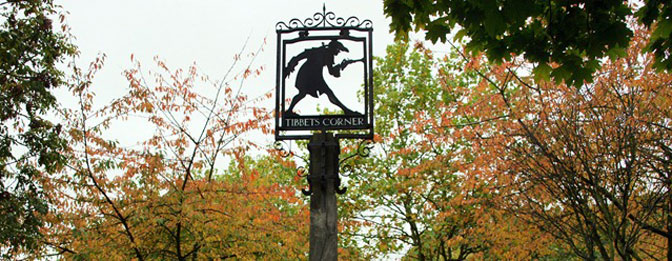
At the top of Putney Hill is a sign depicting a skulking highwayman wearing a long-brimmed hat and brandishing a pistol, obviously intent on surprising his next victim, celebrating the memory of a famous highwayman who used to frequent the then lonely wastes of Putney Heath. While Tibbets Corner was the haunt of criminal ne’er-do-wells and malcontents eager to relieve wealthy road users of their valuables there is no record of a highwayman by that name operating anywhere near the spot. Prosaically Tibbet was the name of the gate-keeper at the entrance to Lord Spencer’s estate.
London’s Corners
Apex Corner
Birchwood Corner
Canons Corner
Chalkers Corner
Crittalls Corner
Dovers Corner
Fiveways Corner
Frognall Corner
Gallows Corner
Gillette Corner
Gipsy Corner
Harlington Corner
Henlys Corner
Highbury Corner
Hobart Corner
Hyde Park Corner
Malden Corner
Ruxley Corner
Shannon Corner
Staples Corner
Stirling Corner
Tibbets Corner
Waterworks Corner
Featured image: Tibbet’s Corner Sign by Tristan Forward (CC BY-SA 2.0)
 CabbieBlog