All posts by Gibson Square

A Licensed Black London Cab Driver I share my London with you . . . The Good, The Bad and The Ugly

Johnson’s London Dictionary: London Stone

LONDON STONE (n.) A block of limestone that hath mythical status insofar that London’s prosperity depends on its safekeeping.

Dr. Johnson’s London Dictionary for publick consumption in the twenty-first century avail yourself on Twitter @JohnsonsLondon

Let sleeping lions lie

Trivia fact: The sleeping lion on the Golden Syrup tin is a depiction of a dead beast. The reason for this – how the Victorians thought it was a good idea is anyone’s guess – is that there is a story in the Old Testament about some bees improbably building a hive in a dead lion.

Having used this as a promotional logo, Tate & Lyle decided to leave it there for 150 years or so before changing it. Captain Scott even took to the Antarctic and a fat lot of good that did him.

But hold on a moment, the text on the tin reads: ‘From the strong came forth sweetness’ and the Bible story is about bees. Correct me if I’m wrong, but bees don’t make syrup – they are advertising honey on their own syrup tin.

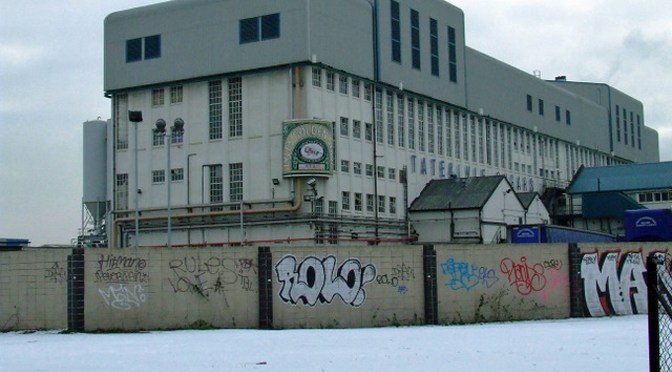
Here in London we have probably the world’s largest depiction of a dead lion (I’m open to correction here), so when I saw in a newspaper that Tate and Lyle were changing their syrup tin logo, I thought of the giant lion on the factory wall in Silvertown, East London.

But apparently, I can now breathe easy, the new logo is just for the squeezy bottle, not the tin. Probably the trouble of taking down that giant lion by the Thames was too much.

As a footnote:
Judges 14:14
So he said to them: “Out of the eater came something to eat, And out of the strong came something sweet.” Now for three days they could not explain the riddle.

So even in the Bible, it is described as a riddle.

Featured image: Tate & Lyle factory by Thomas Nugent (CC BY-SA 2.0 DEED)

London in Quotations: Sophie Kinsella

Because it is the triumph of a lack of planning –both for good and bad. It’s chaos –and whether you say that with a gasp of despair or glee or both is up to you. Whereas Paris (certainly in the centre) is the success of a single overarching monomaniacal topographic vision, London is a chaotic patchwork of history, architecture, style, as disorganised as any dream, and like any dream possessing an underlying logic, but one that we can’t quite make sense of, though we know it’s there. A shoved-together city cobbled from centuries of distinct aesthetics disrespectfully clotted in a magnificent triumph of architectural philistinism. A city of jingoist sculptures, concrete caryatids, ugly ugly ugly financial bombast, reconfiguration. A city full of parks and gardens, which have always been magic places, one of the greenest cities in the world, though it’s a very dirty shade of green –and what sort of grimy dryads does London throw up? You tell me.

China Miéville (b.1972)

London Trivia: Test Match Special

On 10 March 1906, rumoured to have been funded by a few businessmen wanting to get to and from Lord’s Cricket Ground during Test Matches, the Baker Street and Waterloo Underground Line was opened. ‘Bakerloo’ was first coined by the Evening News. The trains ran between Baker Street and Lambeth North. It is now the 9th busiest line on the network, carrying over 111 million passengers annually.

On 10 March 1886 the First Great Terrier Show precursor to Cruft’s was organised in London by Spratt’s dog biscuit salesman Charles Cruft

Temple Bar on Fleet Street displayed decapitated traitors heads on spikes after being boiled in brine and cumin seeds to deter pecking birds

On Knight’s Road Docklands the world’s largest tin of syrup is affixed to Tate & Lyle’s factory producing the world’s oldest branded product

In his will Dickens stipulated that no monuments be erected to his memory, that’s why London has no statues of one of its greatest writers

On 10 March 1914 suffragette Mary Richardson attacked Velazquez’s painting the Rokeby Venus, hanging in the National Gallery, with an axe

Now charmingly inaccurate, the life-sized models of dinosaurs in Crystal Palace Park, constructed in the 1850s were the first in the world

The basement at 27 Endell Street was once the animal depot for West End theatres once two bulls escaped liberating a menagerie on Soho streets

A white strip near BBC White City marks the finish of the world’s first modern marathon in 1908 originally 25 miles extended to 26m 385yards

Early rear view mirrors in taxis couldn’t be adjusted allegedly to prevent drivers from ogling the legs of their lady passengers

South Bank’s Anchor Brewery, once the largest brewery in the world, all that remains is the old brewery tap the Anchor Tavern on Park Street

Burrell & Co on Blasker Walk Docklands once manufactured dyes, red smoke from the chimneys would tint the local pigeons rose-pink

CabbieBlog-cab.gifTrivial Matter: London in 140 characters is taken from the daily Twitter feed @cabbieblog.
A guide to the symbols used here and source material can be found on the Trivial Matter page.

Previously Posted: Divided by a common language

For those new to CabbieBlog or readers who are slightly forgetful, on Saturdays I’m republishing posts, many going back over a decade. Some will still be very relevant while others have become dated over time. Just think of this post as your weekend paper supplement.

Divided by a common language (15.02.11)

It’s that time of year again when all the hotel chains offer cut price breaks to pull in the punters.

In the summer months communicating with London’s visitors is simple: those tourists from the Middle East have learnt two or possibly three words of English; “Harrods”, “Selfridges” and “ThankYou”. Europeans on the other hand make a better fist of it: the Dutch have better English grammar than most cabbies I know (I was told once that they watched BBC TV from a young age); most other Europeans have English as their second language and feel the need to brush up their linguistic skills with any cabbie they can find. The ever resourceful Japanese take some headed notepaper from their hotel room and show it to the driver.

Thank goodness the American’s have a sense of humour for although they speak American it is not easily understood by the English “Our hotel is in South-Waark” or “Li-Cest-Tur Square are common phrases. But after some good humoured banter on the correct pronunciation of tomato or potato we usually manage to arrive at their destination.

But for our bargain mini break visitors, well, it’s frankly embarrassing; to paraphrase it is like two languages conjoined by a common country. If I can do my best at Estuary Speak and sprinkle “geezer”, “wots up” and “fink” into my lexicon, those northern folks after watching Eastenders four times a week since the old King died, should at least understand me and I them.

But help is at hand from of all people The University of Leeds who are preparing a “Language and dialect atlas of Britain in the 21st Century”. In an important use of their £460,000 research grant they intend to highlight regional variations of English.

Just how we have got to this stage of the development of English since we have been speaking it among ourselves since Saxon times, with just a slight interruption from the Normans, I don’t know. For by now the BBC’s received English should be the spoken norm for all of us.

But what I do know is that Wayne and Charlene will not be using the research paper to brush up their cockernee for their next visit to the Capital. And certainly can I be bovvered?