
We challenge our contributors to reply to ten devilishly probing questions about their London and we don’t take “Sorry Gov” for an answer. Everyone sitting in the hot seat they will face the same questions ranging from their favourite way to spend a day out in the capital to their most hated building on London’s skyline to find out what Londoners think about their city. The questions are the same but the answers vary wildly.

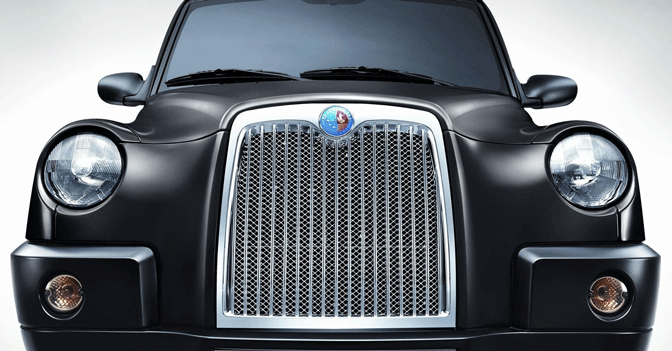
My name is Marie-Louise, and I am a London Black Cab driver. I have been a cabbie for just over four years and I absolutely LOVE my job, making passengers smile and giving them a great lasting impression of me! I’m not the usual type of cab driver that you would expect when you hail me down. You will be met with a welcoming smile and big positive, vivacious energy, my flamboyant personality is as much versatile as my dress sense. I enjoy travelling, learning new things, as I don’t know it all and laughing as it’s good for the soul, try it!
What’s your secret London tip?
My secret London tip is to get lost! You’ll find out so many new things or may end up in a bar or two!
What’s your secret London place?
My secret London place wouldn’t be a secret now as you’re going to know! But as I’m one to share it would be Peckham Levels something about being in familiar territory.
What’s your biggest gripe about London?
London’s cycle lanes the length of a car space but are not being used! Take Euston underpass for one, get rid of the lane and revert it to its original two lanes and get London moving again – well eastbound anyway.
What’s your favourite building?
My favourite building or one of them is the Shard! Been there a few times and the view of London/surrounding areas is amazing even better at night.
What’s your most hated building?
Most hated building in London? I don’t have one! I reckon if you give them a good clean then they would look nicer, well to look at anyway.
What’s the best view in London?
The best view in London as told by a passenger would be in Highgate (Southwood Lane), you can see the Dartford Crossing without wincing, but the view is amazing.
What’s your personal London landmark?
My personal landmark is the buildings in Canary Wharf, just something about staring at it from Greenwich or from the Emirates Air Cable gives me at ease love my city vibes.
What’s London’s best film, book or documentary?
London’s best film for me personally is Rocks (2020), it gives a true reflection of London where I grew up and have come to know.
What’s your favourite restaurant?
Balthazar in Covent Garden.
How would you spend your ideal day off in London?
I would usually spend my day off by going to the gym and getting a workout done as it helps me start my day off right and then go catch a film as I like to keep on top of the latest films. I then go to my favourite place in London which is Southbank, taking a long stroll down the Embankment, watching everyone around me go by and take in the incredible London sights, grab a coffee and not think about work or being in my cab!! There’s so much to appreciate around us and some parts you can’t get to in a cab.


 On 5 June 1963 John Profumo resigned as Secretary for War after admitting he had lied over his affair with Christine Keeler
 Bow Street was the only police station to have white lights outside instead of the traditional blue – they were ordered by Queen Victoria
 The golden flames on top of St. Paul’s lean in the direction the wind was blowing on the night of the Great Fire
 In 1637 playwright Ben Jonson was buried upright in Westminster Abbey as he couldn’t afford to pay for a larger space
 London’s epic Parliament Square peace protestor (no one else can permanently stay there) Brian Haw, born 1949 stood there since 2 June 2001 until his death in 2011
 Harry Potter’s magic luggage trolley sticks out of a wall between platforms 8/9 not 9/10 because J. K.Rowling was thinking of Euston
 Until recently Londoners consumed a prodigious amount of champagne, by volume they equalled the entire amount exported by France to America
 In the 18th century at the Cat & Mutton, Broadway Market hosted the Soapy Pig Swinging Contest, drovers lathered a pig’s tail and hurled it
 The colourful benches on the Southeastern High Speed platform in St Pancras are the five chopped-up Olympic rings once hanging there in 2012
 Isaac Newton lived at 87 Jermyn Street, St. James when he worked at the Royal Mint where he was tasked with prosecuting counterfeiters
 On 5 June 1939 an assassin attempted to shoot the Duchess of Kent she didn’t realise what was happening and went to see Wuthering Heights


