

Go where we may, rest where we will, / Eternal London haunts us still.

Thomas Moore (1779-1852)

Go where we may, rest where we will, / Eternal London haunts us still.
Thomas Moore (1779-1852)
On 15 October 1702 the first model for Britannia died from smallpox. Lady Frances Teresa Stewart, Duchess of Richmond and Lennox had been mistress to King Charles II and sat for the first portrait of Britannia. The Duchess was Diana, Princess of Wales’s great-great-great-great-grandmother. Britania was featured on all modern British coinage series until the redesign in 2008, in 2015 a new definitive £2 coin was issued, with a new image of Britannia.
 On 15 October 1066 rumours circulated in London that King Harold had only been wounded that would have been one in the eye for the Normans
 Number 17 Wimpole Mews was the home of society Osteopath Stephen Ward who became embroiled in the 1963 Profumo scandal
 Lower Robert Street is the only remnant of underground streets below the Adelphi buildings built by the Adam brothers in 1773
 Bethnal Green residents once knew Bethnal Green Gardens as ‘Barmy Park’ after a lunatic asylum formerly situated there
 Edward VI punished Westminster Abbey (St Peter’s) by diverting their funding to St Paul’s hence the phrase ‘Robbing Peter to pay Paul’
 In the central courtyard of the Victoria and Albert museum is a memorial to Jim, faithful dog of Henry Cole, the museum’s first director
 The Palace Theatre at corner Charing Cross Road and Shaftesbury Avenue was the venue of the first Royal Command Performance in 1919
 Only since the 1700s has Chelsea been known as that, before it was Chelsey, Chelceth; Chelchith. Doomsday Book lists Cercehede; Chelched
 The phrase “Mind the gap” dates back to 1968. The recording that is broadcast on stations was first done by Peter Lodge, who had a recording company in Bayswater
 Howard House, 14 Fournier Street, Spitalfields is where the silk for Queen Victoria’s coronation gown was woven
 The City of London the historical core of the Capital, roughly matches the boundaries the Roman city of Londinium and of medieval London
 Trivial Matter: London in 140 characters is taken from the daily Twitter feed @cabbieblog.
A guide to the symbols used here and source material can be found on the Trivial Matter page.
For those new to CabbieBlog or readers who are slightly forgetful, on Saturdays I’m republishing posts, many going back over a decade. Some will still be very relevant while others have become dated over time. Just think of this post as your weekend paper supplement.
Broadcasting House in Portland Place is almost certainly the most famous 20th century building in London. Completed in May 1932 to provide a home to the world famous British Broadcasting Corporation (BBC), whose motto “Nation shall speak unto Nation” would be better interpreted for BBC executives as “Where moron shall speak unto moron”, for Broadcasting House was inadequate from day one.
Its ingenious design to provide 22 soundproof studios, by surrounding the inner core of studios with the offices, the only part of the building visible from the outside, thereby forming a sort of protective outer shell worked, unfortunately no such consideration was made to soundproof beneath the building, as a consequence it allowed the rumble of tube trains to be heard occasionally.
Costing £350,000 a tidy sum at the time, within months it was found to be far too small and St. Georges Hall next door was taken over along with a disused roller-skating rink in Maida Vale.
Lord Reith the guiding force in the BBC in its formative years would have been particularly proud of newsreader Bruce Belfrage on 15 October 1940. For reasons best known only to Reith newsreaders wore a dinner jacket resplendent with bow tie to read on radio to the nation that day’s news.
Despite have painted the pristine Portland stone of Broadcasting House grey, German bombers managed to target the building, destroying the world famous gramophone library and killing seven, nonetheless Bruce brushed the fallen plaster from his dinner jacket and soot off his script and continued to read the Nine O’clock News with barely a pause for breath.
On the first floor directly over the entrance with its statute of Prospero and Ariel is the council chamber, the statute depicting from Shakespeare’s Tempest, Prospero sending Ariel, the spirit of the air, symbolises the future of broadcasting to the world.
Eric Gill its sculptor it would seem had other ideas. He insisted on carving the statute in situ. Standing on scaffolding above the entrance, female employees on arriving would be greeted by the unwelcome sight of London’s first “builder’s bum” for Gill wore a monk’s habit with nothing underneath.
When completed Prospero was found to have a girl’s face carved upon his bottom, the image facing the council chamber. As for Ariel being sent out into the world, he would appear rather well endowed for that, for such a young child.
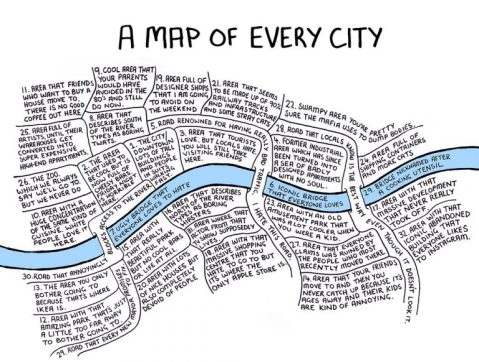
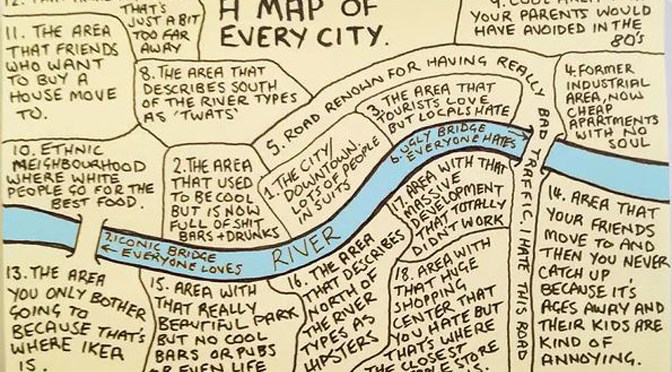
After Tuesday’s post about 1930s London maps, I thought a contemporary definition could be looked at. Seven years ago Chaz Hutton doodled a map on a post-it note, he then posted it on Twitter [featured image] and 48 hours later it had 3,000 re-tweets.
He described it as:
A map of people’s experience of living in cities: The changing circumstances of people as they get older and have children, the way ‘cool’ areas emerge from formerly ‘rough’ areas and are then invariably compared to the less-cool, traditionally wealthy areas, the kind of areas that an Ikea needs to be built for it to be profitable. All these things are endemic to most large cities, with most of them the outcomes of events situated at some point along the gentrification arc.
Since that map appeared there’s been a lot of speculation as to which city he drew. Chaz claims that it is a generic representation, and as many cities have a river running through them, he could be right. Curiously everyone managed to find their own cities within the same map.
Although the original conception of the idea for the style of the map did originally stem from a map of London, and the river has the same proportions, the diagram could apply to most cities.
Below is the refined version, I’ll leave it to you to decide what city it represents.
For reasons now lost in the mists of time, I started uploading daily trivia. First I used what’s now called a burner phone to what was then called Twitter, although not realising at the time that social media is a two-way street. Then with my first iPhone, I discovered that multiple tweets could be scheduled, and more importantly that the snippets could appear here on CabbieBlog. Over time the posting services that I used have each fallen by the wayside or have imposed cost restrictions on the number of postings: Twuffer, Twittimer, TweetLater which morphed into SocialOomph. I then went to Buffer which allows, using a free account, 10 postings at a time. But now X doesn’t allow API keys from these third-party sources unless a large premium is paid. Now I’ve had to turn to Google Calendar to bring you the ‘Daily London Trivia’, tediously uploading the data, and using WordPress’ Upcoming Events widget. Now this new widget developed for their Gutenberg platform sometimes gives ‘No upcoming events’ instead of today’s trivia, their Happiness Engineers (an oxymoron) are trying to find a solution.


 CabbieBlog