
Twenty bridges from Tower to Kew – / Wanted to know what the River knew, Twenty Bridges or twenty-two, / For they were young, and the Thames was old / And this is the tale that River told.

Rudyard Kipling (1865-1936), The River’s Tale

Twenty bridges from Tower to Kew – / Wanted to know what the River knew, Twenty Bridges or twenty-two, / For they were young, and the Thames was old / And this is the tale that River told.
Rudyard Kipling (1865-1936), The River’s Tale
A plaque marks the spot where on 24 September 1917 the old Bedford Hotel stood on Southampton Row in Bloomsbury, recording that on the day a 112lb bomb was dropped from a German Gotha in one of London’s first night air raids, killing 13 people and injuring a further 22. The airships were vulnerable to the vagaries of the wind and British fighter aircraft, to counter these the Germans developed powerful twin-engined Gotha bombers.
 On 24 September 1842 a bronze statute of the Duke of Wellington astride his horse, Copenhagen was conveyed to Hyde Park Corner
 The Boundary Street Estate London’s first council estate was built on the rubble of the Old Nichol, once a notorious criminal area
 In 2003 Temple Bar Trust bought the gate for £1 it was returned to London stone by stone and re-erected as an entrance to Paternoster Square
 William Blake (who wrote the lyrics to Jerusalem) married Catherine Boucher at St Mary’s, Battersea in 1782
 Nancy Astor, the first woman take a seat in Parliament after a by-election in December 1919 and was elected as a Conservative for the Plymouth, once lived at 4 St James’s Square, Westminster
 In 1891 Sherlock Holmes creator, Sir Arthur Conan-Doyle, penned his first 5 short stories at 2 Upper Wimpole Street then known as Devonshire Place
 A red, white or black flag was flown outside the Globe in Shakespeare’s time to denote a history, comedy or tragedy
 London’s oldest sports building still in use for its original purpose is the Real Tennis Court at Hampton Court Palace, one of its walls dates back to 1625. Today the court is listed Grade I
 The Central line introduced the first flat fare when it opened the tuppence fare lasted until the end of June 1907 when a threepenny fare was introduced for longer journeys
 Elephant and Castle is named from a pub whose sign was the symbol of the Cutlers who made cutlery with ivory handles
 It costs £4 million a year to advertise your firm on Piccadilly Circus’s neon sign which measures 21.1 metres by 4.8 metres
 Trivial Matter: London in 140 characters is taken from the daily Twitter feed @cabbieblog.
A guide to the symbols used here and source material can be found on the Trivial Matter page.
For those new to CabbieBlog or readers who are slightly forgetful, on Saturdays I’m republishing posts, many going back over a decade. Some will still be very relevant while others have become dated over time. Just think of this post as your weekend paper supplement.
We’ve all had a Tardis Teaser fantasy. What moment in history would you like to be transported if you had a time machine?
One point in London’s timeline worthy of consideration might be the opening of “The Palace of the Great Exhibition of the Works of Industry of All Nations” or as Punch nicknamed it the Crystal Palace. Covering 19 acres with room inside to accommodate four St. Paul’s Cathedrals it was at the time the largest building on earth.
Started 160 years ago on 31st August 1850, a year earlier it had not even existed as an idea, until Henry Cole more famous for inventing the Christmas card conceived the idea after visiting the Paris Exhibition.
An open competition attracted 245 designs all were deemed unworkable. A design committee was formed having amongst their number Isambard Kingdom Brunel, and between them they produced a vast low, dark shed of a building, needing 30 million bricks. Now with only 16 months to go desperate times required desperate measures and Joseph Paxton was approached.
Paxton, born into a poor farming family in Bedfordshire, he was at the age of 20 running an experimental arboretum for the Horticultural Society. There one day he made such an impression on the Duke of Devonshire in that his strong, clear voice could be heard by the near deaf Peer of the Realm, he was offered the post of Head Gardener at Chatsworth House.
Paxton really was a boy wonder, he created one of the great gardens of England at Chatsworth with the Emperor Fountain’s raising a jet of water 290 feet into the air, a feat only exceeded once to this day in Europe; built the largest rockery in the country; designed estate villages; became the world’s expert on dahlias; produced the country’s finest melons, figs, peaches and nectarines winning numerous prizes; he ran two gardening magazines; a daily newspaper; he was on the board of three railway companies; built the world’s first municipal park, later copied to form Central Park in New York; the hot house at Chatsworth he built was so vast that when Queen Victoria visited the Great Stove, as it was called, she toured it in a horse drawn carriage.
Learning of the committee’s struggle to design a building for the Great Exhibition he doodled plans while chairing a meeting and had completed drawing ready for review in two weeks. The design broke all the criteria stipulated for the competition, but desperate times required desperate measures and after a few days of hand wringing the committee accepted them in their entirety.
Nothing, really absolutely nothing, says more about Victorian Britain and its capacity for brilliance than entrusting this iconic building to a gardener. No bricks, no mortar, no foundations, prefabricated from standard parts away from the building site it was simply bolted together. The build time was phenomenal in eight months, one million square feet of glass, 18,000 panes a week (one third of all the glass produced that year); 20 miles of guttering, 33,000 iron trusses and tens of thousands of planks of wooden flooring, this being tested by a battalion of soldiers marching across it. The finished building was 1,851 feet long (in celebration of the year the exhibition was held, now copied by the new World Trade Centre whose height matches in feet the year of their independence), 408 feet across and 110 feet high and spacious enough to accommodate a much admired avenue of mature elm trees.
Queen Victoria opened the exhibition on 1st May 1851 describing with some justification that it was “the greatest day in our history”. Open for five and a half months it attracted six million people at a time when Britain had a population of only 20,959,477. Almost 100,000 objects went on display; a knife with 1,851 blades; furniture carved from coal; a 4-sided piano; a bed which automatically tipped its surprised occupant into his morning bath; an enormous lump of guano from Peru. Newfoundland for some inexplicable reason devoted its entire stand to cod-liver oil, and the highlight of the day was a use of the elegant “retiring rooms” the flushing toilets, a novelty at the time.
Unlike its successors the Great Exhibition cleared a profit of £186,000, enough to buy 30 acres of land south of the exhibition site where the Royal Albert Hall, Victoria and Albert Museum, Natural History Museum, the Royal College of Art and Royal College of Music were later built.
After the Exhibition was closed the Crystal Palace was moved to Sydenham were we managed to burn it to the ground in 1936. All that marks its passing is the Colebrookdale Gates originally made to stand at the entrance to the north transept of the Exhibition, now moved to the entrance to Kensington Gardens beside Alexandra Gate and behind which Albert sits enthroned in his memorial, on his lap he holds a book: The Catalogue of the Great Exhibition.
One of the most prestigious shopping thoroughfares runs in a circulatory route between Oxford Street and Piccadilly and is the only street running between the two. Most shoppers erroneously would call it Bond Street. Running through the centre of Mayfair it’s prosaically named after Sir Thomas Bond, the landowner who had it developed in the 1720s.
But hold on, there is no Bond Street featured on the Geographers’ A-Z. Did you ever notice that Bond Street doesn’t actually exist as a road? You’ll find a Bond Street tube station and numerous brands advertising that their shop fronts the street, but the road itself is strictly termed New Bond Street, or Old Bond Street.
Sir Thomas Bond’s family motto was Orbis non sufficit, which translates as The World is not Enough. Where have we heard that recently?
The phrase originated from Sir Thomas Bond, 1st Baronet, a 15th-century landowner, who was used by Fleming as an ancient ancestor of the modern-day Bond. The coat of arms was first revealed in the novel On Her Majesty’s Secret Service, and it was subsequently used in the film adaptation of the novel as well. It’s implied elsewhere in Ian Fleming’s novels that Thomas was an ancestor of the illustrious spy.
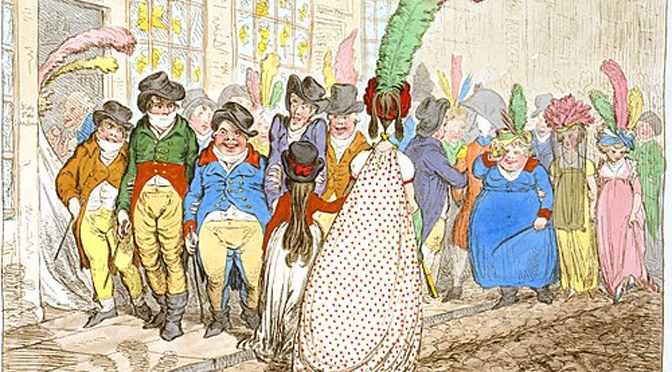
Featured image: In High-Change in Bond Street (1796), James Gillray caricatured the lack of courtesy on Bond Street (young men taking up the whole footpath), which was a grand fashionable milieu at the time.
As featured elsewhere on CabbieBlog, Clipper Automotive takes a perfectly serviceable second-hand cab, gives it a thorough overhaul, installs an electric motor and new drive train and replaces the dashboard. This work produces a much more economical vehicle with zero emissions.
Now that we realise the issues associated with waste, you’d have thought that re-purposing a vehicle recognised all over the world as London’s iconic form of public transport was to be commended.
Not so TfL and London’s Mayor who refuse to licence these vehicles, preferring to send parts of 12-year-old vehicles to landfill.
So much for their claims ‘Saving the Planet’.


 CabbieBlog