

It’s a sad fact of modern life that if you drive long enough, sooner or later you must leave London behind.

Ben Aaronovitch (b.1964), Moon Over Soho

It’s a sad fact of modern life that if you drive long enough, sooner or later you must leave London behind.
Ben Aaronovitch (b.1964), Moon Over Soho
On 30 July 1966, playing West Germany at Wembley Stadium England won football’s World Cup for the first time since the tournament began in 1930 watched by 93,000 spectators including the Queen. Another 400 million people around the world watched the keenly fought match on television. In the final moments of extra time Geoff Hurst powered home his third goal to give England a 4-2 victory and to become the first man ever to score a hat-trick in a World Cup final.
 On 30 July 1746 the last executed traitor to have their head displayed on a pike (his at Temple Bar) was Jacobite rebel Francis Towneley
 It was outside the Lamb and Flag pub, Covent Garden in 1679 that poet John Dryden was set upon by thugs, being beaten very close to death
 The Lamb and Flag, Rose Street, Covent Garden dates back to 1627 being a favourite watering hole of Charles Dickens
 Victorian publisher Joshua Butterworth left money for a ceremony at St. Bartholomew’s, Smithfield to give alms and buns to poor London widows
 It is thought that the ‘Window Tax’ brought about the phrase: “Daylight Robbery”, being robbed of daylight by taxation
 Gieves (the name) of Gieves and Hawkes, 1 Savile Row was the inspiration for P. G. Wodehouse’s butler Jeeves, albeit spelt different
 In 1251 a Polar Bear given to King Henry III by the King of Norway lived in the Tower of London and went fishing in the Thames
 Cricketing legend W. G. Grace was a practising doctor who worked from his practice at 7 Lawrie Park Road, Sydenham
 Early London and Greenwich Railway trains were made in the style of a Roman galley ship to fit in with the viaducts they travelled across
 London’s oldest shop Twining’s in the Strand has been selling tea since 1706. Twining family home in Twickenham, Dial House is now a vicarage
 One of the first (if not THE first) British suppliers of Doc Marten shoes and boots was Blackman’s, Cheshire Street, Bethnal Green
 Trivial Matter: London in 140 characters is taken from the daily Twitter feed @cabbieblog.
A guide to the symbols used here and source material can be found on the Trivial Matter page.
For those new to CabbieBlog or readers who are slightly forgetful, on Saturdays I’m republishing posts, many going back over a decade. Some will still be very relevant while others have become dated over time. Just think of this post as your weekend paper supplement.
Nimbyism, even the word sounds, well slightly nerdy, with a vision of a moustached man, clipboard at the ready trying to get your signature on his petition protesting about a local issue.
But to paraphrase Gordon Gekko, Nimbyism is good, Nimbyism empowers you, Nimbyism is hugely valuable, Nimbyism is to be encouraged, for if you don’t look after your own back yard who do you expect to do it for you, the State, local councillors, your neighbour? There may be some martyrdom involved particularly as almost certainly you will be trying to stop a juggernaut of self interest: vain architects; big business; dodgy politicians; or greedy developers; or God help you if you encounter a combination of all four.
To take just two less high profile examples of people power in London, with varying degrees of success, and both curiously involving Camden Council Planners.
Little Green Street off Highgate Road in Kentish Town is one of only a few intact Georgian streets in London. Most of the dozen houses were built in the 1780s, all are Grade ll listed, and have survived the Blitz and more than two hundred years of wear and tear from the generations who have raised their children in this narrow cobbled terrace. It is the stuff of picture books showing Georgian England, built before America won its independence; the street has been the playground to generations of children with no front yard to play in.
However, in 2008, the residents, users and friends of the street apparently lost an eight year battle to prevent it being used as a truck route to develop a small patch of land, theoretically only accessible down this seven foot wide cobbled lane. It was proposed that a vehicle would pass within inches of the front doors of these homes every three minutes, all day every day for up to four years down this delicate cul-de-sac.
Although, after campaigning by more than 15,000 people and with planning permission lapsing, due to the developers running out of cash, Camden Council are still vacillating about whether the construction work on a gated community to be built at the end of this street, with an underground car park should continue.
Mad, isn’t it? Everyone knows that to risk these houses is daft, but the irony is it is the very greed that motivated the purchase of one of London’s iffier bits of derelict land will probably ensure the street’s continuing peaceful quietness, for the developers paid such a premium for the site making money from the old railway club can’t be done. A moral (or at least a sound bit of buying advice) “Don’t buy anything at auctions unless you’re really sure you are getting a good price for something that you not only want, but can also use”. Don’t pay over the odds for an unremarkable bit of land you can only cheaply get to down a tiny cobbled lane, for example. And more importantly don’t mess around with concerted well organised Nimbys.
As of the end of February 2008 (and after a huge public outcry), the developers’ third attempt at a construction methodology statement was rejected. They appealed and the Planning Inspectorate who decided in August 2008 that it was in the public interest to turn this little green street into a truck route, down a street remember that is just wider than the length of your bed. Since then, relative silence, other than an expensive mortgage on a very poorly thought out idea.
While in the south of the borough in Bloomsbury, the local Camden Civic Society and the Bloomsbury Group have been roundly castigated for questioning the empire building of the British Museum. In newspapers and letters they were told they ought to know what’s good for them and an “improvement” scheme will go ahead. But the local Nimbys did modify what was a badly conceived plan – Richard Rogers’s original proposal would damage the Arched Room, the King Edward VII North Galleries and staircase, the north elevation of Robert Smirke’s Great Court, and obscure views down Malet Street. Openings would have been cut into the original stone walls of the Grade I-listed Great Court for access to the new wing.
The museum is still going to knock holes in the north wall of the Great Court; it’s OK, apparently, because the wall is only a 100 years old. Would they have dreamed of drilling holes in the Rosetta stone to facilitate screwing it to the wall? No, of course not, and they would hardly countenance a similar cavalier approach to even the humblest shard of their precious artefacts but will quite happily disfigure forever the historically important monument that house them. Beats me.
Little Green Street might not have won the war – yet, but their brilliant campaign, that and the Credit Crunch, has protected for the time being this beautiful Georgian Street.
While in Bloomsbury, Lord Rogers’ revised modernisation plans have won the day for the British Museum, but what London gems could his architectural practice destroy in the future if nobody protested?
I was rather surprised to watch Tom Hutley’s latest youtube video. Here he’s found a piece of film travelling around London in the 90s, at the time I first drove a cab. It’s remarkable how much has changed and Tom’s commentary of the changes is very surprising. Recommended.
Tom Hutley was a guest on the podcast WizzAnnCast discussing cabbie’s books – and thanks for the mention by the way – I don’t know why it’s taken me so long to start listening to Dean Warrington. A great listen if you want to understand or start The Knowledge.
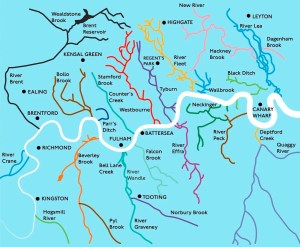
I’ve just finished Christopher Fowler’s The Water Room and it is a great romp around London’s [spoiler alert] underground rivers. So I thought I’d reproduce TfL’s Pride poster campaign including a fabulous map of London’s lost rivers.
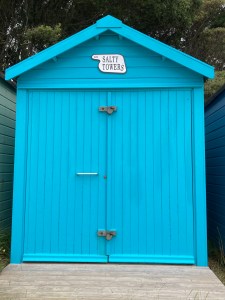
East London Boy Jay Blades has been making a show for C4 – Britain’s Best Beach Huts, and whilst in Dorset this example amused me, with its nod to TV’s greatest comedy.
This diary entry from diamondgeezer made me laugh:
Tue 6: Today, as temperatures soared, I was privileged to be in attendance at London’s annual Please Carry Water With You In Hot Weather ceremony. Two members of TfL staff appeared at the far end of the Central line platform at Holborn station, the junior acolyte clutching freshly-printed rolled-up posters. The elder used his radio device to alert staff further up the line that the religious objects were ready, then handed them to a train driver for safe transfer to the next two stations. I missed the unloading ritual at Chancery Lane but at St Paul’s a member of staff graciously accepted the offering, checked that it had the sacred text “St Paul’s” scrawled on the back in pen, then processed serenely up two sets of escalators and delivered it to the control room. I imagine a prayer was said and the poster splashed with holy water, and when I came back a few hours later it was on proud display in the ticket hall.

Seventy-five years ago, on 22nd July 1948, bread rationing came to an end. With Ukraine, Europe’s bread basket still at war with Putin, is Harrods’ Roquefort and Almond Sourdough Bread priced at £20 per loaf, under threat of being unavailable for us all?
International bank HSBC is going to leave its dockside headquarters for a smaller office near St Paul’s and it’s estimated that the bank’s departure will decrease the area’s value by £542m. So how does the financial district counteract this loss? Well, Canary Wharf has ambitions to become a tourist destination. “How do you turn the most corporate, concrete, soulless corner of the city, five miles from Trafalgar Square, into a place that people actually want to come and visit?” asks Greg Dickinson in The Telegraph. Well, quite.


 CabbieBlog