Previously Posted: Moving the Mad

For those new to CabbieBlog or readers who are slightly forgetful, on Saturdays I’m republishing posts, many going back over a decade. Some will still be very relevant while others have become dated over time. Just think of this post as your weekend paper supplement.

Moving the Mad (04.06.2010)

If you would bear with me for a while as I tell you the tale of how Bedlam became synonymous with a state of total chaos.

Built in 1250 the first Bethlehem hospital was situated just outside the City’s walls near Bishopsgate. Where now the ANdAZ Hotel in Liverpool Street now stands, on a wall adjacent to it a blue plaque marks Bethlehem Hospital’s location. It was here the priory of St. Mary of Bethlehem and like all religious orders in Catholic England it had a duty to help the poor and needy.

Within 100 years the priory had been expanded and new parts were specifically designed to house the “weak of mind”. As auteristic as the monks would appear the treatment meted out to inmates were appalling, if not killed for being possessed with the devil, they were shackled or chained to the wall throughout their stay was the norm. Never washed, fed like animals and as a change to their routine would be ducked in freezing water or whipped.

With the Dissolution of the Monasteries the Priory was converted to a place for those who “entirely lost their wits and God’s great fit of reasoning, the whiche only distinguisheth us from the beast”.

In the late 17th century the hospital moved to open fields just outside Moorfields. A beautiful purpose classical building was provided not for inmates comfort (overcrowding and insanitary conditions prevailed), but for the entertainment of Londoner’s at the weekend. Social attitudes had changed towards them and hundreds would arrive to look around the madhouse, it was deemed to “guarantee to amuse and lift the spirits”.

The hospital’s principle income came from these visitors who paid good money to have their spirits lifted and evidence of wardens deliberately working up the patients to act even more wildly on Sunday afternoons.

The hospital’s name had, over the years, been abbreviated to Bethlem, but now the hospital had become known as Bedlam and the word became synomous with a scene of chaos. It was only when King George III became mad and his plight aroused sympathy that social attitudes started to change.

In the early 19th century that the hospital moved from Moorfields to the building that is now the Imperial War Museum in Lambeth. The patients were brought across London in a long line of Hackney cabs that were prepared to go south of the River with the inmates under a careful guard.

The latest of the long line of buildings is a hospital built at Addington in Surrey.

The Kremlin Reopens

Only 13 London Cab Shelters remain out of the original 61 constructed, many of the survivors are Grade II Listed, and all incidentally are found North of the River.

The Chelsea Embankment Shelter opened in 1910 and is situated on the Thames’ north bank, overlooking the romantic Albert Bridge.

Due to the Chelsea Embankment being designated a Red Route and the local authority only providing parking for two cabs, the Shelter closed 20 years ago and slowly degenerated. David Fletcher has created this amazing 3-D model of the shelter in this dilapidated state.

After the Cabmen’s Shelter Fund was awarded a grant from the Heritage of London Trust. Despite the difficulty of delivering materials to the site, due to the parking restrictions, the shelter now has new timber around three sides, and a new clerestory roof, all finished with the all-important distinctive Dulux Buckingham Paradise 1 Green.

These works were completed in January 2022, and now Café Pier (a considerably better title than The Kremlin, its former nickname due to the Left-leaning cabbies who once frequented the Shelter) has taken over the lease and is opening tomorrow.

The Shelter enjoys a lovely little terrace overlooking the River enough for 12 diners. The team behind this revival promise to offer a much better bill of fare than the average greasy spoon, and if this wasn’t an excuse to give it a try, its an opportunity to check out one of these little Victorian gems which normally are for the exclusive use of London’s cabbies.

Birthday treat

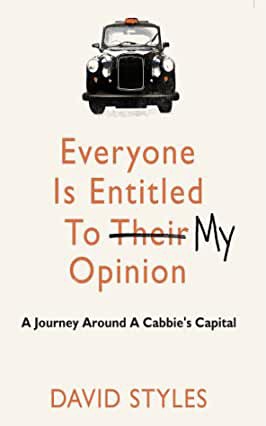
It’s my birthday in a few days time, so in anticipation I’m counting down the days with offering my Kindle book for 99p. As you might guess, this isn’t an opportunity for others to cheaply buy my birthday present, but a chance for you to get the inside Knowledge of London and its cabbies.

Catch it on Amazon:

https://tinyurl.com/4tnnb3d8

Part Knowledge memoir, part history book and facts of London, this is a wonderfully written gem, with lots of nuanced history about London of which I was totally unaware.’ – Tom Hutley, Member of The Worshipful Company of Hackney Carriage Drivers and top YouTuber with over 73,000 subscribers.

Johnson’s London Dictionary: Boat Race

BOAT RACE (n.) Aquatic competition between university students who rather than studying spend their days paddling water.

Dr. Johnson’s London Dictionary for publick consumption in the twenty-first century avail yourself on Twitter @JohnsonsLondon

The London Grill: Jack Hines

We challenge our contributors to reply to ten devilishly probing questions about their London and we don’t take “Sorry Gov” for an answer. Everyone sitting in the hot seat they will face the same questions ranging from their favourite way to spend a day out in the capital to their most hated building on London’s skyline to find out what Londoners think about their city. The questions are the same but the answers vary wildly.

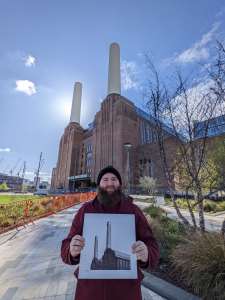
I am Jack Hines, an aspiring artist from Kent who has embarked on a highly ambitious project to draw every single building in Greater London – www.drawingalloflondon.co.uk. London has such a rich and diverse architectural history, I hope to take a snapshot of London by drawing the city in the span of my own lifetime. I am not only doing this for the creative challenge but to also create an archive of London in the 21st Century for future generations to look back on.

What’s your secret London tip?

When you’re in the centre of London, never get the Tube. You’ll discover many new places and buildings that you would normally miss if you weren’t travelling on foot.

What’s your secret London place?

St Swithin’s Church Garden. When I used to commute to and from London, if I had to wait for my return train from Cannon Street station, I’d regularly visit this tiny garden opposite the station. It’s right outside the station, tucked away down a small alleyway, so not many people know about it. Which makes it a great place to wait out the usually delayed train.

What’s your biggest gripe about London?

The trains. I live in Kent so whenever I need to visit the city for photography purposes, it can be quite pricey to visit all the locations I need to. It builds up over time and is very expensive. On top of the expensive tickets, you’re not guaranteed a seat, which can be fairly tiresome on longer all-day journeys.

What’s your favourite building?

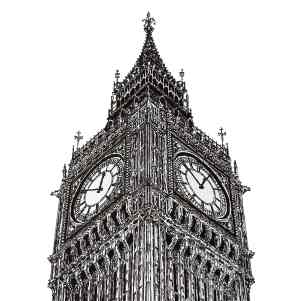
A classic, it has to be Big Ben. It’s an icon of the city and also the nation. Drawing Big Ben brings back great memories from the start of my project where I would stream the drawing process, it was great to interact with people who also had a shared interest in architecture and artwork.

What’s your most hated building?

I wouldn’t say I outright hate any building in London, as they all have some kind of redeeming quality or a story to tell. But if I had to choose, it would be 22 Bishopsgate. Most skyscrapers in London have a quirky twist that makes them unique, however, 22 Bishopsgate is just a bland glass tower that could be copied and pasted from any financial district from around the world.

What’s the best view in London?

The view from The Monument (but only if you’re in the mood to climb the 311 stairs). This location brings back cherished memories of my artwork in the sixth form where I would create sweeping panoramic drawings of the London skyline

What’s your personal London landmark?

It was the iconic brutalist Welbeck Street car park until it was demolished a few years ago. Its spectacular facade has been my desktop wallpaper for about 5 years now, I never get tired of seeing it.

What’s London’s best film, book or documentary?

Perhaps slightly biased as I’ve recently watched it, but I’d say The Favourite. Filmed at Hampton Court Palace, it brings to life the extravagance of the 18th Century and showcases the beautiful architecture of the time. Also, Olivia Coleman’s performance is fantastic, a well-deserved Oscar winner for this film. The Favourite has become one of my personal favourite films.

What’s your favourite restaurant?

Lowlander Grand Cafe, it has the best selection of Belgian beers in London, great staff and excellent food, and all-round brilliance.

How would you spend your ideal day off in London?

I’m lucky in what I do as I get to experience my ideal day fairly often. That is to explore the city, mostly on foot, discovering parts of the city I haven’t visited before. As I travel around I like to photograph buildings for future drawings in my project to draw all of London.