
EASTENDERS (n., a.) Television species much given to shout for no apparent reason in the name of entertainment
Dr. Johnson’s London Dictionary for publick consumption in the twenty-first century avail yourself on Twitter @JohnsonsLondon

EASTENDERS (n., a.) Television species much given to shout for no apparent reason in the name of entertainment
Dr. Johnson’s London Dictionary for publick consumption in the twenty-first century avail yourself on Twitter @JohnsonsLondon
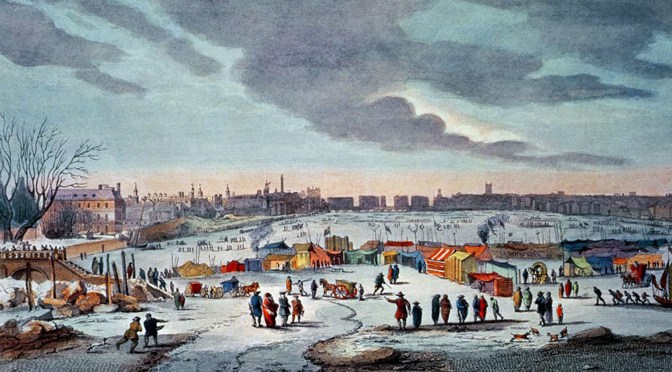
There is a real street in London that never actually existed, in the sense that one minute it wasn’t there, then it was, and then it was gone again.
It was called Broad Streete, and it appeared on 8th January 1683 in, what is, the most central part of the city. A great many shops opened on it, many thousands of people visited and traders arrived, a bullring was built and there were games and displays of strength and skill. Oxen were roasted and drink was sold, and a great time was had by all along its length.
Broad Streete could only be built because between the 14th and 19th centuries the Thames froze solid more than a dozen times. John Evelyn describes the street thus: “The ice was now become so incredibly thick, as the beare not onely whole streets of boothes in which they roasted meate, & had divers shops of wares…but coaches and horses passed over.”
In early January 1683, the Thames had frozen to a thickness of almost a foot and stayed that way for two months. At other times the ice grew to several feet thick, especially between Blackfriars and London Bridge. There are various reasons for the existence of Broad Streete. One was the ‘Little Ice Age’ that hit England, another was that the Thames had yet to be embanked, so it flowed more slowly and was prone to icing over. At that time London Bridge has several supports, called starlings, sunk into the river bed which also slowed the flow.
Rapid thaws sometimes caused the loss of life and property. In January 1789, melting ice dragged away a ship that was anchored to a riverside pub, pulling the building down and causing five people to be crushed to death.
In the pedestrian tunnel under the south bank of Southwark Bridge, there’s an engraving by sculptor Richard Kindersley made of slabs of grey slate, depicting a frost fair.
The global climate grew milder, the river was banked and flowed faster, and that was the end of Broad Streete.
That is until we get more climate change.

London is a world in itself … It contains within itself all that is gorgeous in wealth, and all that is squalid in poverty; all that is illustrious in knowledge, and all that is debased in ignorance; all that is beautiful in virtue, and all that is revolting in crime. Adequately to chronicle and to describe such a city … is a task beyond any individual powers.

Charles Knight (1791-1873), The Penny Magazine of the Society for the Diffusion of Useful Knowledge
On 13 March 1967 hundreds of students at the London School of Economics took part in a sit-in over disciplinary action taken against two union officials, following their part in a demonstration on 31 January against the appointment of the LSE’s next director, Dr Walter Adams, in which a college porter died of a heart attack during the demonstrations. Students opposed the appointment as he had links with Ian Smith’s racist regime.
 On 13 March 1961 five members of Portland Spy Ring went on trial at the Old Bailey charged with plotting to pass plans of HMS Dreadnought, Britain’s first nuclear submarine, they were all found guilty
 The London Hackney Carriage Act makes it illegal to hail a cab whilst the vehicle is moving, thankfully the police don’t enforce the law
 London’s first Russian Orthodox Cathedral was consecrated in 2000 look down on its blue onion dome from Chiswick Flyover’s eastbound lane
 The corpse of Henry V’s wife Catherine de Valois was dug up and put on display for 200 years, Samuel Pepys records kissing the lips for a bet
 In 1940 Winston Churchill met at St. Ermin’s Hotel promising to ‘Set Europe Ablaze’ the genesis of the SOE which ultimately became the SAS
 Harry Potter’s magic luggage trolley sticks out of a wall between platforms 8/9 not 9/10 because J.K.Rowling was thinking of Euston
 Kaspar the Cat was a large feline figure used at the Savoy Hotel if a table setting totalled 13 increasing it beyond that unlucky number
 Ping-pong bar Bounce at 121 Holborn is on the site where John Jacques created and patented the game in 1901
 The taximeter invented in 1891 giving the cab its alternative name wasn’t used in London until 1907 in a attempt to prevent rows about fares
 In the Royal Mews the carriages are the responsibility of the Master of the Horse a position created by Edward III after the Siege of Calais
 The world’s first ATM was installed outside Barclays Bank, Enfield in 1967 it was opened by actor/comedian Reg Varney who withdrew £10
 Trivial Matter: London in 140 characters is taken from the daily Twitter feed @cabbieblog.
A guide to the symbols used here and source material can be found on the Trivial Matter page.
For those new to CabbieBlog or readers who are slightly forgetful, on Saturdays I’m republishing posts, many going back over a decade. Some will still be very relevant while others have become dated over time. Just think of this post as your weekend paper supplement.
I don’t know how it happened, but I used only to put out the rubbish once a week, a simple task which took but a few minutes.
Now I have been promoted by Cabbie Wife to Chief Recycler. I spend a lot of time every week recycling rubbish. Newspapers and plastic bottles have to go in one box, but yellow pages for some inexplicable reason are unacceptable, wine bottles to go to the glass bank, not to mention leaves, cut grass and other garden waste collected separately. In the busy life of CabbieBlog it eats up between half an hour and an hour a week spent recycling.
Apparently I’m only member of the household who can perform this important task. If asked to get rid of a carton or bottle, which seldom happens, they peer at it as though they have never seen such an object before.
Millions of us have to recycle and we live in daily fear of being fined by officious council representatives for getting our bins in a muddle, putting out rubbish on a wrong day, or just putting the bins in the wrong place.
I still harbour a distant hope that in doing so I may somehow be helping the planet by ensuring that too many nasty tins and bottles aren’t buried in Britain’s green and pleasant land and thereby stopping polar bears drown in the Arctic.
According to Peter Jones, an expert on waste, who advises the Mayor of London, “the global warming impact of putting material through an incinerator five miles down the road is actually less than recycling it 3,000 miles away”. So there you have it, fewer greenhouse gases are produced if you burn rubbish locally than if you sort it and send it halfway around the world.
Now as a result of the current precarious state of the world’s economy, there is a collapse in the market value of recyclable waste and many waste disposal firms are having to stockpile paper, metals and plastics in vast warehouses because they are unable to sell them on. This means that the rubbish I spend hours struggling to sort out every day may, in fact, never be recycled because it is not economic to do so.
The Government and local councils are fully aware of the shortcomings of recycling, and yet they do not share their reservations with us. They seek to impose ever more draconian penalties. We have to do what we are told, whereas many councils do as they choose by collecting kitchen rubbish once a fortnight, as opposed to once a week, as used to be the rule. So we are bullied and intimidated and threatened by the authorities who, meanwhile, have the nerve to set aside their own traditional obligations. I have recently received a letter with a veiled threat of prosecution under the Environmental Protection Act 1990. Yet they know that recycling is a very imperfect process, and use the law to ensure that we carry it out on pain of a fine, one can only conclude that they love ordering our lives to the tiniest degree.
Most of us would cheerfully give up our time to recycle if we thought it was beneficial to the environment. But it is impossible to respect a Government that privately acknowledges the shortcomings of recycling – and whose adviser openly expresses his doubts – while it treats a small infraction in our kitchens as a crime.
.

 CabbieBlog