
Monthly Archives: December 2021

Johnson’s London Dictionary: Downing Street
DOWNING STREET (n.) Once a publick place, now a gated community thus designed to keep its inhabitants from meeting voters
Dr. Johnson’s London Dictionary for publick consumption in the twenty-first century avail yourself on Twitter @JohnsonsLondon
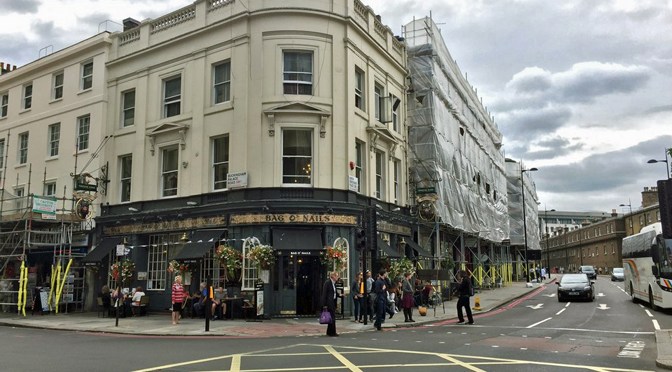
Why are pubs on street corners?
Why are London pubs so often situated on street corners, and why didn’t developers hardly ever construct pubs in the middle or halfway down a terrace?
The whole building of the pub is always divided into several sections: saloon or lounge, parlour, public bar, snug, counter, and beer engine. Most of the time, one side is allocated for a saloon or lounge, while the public bar is exactly that. The parlour or saloon is mostly reserved for business persons, and they used to sit here with a modicum of privacy and discuss business matters, away from the riff-raff in the public section. In addition, many public houses also provided limited accommodation and a beer garden.
Landowners controlled large pieces of land and worked with developers through the leasehold system. The landowners let plots out to the developers, who paid for the construction of long terraces, and the developers borrowed to pay construction costs.
The pubs, therefore, were built first to house, feed and water the builders. In the worst case, the pub and its licence could be flogged off to pay for finishing the terrace.
The developer could lend building money to plumbers, glaziers and construction workers who’d do the work on each other’s homes for free – so everybody won. And the pub remained on the corner after they’d all finished, ready to provide them with a social focus. Thus the pub was there first and last, throughout the lives of those who lived in the terraces.
Odd fact: Griffin Park, where Brentford FC play, is the only football ground with pubs at all four corners.
The Bag o’ Nails on the corner of Lower Grosvenor Place by Alan Hughes (CC BY-SA 2.0)
London in Quotations: Anna Quindlen

London has the trick of making its past, its long indelible past, always a part of its present. And for that reason it will always have meaning for the future, because of all it can teach about disaster, survival, and redemption. It is all there in the streets.

Anna Quindlen (b.1953), Imagined London: A Tour of the World’s Greatest Fictional City, 2004
London Trivia: Their Lordships tussle
On 19 December 1666, the Duke of Buckingham had a serious tussle with the Marquess of Dorchester in the House of Lords. Buckingham pulled off the Marquess’s periwig and Dorchester also ‘had much of the Duke’s hair in his hand’. Both offenders were sent to cool down in the Tower, and released after apologising.
 On 19 December 1783, William Pitt became the youngest Prime Minister at the age of twenty-four and 205 days
 Smoking was banned on the Underground as a result of the King’s Cross fire in November 1987 which killed 31 people. A discarded match was thought to be the cause of that inferno
 There are plaques in London to stars of the Carry On films including Joan Sims in Kensington and Hattie Jacques in Earls Court
 On 19 December 1851 artist JMW Turner died in Chelsea he left his £140,000 estate for ‘decayed artists’ distant relations took the bequest
 During World War II Eastenders would dine on whale meat as it was one ‘meat’ that was in abundance and not rationed the same as beef
 On 19 December 1932 the BBC Empire Service was born at Broadcasting House on a budget of £10 per week now the World Service is the world’s largest
 It was on Jack Smith’s Berwick Street market stall that the first grapefruit was introduced to London and England in 1890
 One of the levels in Tomb Raider 3 is set in the disused Aldwych tube station, featuring scenes of Lara Croft killing rats
 It’s proximity to Smithfield Market was a determining factor as to why Farringdon was chosen as the eastern terminus of the first tube line
 Edward Johnston designed the typeface for the London Underground in 1916. The font he came up with is still in use today it’s called Johnston Sans
 The term Cockney comes from Middle English cockeney, meaning misshapen eggs and was used by country folk to deride those born in the City
 Trivial Matter: London in 140 characters is taken from the daily Twitter feed @cabbieblog.
A guide to the symbols used here and source material can be found on the Trivial Matter page.
 CabbieBlog